
Behaviour of Gases Class 10 Physical Science Notes – WBBSE
Content Structure
- 1. Matter
- 2. Some Physical Properties of Gases
- 3. Units of Pressure
- 4. Measurement of Pressure Exerted by a Gas
- 5. Units of Volume
- 6. NTP or STP
- 7. Boyle’s Law (1662)
- 8. Charles’s Law (1787)
- 9. Combined Form of Boyle’s Law and Charles’s Law
- 10. Ideal Gas
- 11. Real Gases
- 12. Gay-Lussac’s Law
- 13. Berzelius Hypothesis
- 14. Avogadro’s Law
- 15. Avogadro’s Number
- 16. Molar Volume
- 17. Pressure of Dry Gas
- 18. Equation of State for an Ideal Gas
- 19. Calculation of Molar Mass from the Equation of State
- 20. Dimension and Values of Molar Gas Constant (R)
- 21. Boltzmann Constant (k)
- 22. Determination of Density and Molar Mass of an Ideal Gas
- 23. Dalton’s Law of Partial Pressure
- 24. Diffusion of Gas
- 25. Effusion
- 26. Graham’s Law of Diffusion
- 27. Postulates of Kinetic Theory of Gases
- 28. Influence of Pressure on Volume and Effect of Temperature on Gas Molecules
- 29. Deviation from Ideal Behaviour
- 30. Van der Waals’ Equation
1. Matter
Matter is mainly classified into three states:
- Solid
- Liquid
- Gas
2. Some Physical Properties of Gases
- 1. Motion of Gas Molecules: – A gas contains a very large number of tiny molecules. These molecules move freely and continuously in all directions. Their movement is random.
- 2. Shape and Volume: – A gas has neither a fixed shape nor a fixed volume. It takes the shape and fills the entire volume of the container in which it is kept.
- 3. Density: – Gases have much lower density than solids and liquids.
- 4. Diffusion: – When two or more non-reacting gases come in contact, they mix with each other naturally and form a uniform mixture. This process is called diffusion.
- 5. Expansibility: – Gases can expand freely and occupy all the available space in a container. This property is called expansibility.
- 6. Compressibility: – Gases can be compressed easily because there are large spaces between their molecules. This property is called compressibility.
- 7. Temperature of a Gas: – The temperature of a gas is a measure of the average kinetic energy of its molecules.
- 8. Pressure of a Gas: – Gas molecules are always moving and continuously striking the walls of their container. These collisions produce force on the walls.
The force exerted by gas molecules per unit area of the container wall is called the pressure of the gas.
Units of Force and Area
| Quantity | CGS Unit | SI Unit |
| Area | cm² | m² |
| Force | dyne | Newton (N) |
3. Units of Pressure
The pressure of a gas can be measured in different units.
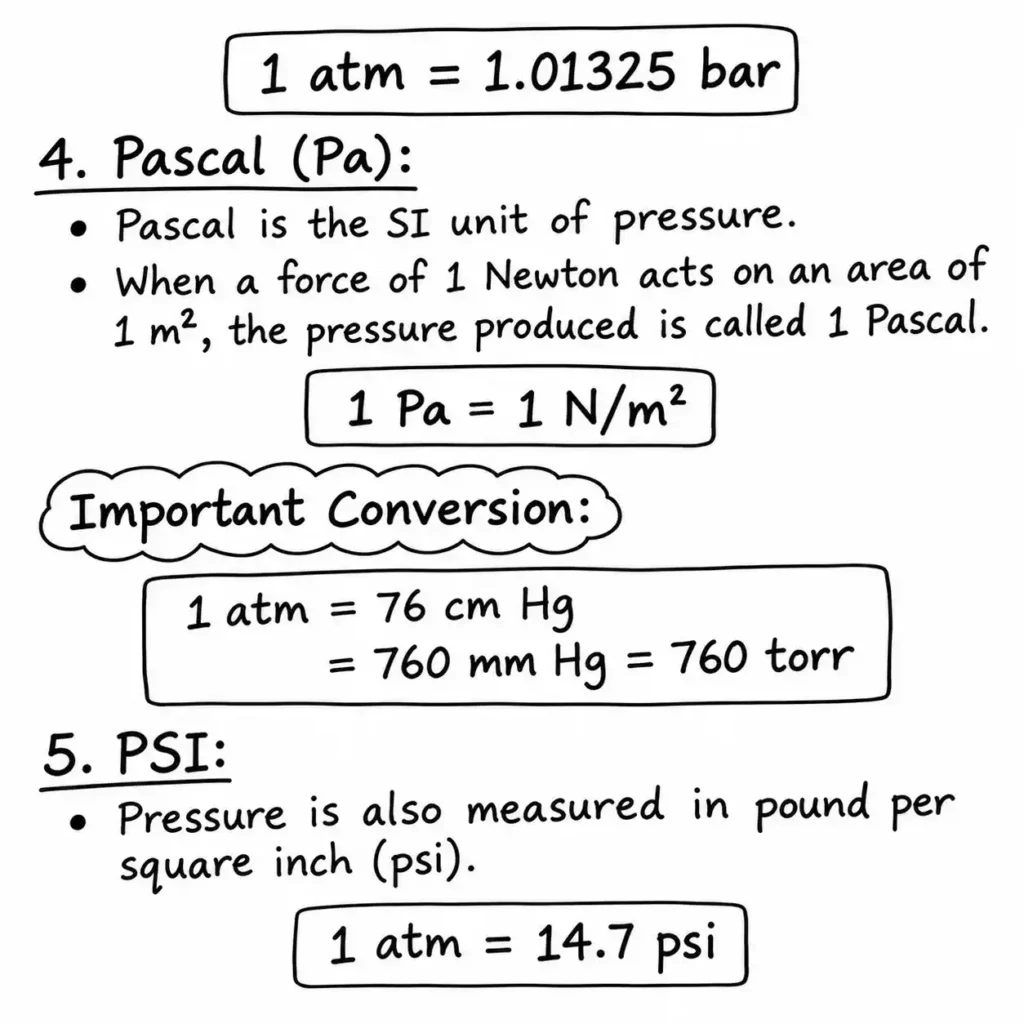
- 1. Atmosphere (atm): – Atmosphere is a commonly used unit of gas pressure.
- 2. Torr: The pressure exerted by a mercury column of exactly 1 mm height at 0°C under standard gravity is called 1 torr.
- 3. Bar: Bar is another commonly used unit of pressure.
4. Measurement of Pressure Exerted by a Gas
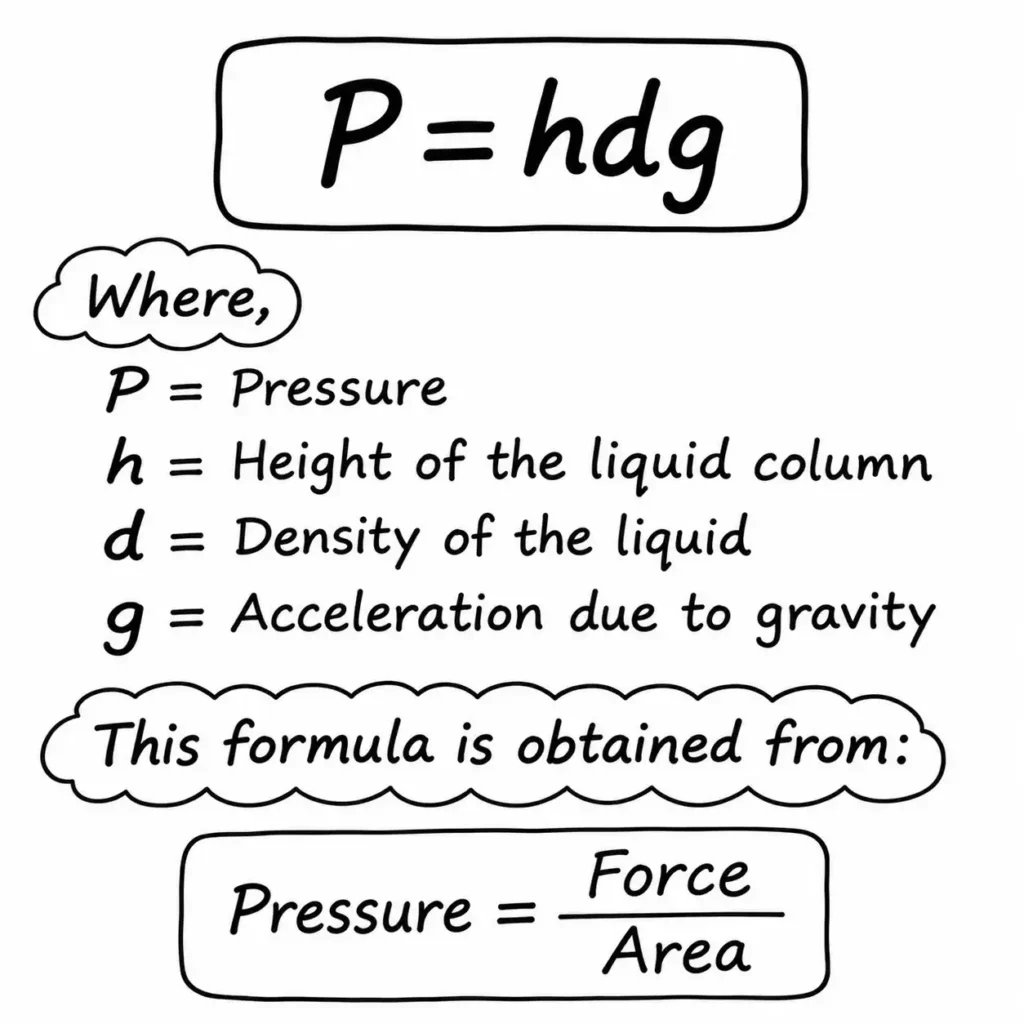
A manometer is a commonly used instrument to measure the pressure of a gas. The pressure of a liquid column is calculated by:
5. Units of Volume
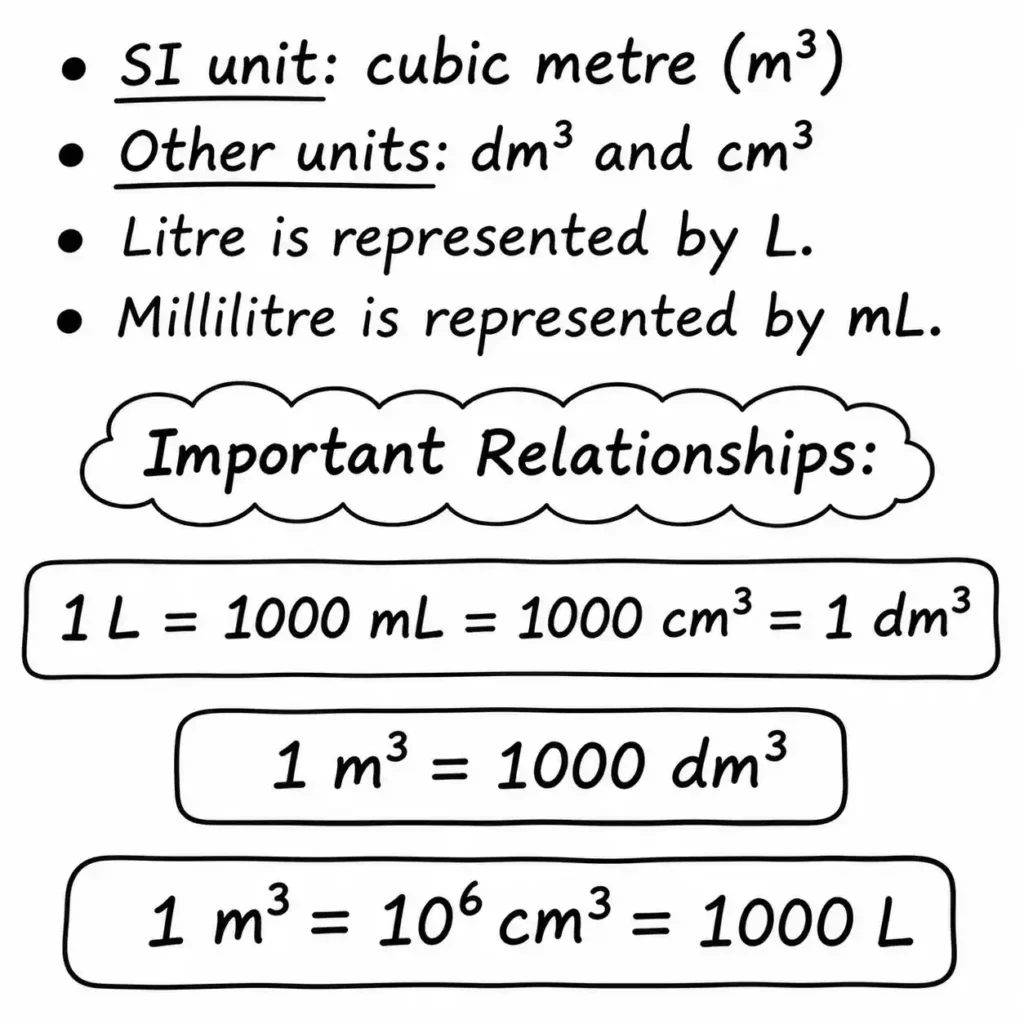
The volume of a gas enclosed in a container is equal to the volume of the container at the same temperature and pressure.
Units of Volume:
6. NTP or STP (Normal or Standard Temperature and Pressure)
NTP or STP refers to a standard condition of temperature and pressure. At STP, the temperature is 0°C and the pressure is equal to the pressure exerted by a mercury column of 76 cm at standard gravity.
7. Boyle’s Law (1662)
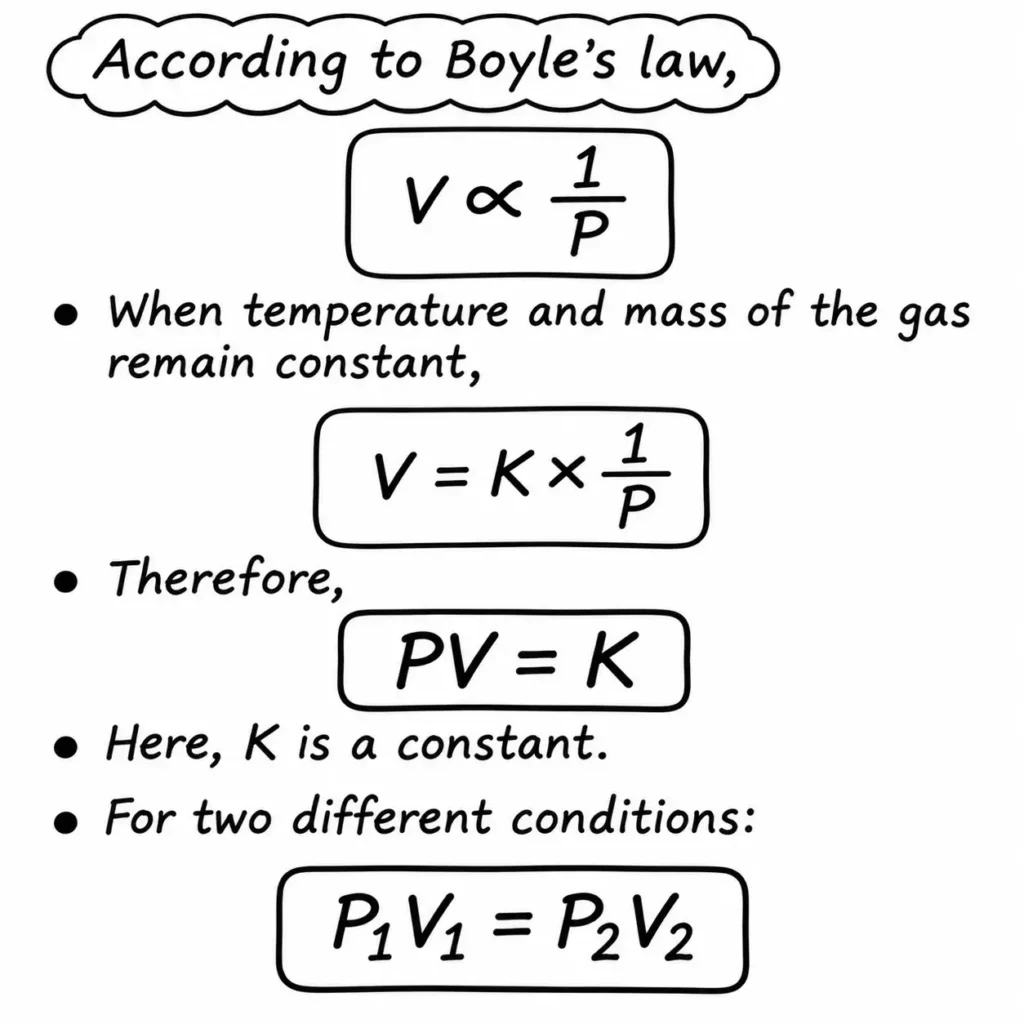
At constant temperature, the volume of a fixed mass of gas is inversely proportional to its pressure.
This means that:
- When the pressure increases, the volume decreases.
- When the pressure decreases, the volume increases.
Mathematical Expression of Boyle’s Law:
Let,
- P = Pressure of the gas
- V = Volume of the gas
- T = Absolute temperature
Graphical Representation of Boyle’s Law
The following graphs represent Boyle’s law for a fixed mass of gas at constant temperature.
- 1. P vs V graph: It is a downward-curving graph. As pressure increases, volume decreases.
- 2. PV vs P graph: It is a horizontal straight line because PV remains constant.
- 3. 1/V vs P graph: It is a straight line passing through the origin.
- 4. V vs 1/P graph: It is a straight line passing through the origin.
- 5. log P vs log V graph: It is a straight line with a negative slope.
Isotherms:
The pressure-volume (P-V) curves obtained at constant temperature are called isotherms.
8. Charles’s Law (1787)
At constant pressure, the volume of a fixed mass of gas increases or decreases by \(\frac{1}{273}\) of its volume at 0°C for every 1°C rise or fall in temperature.
- When temperature increases, the volume of a gas increases.
- When temperature decreases, the volume of a gas decreases.
Mathematical Expression of Charles’s Law:
Let,
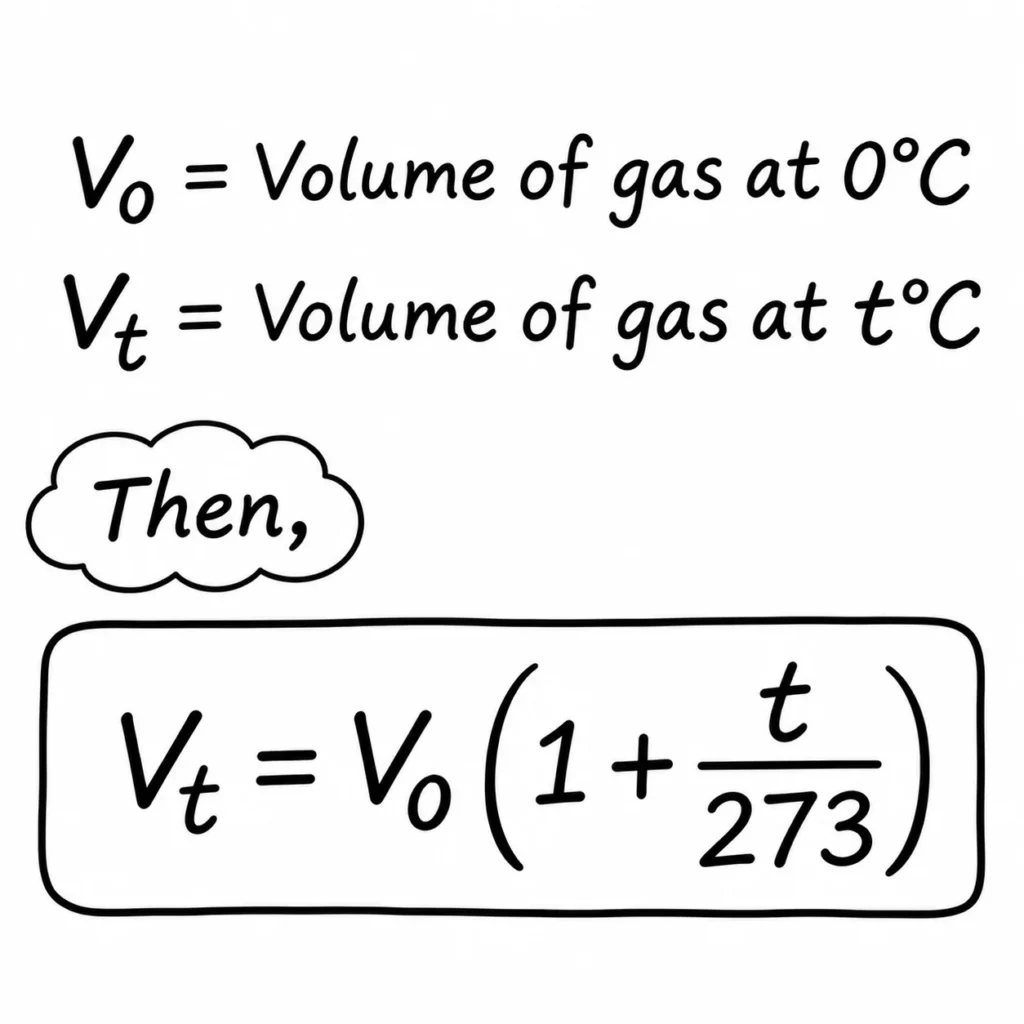
Absolute Zero
According to Charles’s law, at constant pressure, the temperature at which the volume of a gas theoretically becomes zero is called absolute zero.
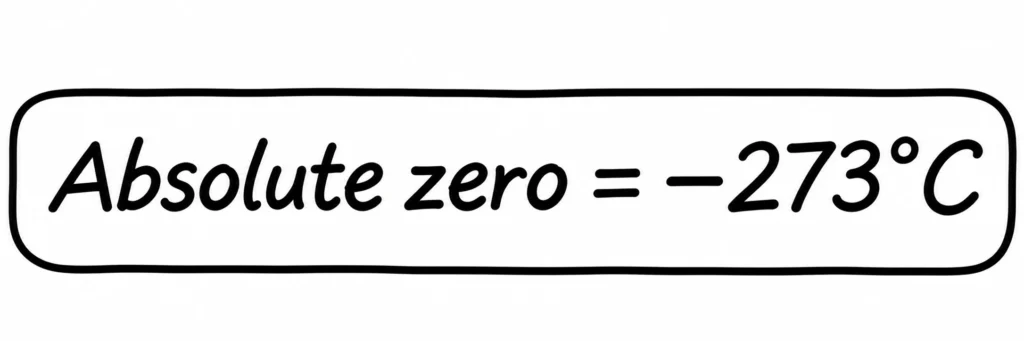
No temperature lower than absolute zero is possible.
Absolute Scale of Temperature
The temperature scale that starts from absolute zero is called the absolute temperature scale or Kelvin scale.
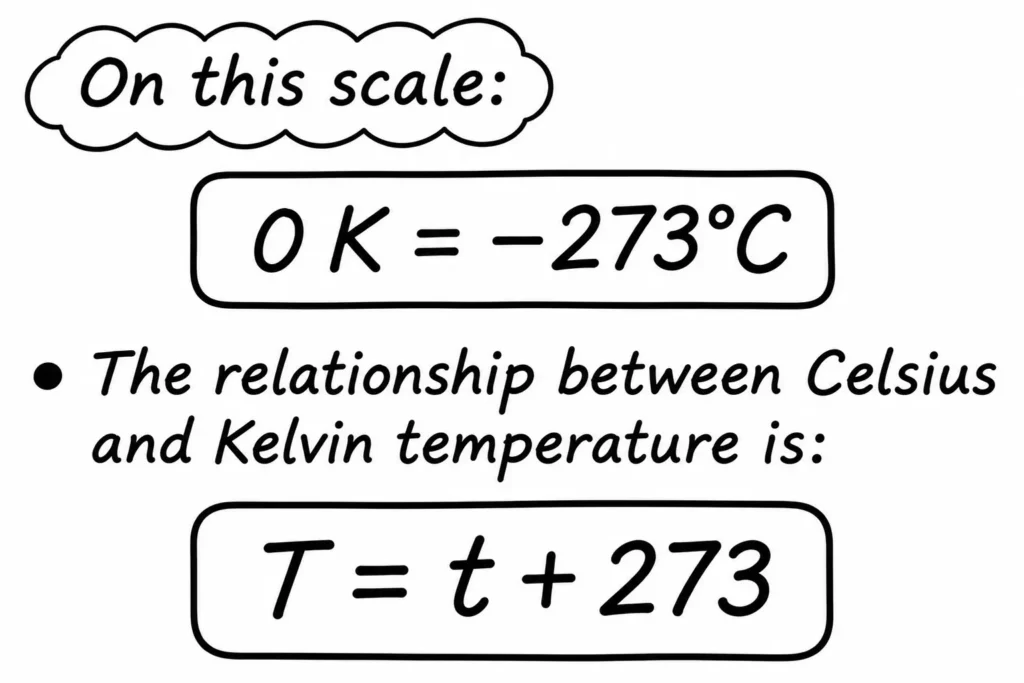
Where,
- T = Temperature in Kelvin
- t = Temperature in Celsius
Alternative Statement of Charles’s Law:
At constant pressure, the volume of a fixed mass of gas is directly proportional to its absolute temperature.
Mathematical Expression of Charles’s Law
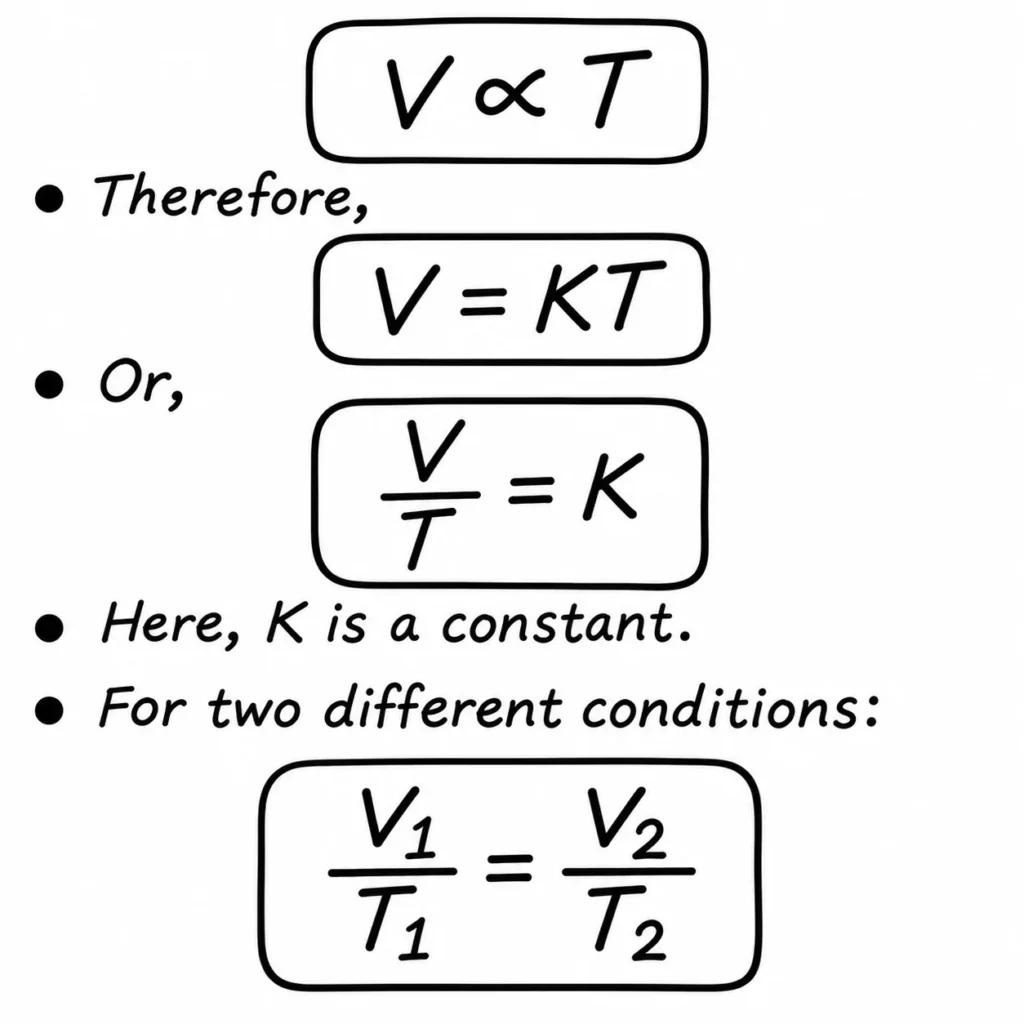
Graphical Representation of Charles’s Law
- 1. V vs T graph: A straight line passing through the origin at constant pressure.
- 2. V vs t°C graph: A straight line that, when extended backwards, meets the temperature axis at -273°C.
- 3. log V vs log T graph: A straight line with a positive slope.
Gay-Lussac’s Law (Pressure-Temperature Relationship)
At constant volume, the pressure of a fixed mass of gas is directly proportional to its absolute temperature.
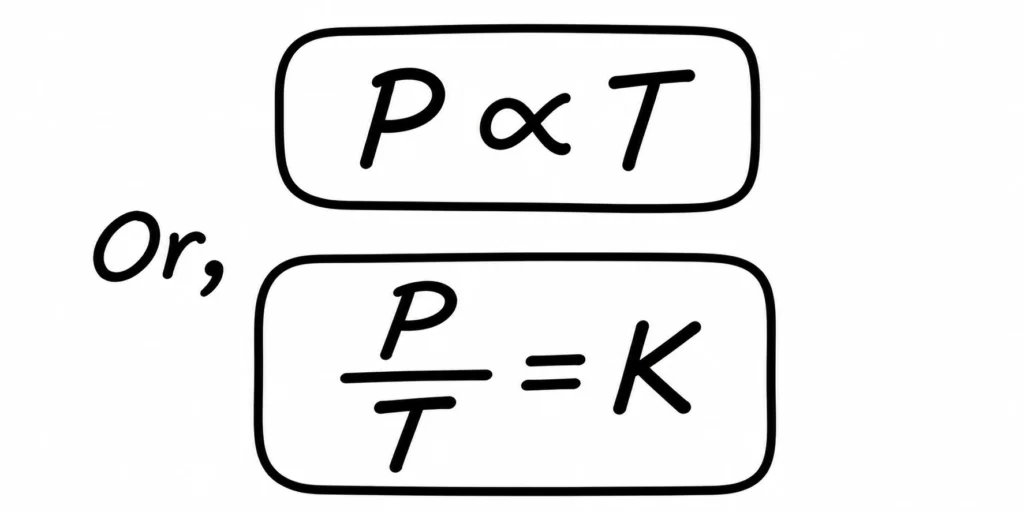
This means that when the temperature increases, the pressure of the gas also increases if its volume remains constant.
9. Combined Form of Boyle’s Law and Charles’s Law
The combined gas law is obtained by combining Boyle’s law and Charles’s law.
Let P, V and T be the pressure, volume and absolute temperature of a fixed mass of gas.
According to Boyle’s Law: At constant temperature,
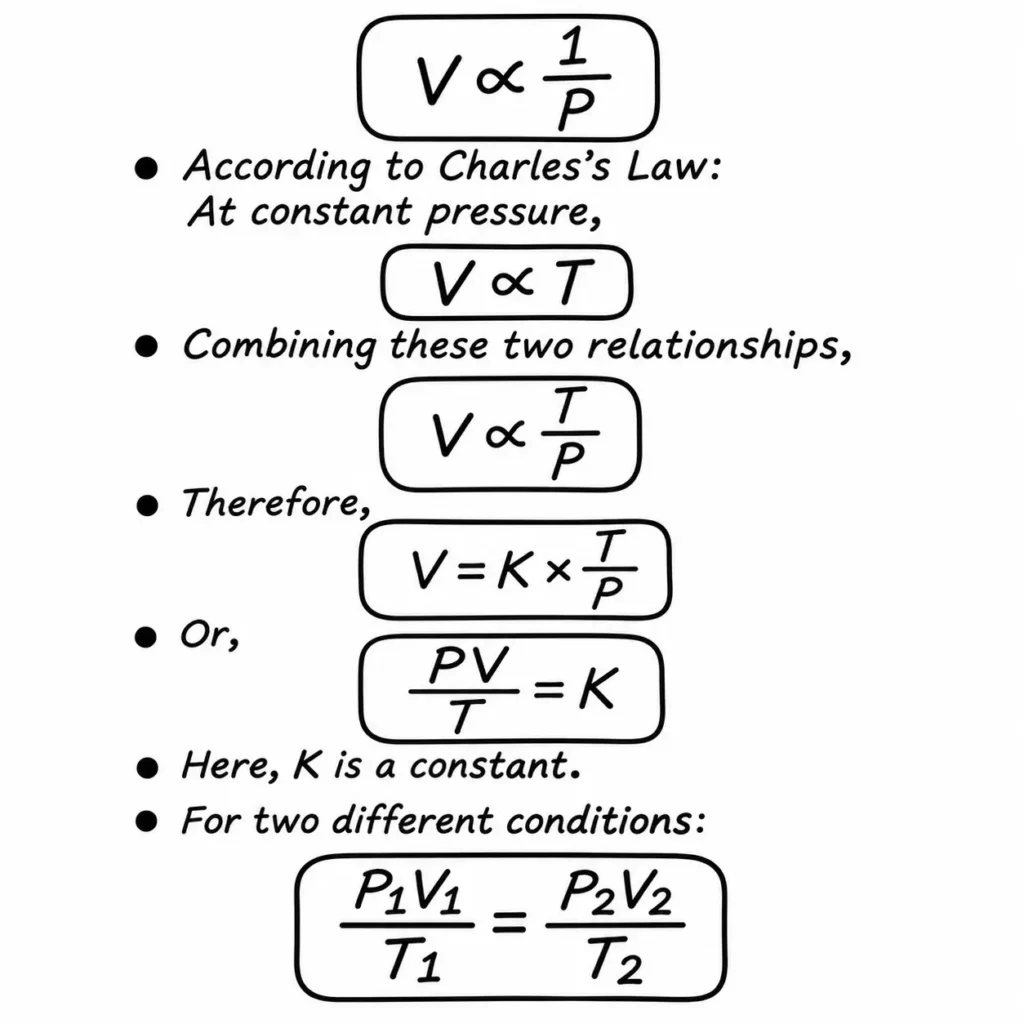
This equation is called the combined gas law or the combined form of Boyle’s and Charles’s laws.
10. Ideal Gas
An ideal gas is a hypothetical gas that obeys Boyle’s law, Charles’s law and Avogadro’s law under all conditions of temperature and pressure.
It also obeys the ideal gas equation:

Where,
- P = Pressure of the gas
- V = Volume of the gas
- n = Number of moles
- R = Universal gas constant
- T = Absolute temperature
11. Real Gases
The gases that do not obey the ideal gas equation under all conditions of temperature and pressure are called real gases. Examples: Oxygen, nitrogen, hydrogen and carbon dioxide.
Compressibility Factor (Z): The compressibility factor is expressed as:
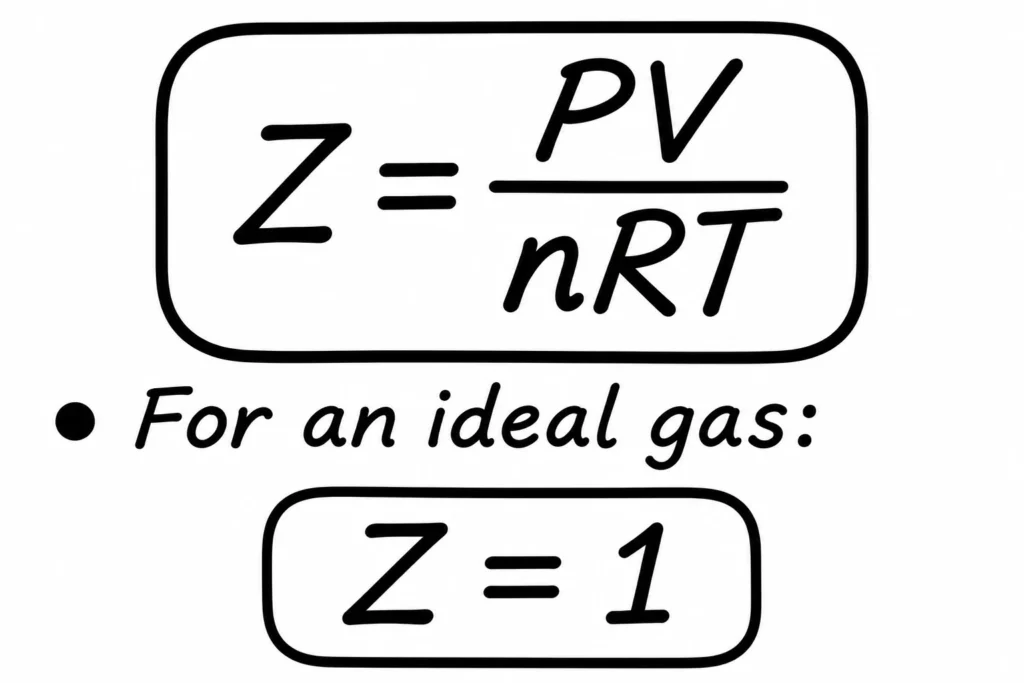
12. Gay-Lussac’s Law (Law of Combining Volumes)
When gases react chemically, their volumes and the volumes of the gaseous products bear a simple whole-number ratio, provided all volumes are measured at the same temperature and pressure. Gases combine in simple ratios by volume when temperature and pressure remain the same.
13. Berzelius Hypothesis
According to the statement given in the original notes, equal volumes of all gases contain the same number of atoms when measured at the same temperature and pressure.
14. Avogadro’s Law
At the same temperature and pressure, equal volumes of all gases contain an equal number of molecules. For example, equal volumes of hydrogen and oxygen contain the same number of molecules when their temperature and pressure are the same.
Mathematical Expression:

Where,
- V = Volume of the gas
- n = Number of moles of the gas
At constant temperature and pressure,
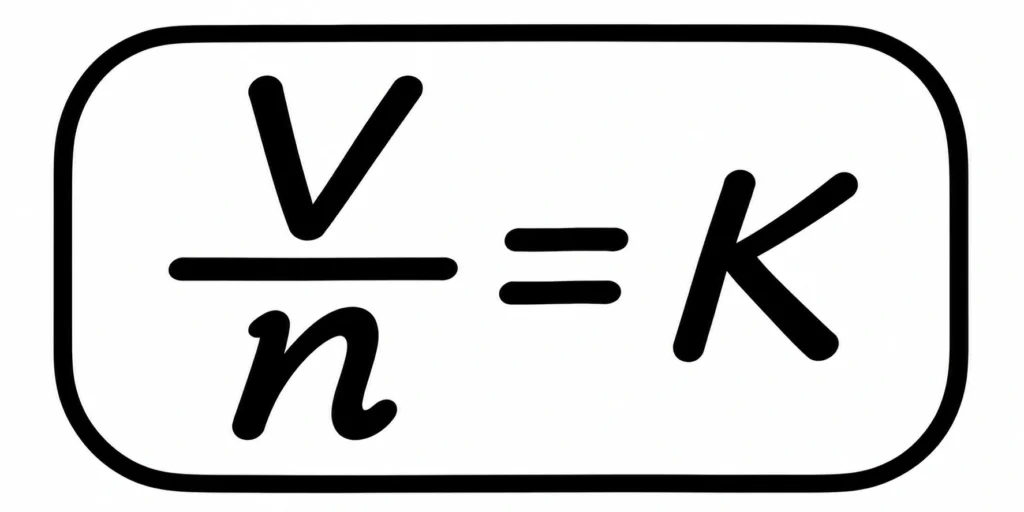
15. Avogadro’s Number
The number of molecules present in one mole of any substance is called Avogadro’s number.
Its value is:
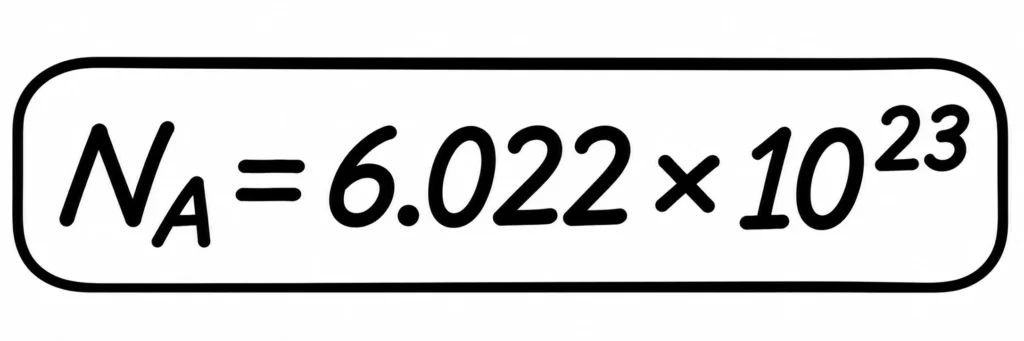
This means that one mole of any substance contains approximately \(6.022\times10^{23}\) elementary particles.
16. Molar Volume
The volume occupied by one mole of a gas at a particular temperature and pressure is called its molar volume. At STP (0°C and 1 atm pressure), the molar volume of an ideal gas is approximately:

This means that one mole of an ideal gas occupies approximately 22.4 litres at STP.
Examples of Molecular Mass
| Substance | Calculation | Molecular Mass |
| H₂O | (2 × 1) + 16 | 18 |
| N₂ | 2 × 14 | 28 |
| O₂ | 2 × 16 | 32 |
17. Pressure of Dry Gas
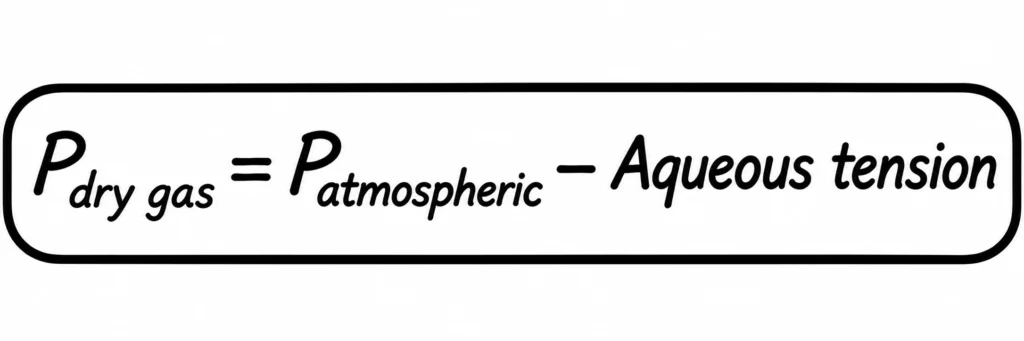
When a gas is collected over water, it contains water vapour along with the gas. The pressure exerted by water vapour is called aqueous tension. Therefore, the pressure of the dry gas is calculated by:
18. Equation of State for an Ideal Gas
The ideal gas equation is obtained by combining Boyle’s law, Charles’s law and Avogadro’s law.
According to Boyle’s Law:
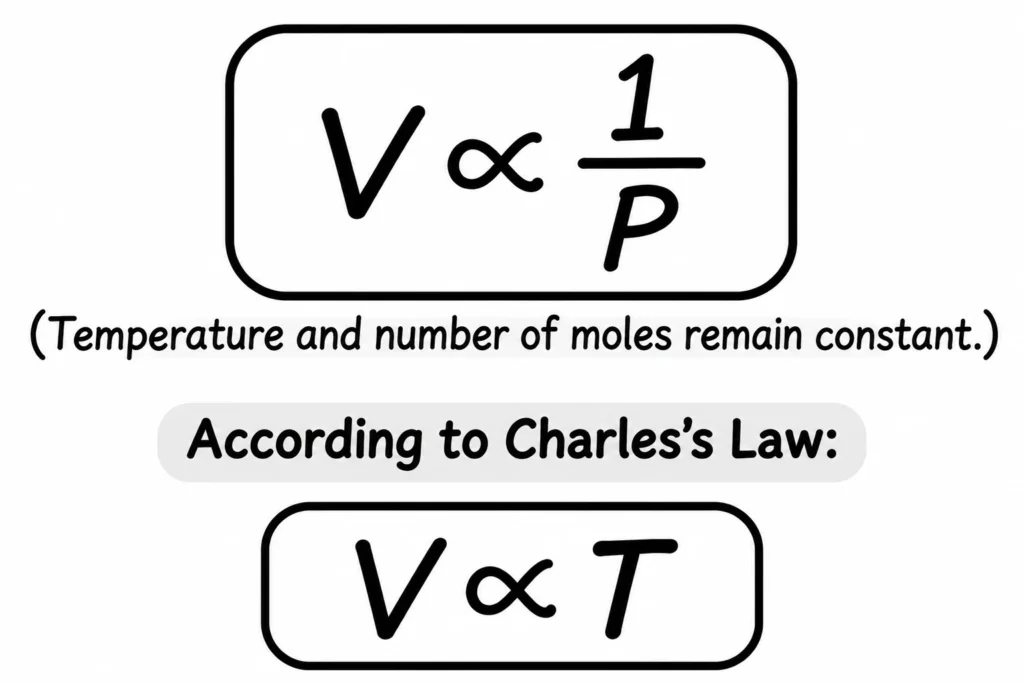
(Pressure and number of moles remain constant.)
According to Avogadro’s Law:
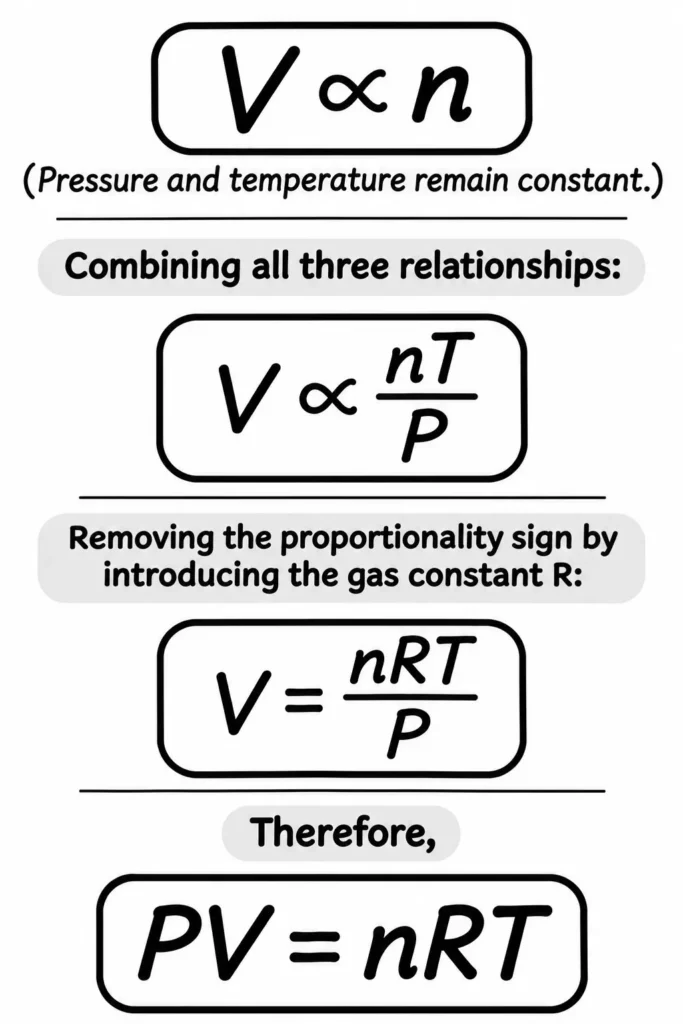
This equation is called the ideal gas equation or equation of state for an ideal gas.
19. Calculation of Molar Mass from the Equation of State
The ideal gas equation is:
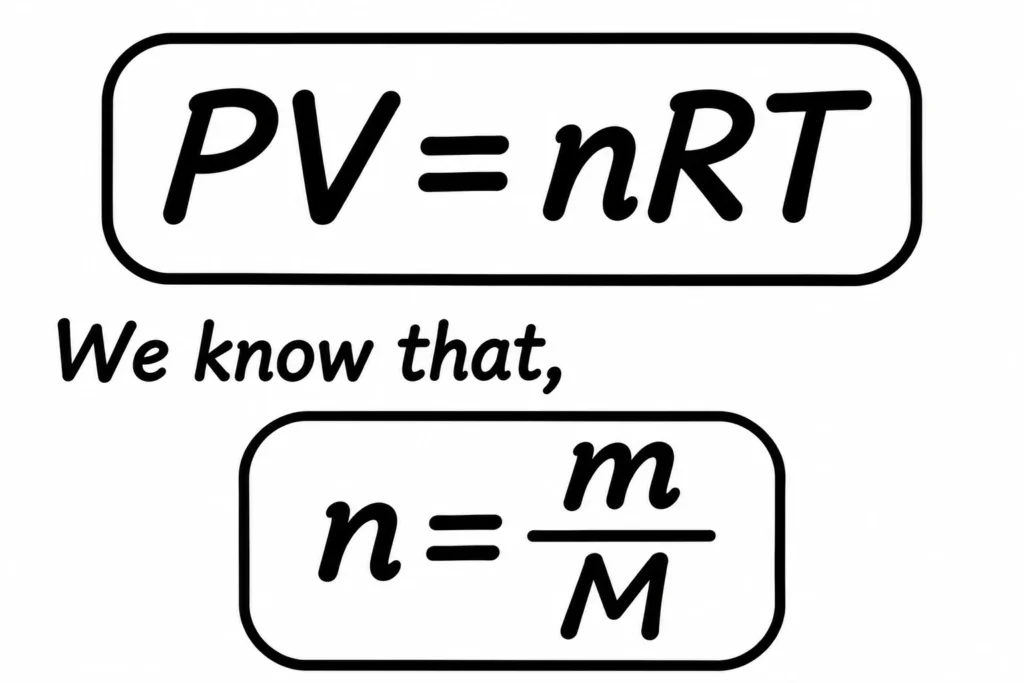
Where,
- m = Mass of the gas in grams
- M = Molar mass of the gas
- n = Number of moles
Putting the value of n in the ideal gas equation:
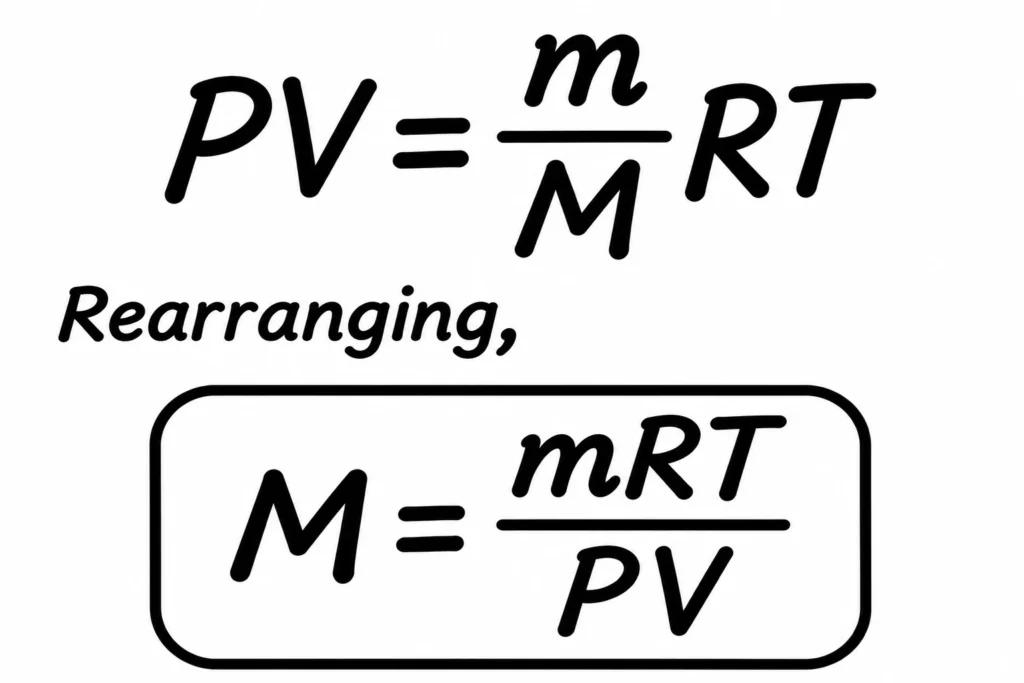
This formula is used to calculate the molar mass of a gas when its mass, pressure, volume and temperature are known.
20. Dimension and Values of Molar Gas Constant (R)
The universal gas constant is represented by R.
Its SI value is:
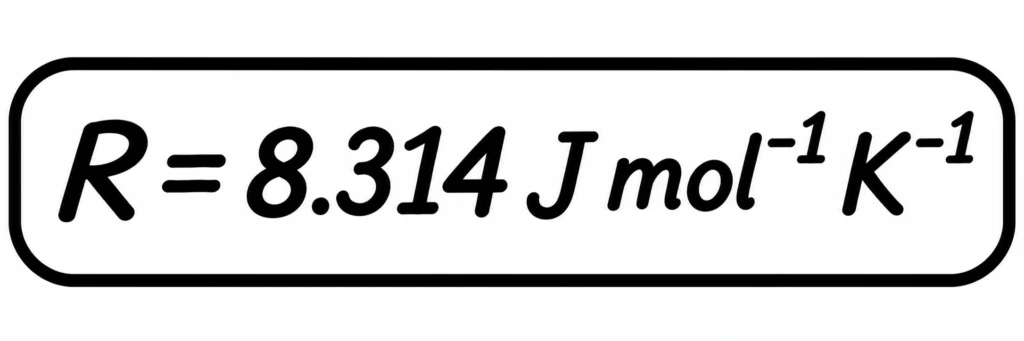
The unit of R is energy per mole per kelvin.
Values of R in Different Units
| Unit System | Value of R |
| L-atm | 0.0821 L atm mol⁻¹ K⁻¹ |
| Calorie | 1.987 cal mol⁻¹ K⁻¹ |
| SI | 8.314 J mol⁻¹ K⁻¹ |
| CGS | 8.314 × 10⁷ erg mol⁻¹ K⁻¹ |
| dm³-torr | 62.36 dm³ torr mol⁻¹ K⁻¹ |
| dm³-kPa | 8.314 dm³ kPa mol⁻¹ K⁻¹ |
21. Boltzmann Constant (k)
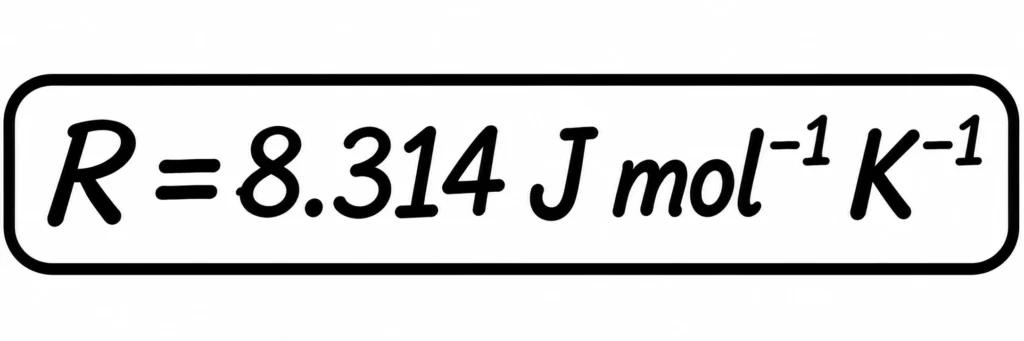
The Boltzmann constant is represented by k. It connects the average kinetic energy of individual gas molecules with the absolute temperature.
Its value is:
22. Determination of Density and Molar Mass of an Ideal Gas
According to the ideal gas equation:
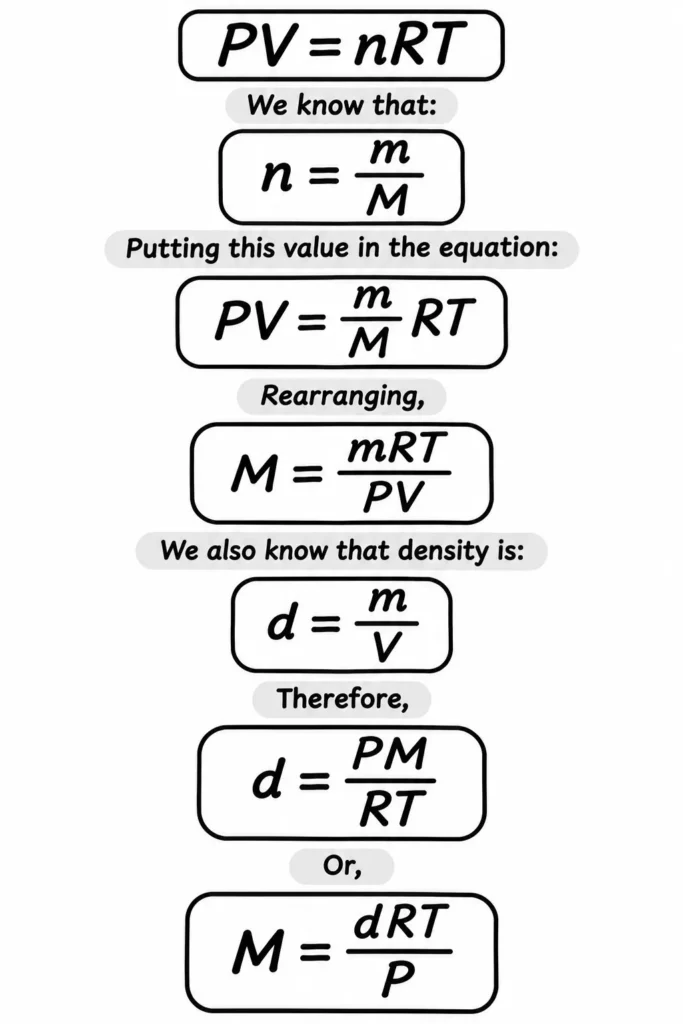
Where,
- d = Density of the gas
- P = Pressure of the gas
- M = Molar mass of the gas
- R = Universal gas constant
- T = Absolute temperature
These equations show the relationship between the density, pressure, temperature and molar mass of an ideal gas.
23. Dalton’s Law of Partial Pressure
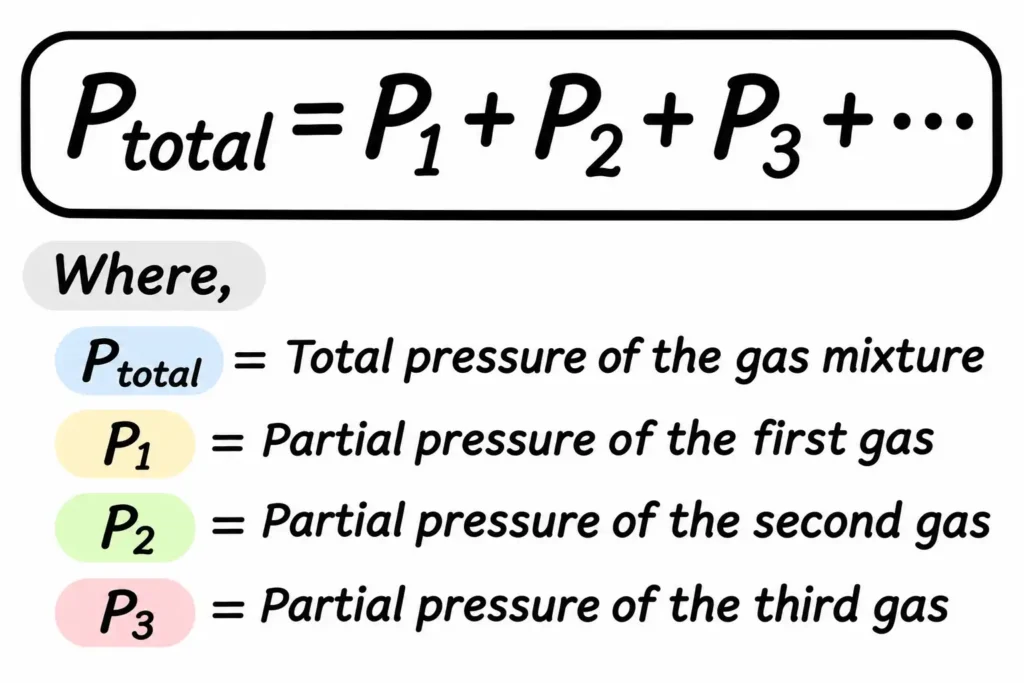
When two or more non-reacting gases are kept together in a closed container at constant temperature, the total pressure of the gas mixture is equal to the sum of the individual pressures exerted by each gas.
The pressure exerted by an individual gas in a mixture is called its partial pressure. Mathematical Expression:
24. Diffusion of Gas
The natural process by which two or more non-reacting gases mix with one another to form a uniform mixture is called diffusion. Diffusion takes place without any external help. The gases can mix with one another irrespective of their densities or molecular masses. Example: When the smell of perfume spreads throughout a room, it happens due to diffusion.
25. Effusion
The process in which a gas escapes from a container through a very small hole is called effusion. Effusion generally occurs when the gas inside the container is under higher pressure than the outside. Example: Air escaping slowly through a tiny hole in an inflated balloon.
26. Graham’s Law of Diffusion
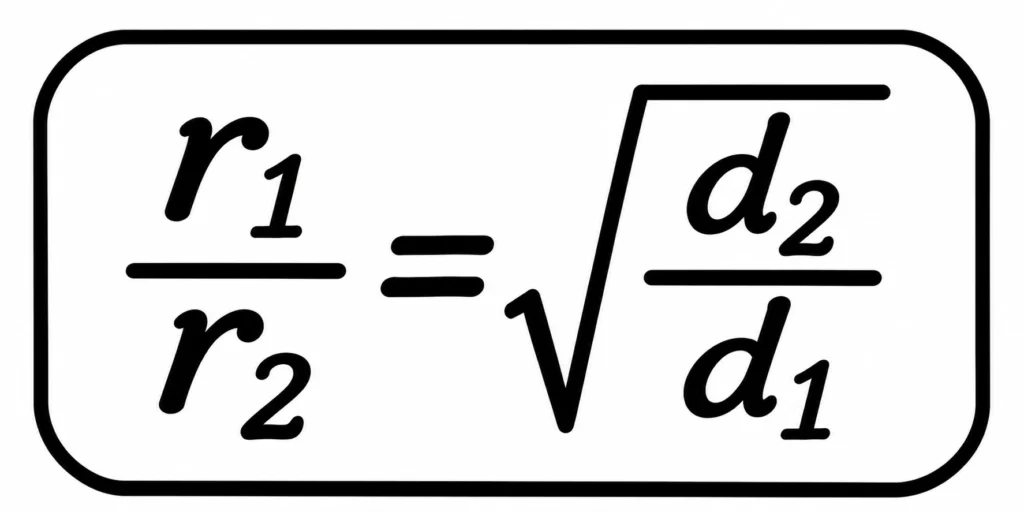
At constant temperature and pressure, the rate of diffusion of a gas is inversely proportional to the square root of its density. Lighter gases diffuse faster than heavier gases under the same conditions.
Mathematical Expression:
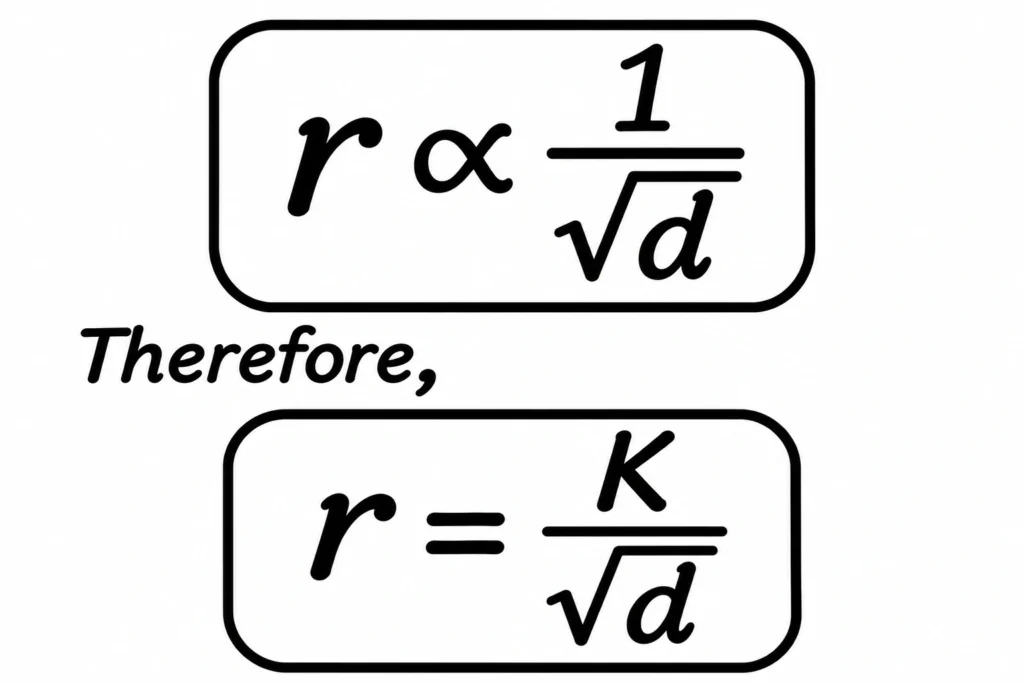
Where,
- r = Rate of diffusion or effusion
- d = Density of the gas
- K = Proportionality constant
For two gases:
27. Postulates of Kinetic Theory of Gases
The kinetic theory of gases explains the behaviour of gases on the basis of the motion of their molecules.
Its main postulates are:
- 1. Composition of Gases: All gases are made up of a very large number of tiny particles called molecules.
- 2. Continuous Motion: Gas molecules are always moving rapidly and continuously in different directions.
- 3. Size of Gas Molecules: Gas molecules are very small, and the space between them is very large. Therefore, the actual volume of the molecules is negligible compared to the total volume occupied by the gas.
- 4. Collision of Molecules: Gas molecules continuously collide with one another and with the walls of their container.
- 5. Origin of Gas Pressure: The pressure of a gas is produced because its molecules continuously strike the walls of the container.
- 6. Elastic Collision: Collisions between gas molecules and the walls of the container are perfectly elastic. This means that there is no loss of total kinetic energy during collisions.
- 7. Intermolecular Force: There is no significant force of attraction or repulsion between ideal gas molecules because they are separated by large distances.
- 8. Random Motion: Gas molecules move freely in all directions. Their speed and direction keep changing due to collisions. Therefore, their motion is random or zigzag.
- 9. Relationship Between Temperature and Kinetic Energy: The average kinetic energy of gas molecules is directly proportional to the absolute temperature of the gas.

28. Influence of Pressure on Volume and Effect of Temperature on Gas Molecules
- 1. Effect of Temperature on the Speed of Gas Molecules: When the temperature of a gas increases, the kinetic energy of its molecules also increases. As a result, the molecules move faster. When the temperature decreases, their average kinetic energy and speed decrease.
- 2. Effect of Molecular Speed on Pressure: When gas molecules move faster, they strike the walls of the container more frequently and with greater force. Therefore, the pressure of the gas increases if its volume remains constant. When the speed of the molecules decreases, the pressure also decreases if the volume remains constant.
- 3. Effect of Pressure on Volume: According to Boyle’s law, at constant temperature, an increase in pressure decreases the volume of a fixed mass of gas. A decrease in pressure increases its volume.
29. Deviation from Ideal Behaviour
Real gases do not always behave like ideal gases. The ideal gas equation assumes that: Gas molecules have negligible volume. There are no significant forces of attraction or repulsion between molecules. However, real gas molecules have their own volume and experience intermolecular forces. Therefore, real gases deviate from ideal behaviour, especially at high pressure and low temperature.
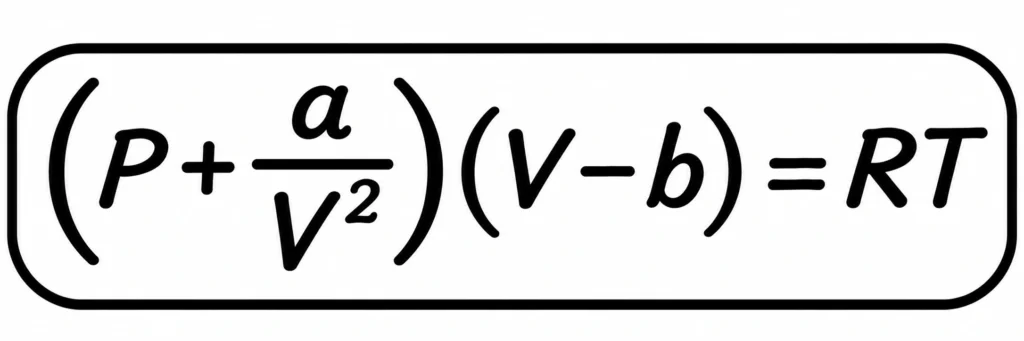
30. Van der Waals’ Equation
To explain the behaviour of real gases, Van der Waals introduced a modified gas equation. For one mole of a real gas:
For n moles of a real gas:
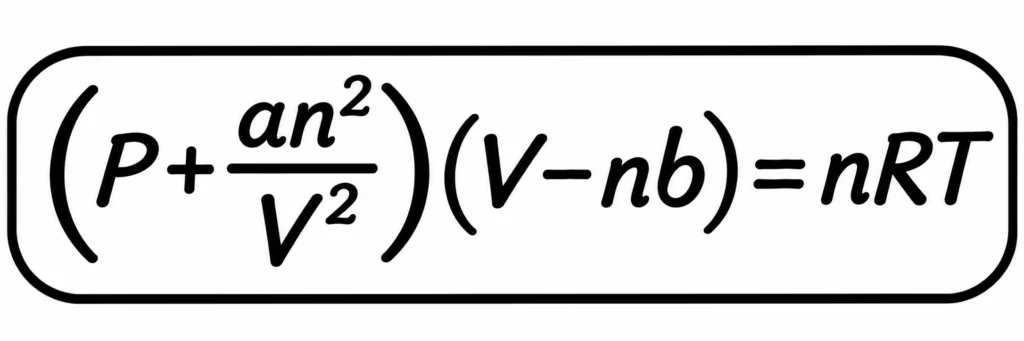
Where,
- P = Pressure of the gas
- V = Volume of the gas
- T = Absolute temperature
- R = Universal gas constant
- n = Number of moles
a and b = Van der Waals’ constants
Meaning of Van der Waals’ Constants:
- a: It represents the correction for intermolecular forces of attraction between gas molecules.
- b: It represents the correction for the actual volume occupied by gas molecules.
The values of a and b depend on the nature of the gas.
Related Links
- West Bengal Board 10 Physical Science Behaviour of gases Notes
- one word substitution
- West Bengal Board 10 Physical Science Concerns about our Environment Questions and Answers
- West Bengal Board 10 Physical Science Syllabus
- WBBSE 10 Result 2026
- Satellite Imageries and Topographical Maps
- Transport and communication system in India
- Population of India
- Industries in India
- Agriculture in India