
WBBSE Class 10 Physical Science – Concerns About Our Environment Questions and Answers
Content Structure
- 1. Exercise Questions and Answers
- 1A. Multiple-Choice Questions (MCQs)
- 1B. Very Short Answer (VSA) Questions
- 1C. True or False
- 1D. Short Answer-Type Questions
- 1E. Long Answer-Type Questions
- 2. Additional Questions and Answers
- 2A. Multiple Choice Questions (MCQs)
- 2B. Fill in the blanks
- 2C. True or false. Correct the false statements.
- 2D. Match the columns
- 2E. Very short-answer questions
- 2F. Short-answer questions
- 2G. Long-answer questions
1. Exercise Questions and Answers
1.1.11. Name two atmospheric gases of which one is responsible for greenhouse effect and other is not.
Ans: Carbon dioxide (CO₂) is a greenhouse gas, whereas nitrogen (N₂) is not a significant greenhouse gas.
1.1.12. What are the use of CFCs?
Ans: CFCs (chlorofluorocarbons) were used as refrigerants in refrigerators and air conditioners, as propellants in aerosol sprays and in the manufacture of foam materials. They damage the ozone layer, so their use has been phased out or restricted under environmental regulations.
1.1.13. What would happen, if atmosphere were made up of only N₂ and O₂ gas?
Ans: If the atmosphere contained only nitrogen and oxygen, it would lack important gases such as carbon dioxide and water vapour that help maintain the Earth’s temperature through the natural greenhouse effect. The Earth would become much colder on average, and photosynthesis would not occur normally because plants need carbon dioxide. Life as we know it would be seriously affected.
1.2.1. What are fossil fuels?
Ans: Fossil fuels are fuels formed from the remains of ancient plants and organisms over millions of years. Coal, petroleum and natural gas are examples.
1.2.2. Why the dependence on fossil fuels should be reduced?
Ans: Fossil fuels are non-renewable and available in limited quantities. Their excessive use can exhaust reserves and release carbon dioxide and other pollutants into the atmosphere. These emissions contribute to global warming and air pollution. Therefore, dependence on fossil fuels should be reduced.
1.2.3. What are sustainable sources of energy?
Ans: Sustainable sources of energy are sources that can meet energy needs over the long term without exhausting resources or causing unacceptable environmental damage. Examples include solar energy, wind energy and sustainably managed biomass.
1.2.4. Between biomass and petroleum which is the renewable source of energy?
Ans: Biomass is the renewable source of energy when it is produced and used sustainably. Petroleum is non-renewable.
1A. Multiple-Choice Questions (MCQs)
(i) For the protection of environment from pollution, involvement necessary of —
A. Only local government
B. Pollution control board
C. Environmentalist
D. All people including masses at grass root level
Ans: D. All people including masses at grass root level.
(ii) Which of the following subjects may be included under physical science?
A. Zoology
B. Genetics
C. Biotechnology
D. Chemistry
Ans: D. Chemistry.
(iii) Our atmosphere extends upto how much height over the earth?
A. 1200 km
B. 500 km
C. 800 km
D. 16 km
Ans: B. 500 km.
(iv) Which of the following atmospheric layers is nearest to the earth’s surface?
A. Troposphere
B. Stratosphere
C. Mesosphere
D. Thermosphere
Ans: A. Troposphere.
(v) Which of the following gases is responsible for ozone layer depletion?
A. O₂
B. NO
C. N₂
D. All of these
Ans: B. NO
1B. Very Short Answer (VSA) Questions
1. Answer the following questions.
(i) What is the temperature of atmospheric layer at a height of 50 Km?
Ans: At about 50 km altitude, the temperature is approximately 0°C, near the stratopause. The exact value varies with atmospheric conditions.
(ii) Coldest temperature of atmosphere is at which region of atmosphere?
Ans: The mesosphere, particularly near the mesopause.
(iii) In atmosphere, where Ozone layer present?
Ans: The ozone layer is mainly present in the stratosphere.
(iv) Which gas is not a greenhouse gas?
Ans: Nitrogen (N₂) is not a significant greenhouse gas.
(v) Manmade which gas destroy the ozone layer?
Ans: Chlorofluorocarbons (CFCs) are human-made substances that release chlorine in the stratosphere and destroy ozone.
2. Fill up the blanks.
(i) The ozone layer shields the earth from _____ radiation. (Ultraviolet (UV) radiation)
(ii) Ozone hole first detected over the _____. (Antarctica)
(iii) Nitrogen is not a _____ gas. (Greenhouse gas)
(iv) _____ is a branch of physical science. (Chemistry)
3. Supply the missing word from these in brackets.
(i) N₂ and O₂ present in _____. (Troposphere, Mesosphere)
Ans: Troposphere.
(ii) Atmospheric pressure _____ with increase of altitude. (increases, decreases)
Ans: Decreases.
(iii) Ozone is an _____ of oxygen. (isotope, allotrope)
Ans: Allotrope.
(iv) N₂ and O₂ _____ solar radiations on the earth. (allow, do not allow)
Ans: Allow.
1C. True or False
4. Indicate which of the following statements is true and which is false.
(i) In Troposphere atmospheric pressure decrease exponentially with increase of altitude. (True)
S/S: Atmospheric pressure decreases with increasing altitude and, approximately, follows an exponential decrease under simplified atmospheric conditions.
(ii) In troposphere temperature rise with increase of height due to presence of ozone. (False)
S/S: In the troposphere, temperature generally decreases with increasing altitude. Ozone absorption causes the temperature to rise with altitude in much of the stratosphere.
(iii) The stratospheric atmosphere is calm and quite. (True)
S/S: The stratosphere is generally more stable and less turbulent than the troposphere.
(iv) The increase of case of skin cancer in south Australia is due to ozone hole. (True)
S/S: Ozone depletion increases ultraviolet radiation reaching the Earth’s surface, which raises the risk of skin cancer. Skin cancer rates are influenced by several factors, including UV exposure and individual susceptibility.
1D. Short Answer-Type Questions – 2 marks each
1. What are the subdivisions of atmosphere?
Ans: The atmosphere is divided into five main layers according to temperature variation:
- Troposphere
ii. Stratosphere
iii. Mesosphere
iv. Thermosphere
v. Exosphere
2. What are the chemical species present in troposphere?
Ans: The troposphere contains mainly nitrogen (N₂) and oxygen (O₂). It also contains argon, carbon dioxide, water vapour and small quantities of other gases, along with dust particles and aerosols.
3. Why the atmosphere of troposphere is turbulent?
Ans: The troposphere is heated mainly from the Earth’s surface. Warm air rises because it is less dense, while cooler air descends. These movements, along with differences in temperature, pressure and humidity, produce turbulent air circulation and weather phenomena such as clouds, winds and rainfall.
4. What is the reason of increasing warming tendency with increasing altitude in stratosphere?
Ans: The stratosphere contains the ozone layer. Ozone absorbs much of the Sun’s harmful ultraviolet radiation and converts the absorbed energy into heat. As a result, temperature generally increases with altitude through much of the stratosphere.
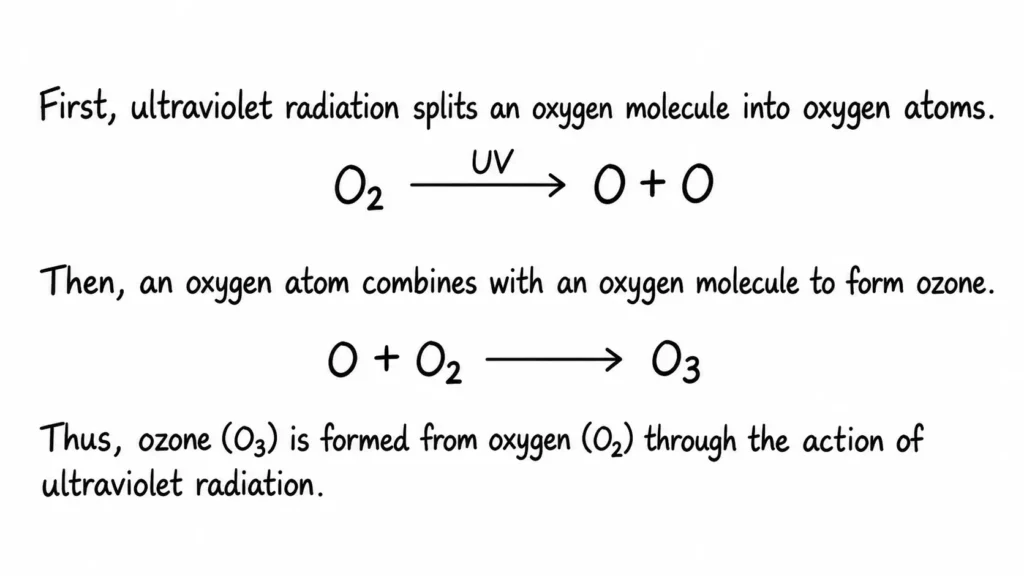
5. Give equations for ozone formation.
Ans: Ozone forms in the stratosphere through the following reactions:
6. Give two reasons for ozone layer depletion.
Ans:
- CFCs release chlorine atoms in the stratosphere, which take part in chemical reactions that destroy ozone.
- Other ozone-depleting substances, including halons and certain industrial chemicals, release reactive chlorine or bromine that can destroy ozone molecules.
7. Mention two harmful effects of ozone layer destruction.
Ans:
- More harmful ultraviolet radiation reaches the Earth’s surface, increasing the risk of skin cancer and eye damage.
- Excessive UV radiation can damage plants, reduce crop productivity and harm aquatic organisms such as phytoplankton.
1E. Long Answer-Type Questions – 3 marks each
1. How environmental protection can be achieved?
Ans: Environmental protection can be achieved through the combined efforts of individuals, communities and governments.
- Air, water and soil pollution should be controlled by treating industrial waste and sewage before discharge.
- Fossil-fuel consumption should be reduced, and renewable sources such as solar and wind energy should be encouraged.
- Forests should be protected, and afforestation should be promoted.
- Natural resources should be used carefully, and waste should be reduced through reuse and recycling.
- Environmental education should be provided to increase public awareness.
Thus, environmental protection requires responsible behaviour, effective laws and the participation of all people.
2. Give two examples of environmental pollution which can be explained by physical science.
Ans:
- Air pollution: Burning coal, petrol and diesel releases harmful gases and particles into the atmosphere. These pollutants can affect human health and contribute to environmental problems.
- Noise pollution: Unwanted or excessive sound from vehicles, industries and loudspeakers causes noise pollution. Prolonged exposure to high noise levels can disturb sleep, cause stress and damage hearing.
Both examples can be studied using physical science principles involving gases, combustion, sound and energy.
3. Explain the reason of turbulent air circulation in troposphere.
Ans: The troposphere has turbulent air circulation due to the following reasons:
- Heating of the Earth’s surface: The Earth’s surface absorbs heat from the Sun and transfers this heat to the air above it. As a result, the air near the ground becomes warm.
- Rising of warm air: Warm air expands, becomes less dense and rises upwards. This upward movement of warm air creates air currents.
- Downward movement of cold air: The air at higher levels is generally cooler and denser. It moves downwards to take the place of the rising warm air.
- Continuous movement of air: The continuous rising of warm air and sinking of cold air produces turbulent air circulation in the troposphere.
These movements of air also help in the formation of clouds, winds and other weather conditions.
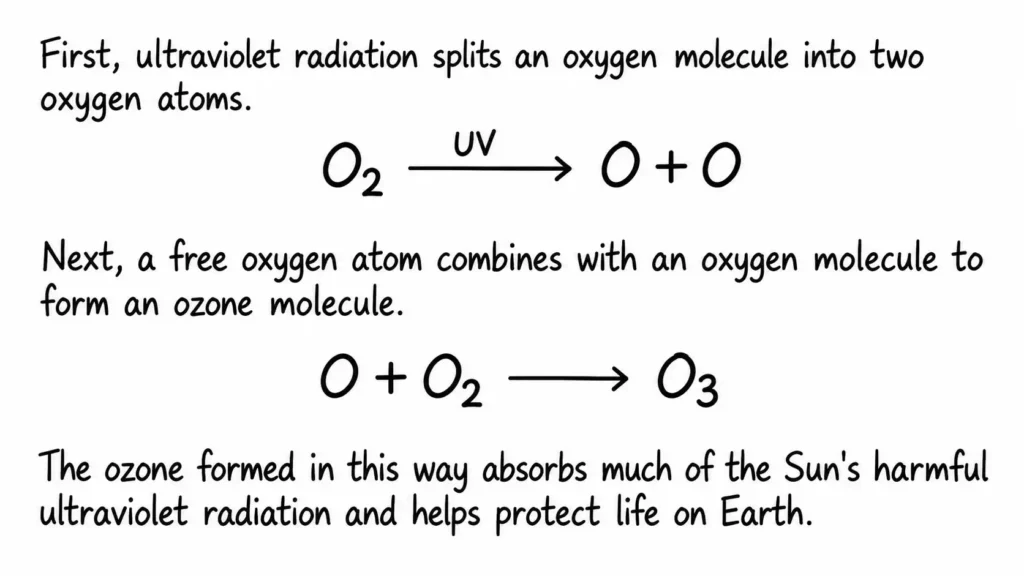
4. Describe the formation of ozone layer.
Ans: The ozone layer forms mainly in the stratosphere through the action of ultraviolet radiation from the Sun.
5. Describe the causes of ozone layer destruction.
Ans: The ozone layer is mainly destroyed by certain chemicals released through human activities. The major causes are given below.
- Release of CFCs: Chlorofluorocarbons (CFCs) were widely used in refrigerators, air conditioners and aerosol sprays. These gases can reach the stratosphere, where the ozone layer is present.
- Action of ultraviolet rays: In the stratosphere, ultraviolet rays from the Sun break down CFC molecules and release chlorine atoms.
- Destruction of ozone molecules: The released chlorine atoms react with ozone (O₃) and help convert it into ordinary oxygen (O₂). In this way, chlorine can destroy many ozone molecules.
- Effect of other chemicals: Halons and certain other ozone-depleting substances release bromine or other reactive substances that also destroy ozone molecules.
- Special atmospheric conditions: Very low temperatures and special cloud conditions over Antarctica favour chemical reactions that cause severe seasonal ozone depletion.
Thus, the release of ozone-depleting substances into the atmosphere is the main cause of ozone layer destruction.
6. What is ozone hole? Where it is found and mention its consequence.
Ans:
- Meaning of ozone hole: The ozone hole is a region of the atmosphere where the ozone layer becomes severely thin. It does not mean that the ozone layer disappears completely from that region.
- Location of the ozone hole: Severe ozone depletion occurs mainly over Antarctica, particularly during the spring season in the Southern Hemisphere.
- Harmful ultraviolet radiation: Due to the thinning of the ozone layer, more harmful ultraviolet (UV) radiation from the Sun can reach the Earth’s surface.
- Effects on human health: Increased exposure to UV radiation raises the risk of skin cancer, eye damage and other harmful effects on human health.
- Effects on plants and aquatic organisms: Excessive UV radiation can damage plants, reduce the growth of some crops and harm aquatic organisms such as phytoplankton.
Therefore, the ozone layer is important because it protects living organisms on Earth from much of the Sun’s harmful ultraviolet radiation.
2. Additional Questions and Answers
2A. Multiple Choice Questions (MCQs) (1 mark each)
1. Which atmospheric layer is nearest to the Earth’s surface?
A. Troposphere
B. Stratosphere
C. Mesosphere
D. Thermosphere
Ans: A. Troposphere
2. Which gas has the formula O₃?
A. Oxygen
B. Ozone
C. Nitrogen
D. Methane
Ans: B. Ozone
3. The ozone layer protects life mainly by absorbing:
A. Sound waves
B. UV radiation
C. Radio waves
D. Visible light
Ans: B. UV radiation
4. Which of the following is a greenhouse gas?
A. Nitrogen
B. Oxygen
C. Carbon dioxide
D. Argon
Ans: C. Carbon dioxide
5. Which is a non-renewable source of energy?
A. Wind
B. Solar energy
C. Tidal energy
D. Petroleum
Ans: D. Petroleum
6. Biogas is produced mainly by:
A. Aerobic combustion
B. Anaerobic decomposition
C. Freezing water
D. Photosynthesis
Ans: B. Anaerobic decomposition
7. The calorific value of a fuel indicates the heat released by:
A. Its colour
B. Complete combustion of a unit amount
C. Its smell
D. Its density only
Ans: B. Complete combustion of a unit amount
8. Which device converts sunlight directly into electrical energy?
A. Solar cell
B. Windmill
C. Tidal barrage
D. Steam engine
Ans: A. Solar cell
9. The boundary between the troposphere and stratosphere is the:
A. Stratopause
B. Tropopause
C. Mesopause
D. Ionosphere
Ans: B. Tropopause
10. Which one is a form of biomass?
A. Uranium
B. Cattle dung
C. Petrol
D. Natural gas
Ans: B. Cattle dung
11. Methane hydrate is also popularly called:
A. Dry ice
B. Fire ice
C. Black ice
D. Water gas
Ans: B. Fire ice
12. Wind energy is harnessed using:
A. Wind turbines
B. Solar cells
C. Ozone generators
D. Refrigerators
Ans: A. Wind turbines
2B. Fill in the blanks
1. The molecule of ozone contains ___ oxygen atoms. (three)
2. The boundary between the troposphere and stratosphere is called the ___. (tropopause)
3. The concentration of ozone is measured in ___. (Dobson units)
4. The gradual long-term rise in average global temperature is called ___. (global warming)
5. Coal, petroleum and natural gas are ___ sources of energy. (non-renewable)
6. A fuel produced from biomass is called a ___. (biofuel)
7. Biogas is formed in the absence of ___. (oxygen)
8. The ice-like substance containing trapped methane is called ___. (methane hydrate)
9. The heat released by complete combustion of a unit amount of fuel is its ___. (calorific value)
10. Solar cells are made from semiconductor materials such as ___. (silicon)
2C. True or false. Correct the false statements.
1. The troposphere is the atmospheric layer nearest to the Earth’s surface. (True)
2. Temperature generally increases with altitude in the troposphere. (False)
3. Ozone is represented by the formula O₂. (False)
4. The natural greenhouse effect is necessary for life on Earth. (True)
5. Petroleum is a renewable energy source. (False)
6. Biogas can be produced from cattle dung. (True)
7. Solar cells generate electricity by burning coal. (False)
8. Methanogenic bacteria help produce methane under anaerobic conditions. (True)
2D. Match the columns
| Column A | Column B |
| 1. Renewable source | (a) Methane hydrate |
| 2. Fossil fuel | (b) Solar energy |
| 3. Fire ice | (c) Petroleum |
| 4. Fuel made from biomass | (d) Biofuel |
| 5. Ozone formula | (e) O₃ |
| 6. Gas produced in a biogas plant | (f) Methane-rich biogas |
Ans: 1–(b), 2–(c), 3–(a), 4–(d), 5–(e), 6–(f).
2E. Very short-answer questions (1 mark each)
1. What is the atmosphere?
Ans: The atmosphere is the envelope of gases surrounding the Earth.
2. Name the four major atmospheric layers discussed in the textbook.
Ans: Troposphere, stratosphere, mesosphere and thermosphere.
3. Name any three gases found in the troposphere.
Ans: Nitrogen, oxygen and carbon dioxide. Water vapour is also present.
4. Why is the troposphere called the turbulent sphere?
Ans: Because storms, rain, lightning and other weather phenomena occur mainly in this layer.
5. What is the unit used to measure ozone concentration in the textbook?
Ans: Dobson unit (DU).
6. Name one substance responsible for ozone depletion.
Ans: Chlorofluorocarbons (CFCs). Nitrogen oxides can also contribute.
7. What is methane hydrate also known as?
Ans: Fire ice.
8. What is sustainable development?
Ans: Development that meets present needs without compromising the ability of future generations to meet their own needs.
9. What is environmental pollution?
Ans: Environmental pollution is the contamination of air, water or soil by harmful substances or activities that adversely affect living organisms and the natural environment.
10. Name the four major layers of the atmosphere.
Ans: The four major layers are the troposphere, stratosphere, mesosphere and thermosphere.
11. What is the tropopause?
Ans: The tropopause is the boundary separating the troposphere from the stratosphere.
12. Which is the coldest major atmospheric layer?
Ans: The mesosphere is generally considered the coldest major atmospheric layer.
13. What is the Dobson unit?
Ans: The Dobson unit is a unit used to measure the total amount of ozone present in a vertical column of the atmosphere.
14. What is ozone?
Ans: Ozone is an allotrope of oxygen. Each ozone molecule contains three oxygen atoms, and its chemical formula is O3.
15. Where is the ozone layer situated?
Ans: The ozone layer is situated mainly in the stratosphere, with a relatively high concentration of ozone found around 25–30 km above the Earth’s surface.
16. What is meant by the ozone hole?
Ans: The ozone hole is a region of severe seasonal depletion of stratospheric ozone, especially over Antarctica. It is not a physical hole in the atmosphere.
17. What is the greenhouse effect?
Ans: The greenhouse effect is the process by which certain gases in the atmosphere absorb and re-emit infrared radiation emitted by the Earth’s surface, helping to keep the Earth warm.
18. Name four greenhouse gases.
Ans: Carbon dioxide, methane, water vapour and nitrous oxide are four greenhouse gases.
19. What is global warming?
Ans: Global warming is the long-term rise in the Earth’s average surface temperature, mainly caused by the increase in greenhouse gases due to human activities.
20. What is solar energy?
Ans: Solar energy is the energy received from the Sun. It can be used for heating and generating electricity.
21. Mention four uses of solar cells.
Ans: Solar cells are used in calculators, electronic watches, streetlights and water pumps. They are also used in traffic signals and artificial satellites.
22. What is the SI unit of calorific value?
Ans: The SI unit of calorific value is joule per kilogram (J/kg). Kilojoule per gram (kJ/g) is also commonly used.
2F. Short-answer questions (2 marks each)
1. Why is environmental studies called a multidisciplinary subject?
Ans: Environmental studies requires knowledge from different subjects. Life Science explains living components and their interactions, while Physical Science explains non-living components, energy transfer and physical or chemical processes.
2. Why should fossil fuels be conserved? Give two reasons.
Ans: Fossil fuels are non-renewable and take millions of years to form. Their combustion also releases greenhouse gases and other pollutants, contributing to global warming and air pollution.
3. Give two advantages of solar cells.
Ans: They generate electricity without burning fuel during operation, and they have no moving parts, so maintenance is generally low. They can also be used in remote locations.
4. How is tidal energy used to generate electricity?
Ans: At a suitable site, a tidal barrage stores water as the tide rises. During the inflow or outflow of water, the moving water turns turbines connected to generators.
5. What is anaerobic decomposition? How is it useful?
Ans: Anaerobic decomposition is the breakdown of organic matter by microorganisms in the absence of oxygen. It is used in biogas plants to produce methane-rich fuel from materials such as cattle dung and plant waste.
6. What is the difference between renewable and non-renewable energy sources?
Ans: Renewable sources are replenished naturally within a relatively short time, for example sunlight and wind. Non-renewable sources are limited and cannot be replaced quickly, for example coal and petroleum.
7. Why is environmental studies called a multidisciplinary subject?
Ans: Environmental studies is called a multidisciplinary subject because it uses knowledge from different branches of science, particularly Life Science and Physical Science, to understand the environment and the interactions between its components.
8. Mention two ways in which human activities damage the environment.
Ans: Human activities damage the environment through industrial emissions and the improper disposal of waste. Industrial emissions pollute the air, while waste can contaminate soil and water.
9. What is the importance of the ionosphere?
Ans: The ionosphere contains electrically charged particles that interact with radio waves. These interactions can help radio signals travel over long distances, although modern communication systems use several different transmission methods.
10. Explain the formation of a sea breeze.
Ans: During the day, land heats up faster than the sea. The air above the land becomes warmer and rises. Cooler air from the sea moves towards the land to replace it. This movement of air from the sea towards the land is called a sea breeze.
11. Distinguish between the troposphere and the stratosphere.
Ans:
| Troposphere | Stratosphere |
| It is the lowest atmospheric layer. | It lies above the troposphere. |
| Temperature generally decreases with altitude. | Temperature generally increases with altitude. |
| Most weather phenomena occur here. | It contains the ozone layer and is relatively stable. |
| It contains most atmospheric water vapour. | It contains much less water vapour than the troposphere. |
12. Mention four harmful effects of ozone depletion.
Ans: Ozone depletion allows more harmful ultraviolet radiation to reach the Earth’s surface. It can increase the risk of skin cancer, cause eye damage, harm plants and damage phytoplankton and other aquatic organisms.
13. Why is the ozone layer important for life on Earth?
Ans: The ozone layer absorbs much of the Sun’s harmful ultraviolet radiation and reduces the amount reaching the Earth’s surface. It therefore helps protect humans, animals, plants and aquatic organisms from radiation damage.
14. What is global warming?
Ans: Global warming is the gradual increase in the average temperature of the Earth due to an increase in greenhouse gases in the atmosphere. Carbon dioxide, methane and nitrous oxide are important greenhouse gases.
15. How does global warming cause a rise in sea level?
Ans: Global warming causes glaciers and ice sheets to melt. It also causes seawater to expand as its temperature increases. These processes contribute to a rise in sea level, which may flood low-lying coastal regions, agricultural lands and river deltas.
16. How does global warming affect agriculture?
Ans: Global warming changes temperature and rainfall patterns. Droughts, floods and heatwaves may damage crops. Warmer and more humid conditions may also increase the growth of certain pests and disease-causing organisms. As a result, agricultural production may decrease.
17. How can an individual help reduce greenhouse-gas emissions?
Ans: An individual can use public transport, walk or cycle for short distances, save electricity, use energy-efficient appliances and choose solar energy where practical. We should also avoid unnecessary use of air conditioners and refrigerators and avoid products containing ozone-depleting CFCs.
18. Why should renewable resources be used sustainably?
Ans: Renewable resources can be naturally replenished, but they may become depleted if they are consumed faster than they can recover. Sustainable use helps ensure that these resources remain available for future generations.
2G. Long-answer questions (3 marks each)
1. Explain the formation of the ozone layer.
Ans: Ozone is formed in the upper atmosphere when ultraviolet radiation breaks an oxygen molecule into separate oxygen atoms: O₂ —(UV)→ O + O. An oxygen atom then combines with another oxygen molecule to form ozone: O + O₂ → O₃. The ozone-rich region absorbs much of the Sun’s harmful ultraviolet radiation and protects life on Earth.
2. Explain the greenhouse effect and its connection with global warming.
Ans: Short-wave solar radiation passes through the atmosphere and warms the Earth’s surface. The surface emits long-wave infrared radiation. Greenhouse gases such as carbon dioxide, methane, water vapour and nitrous oxide absorb some of this radiation and re-emit energy, including towards the surface. The natural greenhouse effect keeps Earth warm, but increasing greenhouse-gas concentrations due to human activities strengthen the effect and cause global warming.
3. What is sustainable development? Explain its main aims.
Ans: Sustainable development means meeting present needs without reducing the ability of future generations to meet their own needs. It aims to improve social welfare and fairness, support economic development, and protect the environment. Natural resources should be used responsibly, and renewable resources should not be consumed faster than they can be replenished.
4. Explain the working and advantages of a biogas plant.
Ans: Cattle dung or other organic waste is mixed with water to form a slurry and fed into an airtight digester. In the absence of oxygen, methanogenic microorganisms decompose the material and release biogas, which is collected in a gas holder and supplied through pipes. The gas can be used for cooking or heating, and the spent slurry can be used as manure. The plant makes useful fuel from waste and can reduce dependence on firewood and fossil fuels.
5. Explain the greenhouse effect.
Ans: The Sun sends shortwave radiation towards the Earth. Much of this radiation passes through the atmosphere and is absorbed by the Earth’s surface, warming it. The Earth’s surface then emits energy in the form of infrared radiation. Greenhouse gases such as carbon dioxide, methane and water vapour absorb some of this outgoing radiation and re-emit energy in different directions, including towards the surface. This process keeps the Earth warmer than it would otherwise be. The natural greenhouse effect is essential for life, but an increase in greenhouse gases due to human activities strengthens this effect and contributes to global warming.
6. Explain the major effects of global warming.
Ans: Global warming can affect the environment in several ways. An increase in the Earth’s average temperature can cause heatwaves and alter rainfall patterns. Melting land ice and the expansion of warmer seawater contribute to rising sea levels, which increase the risk of flooding in low-lying coastal areas. Changes in temperature and rainfall can also damage ecosystems, affect crop production and threaten the habitats of many organisms. These changes may create serious problems for human health, agriculture and the economy.
Related Links
- West Bengal Board 10 Physical Science Concerns about our Environment Questions and Answers
- West Bengal Board 10 Physical Science Syllabus
- WBBSE 10 Result 2026
- Satellite Imageries and Topographical Maps
- Transport and communication system in India
- Population of India
- Industries in India
- Agriculture in India
- Natural Vegetation of India
- Soils in India