
Class 10 CBSE Resources and Development Questions and Answers
Content Structure
- 1. NCERT Solutions
- 1A. Multiple choice questions.
- 1B. Answer the following questions in about 30 words
- 1C. Answer the following questions in about 120 words
- 2. Extra Questions and Answers
- 2A. Multiple Choice Questions (MCQs)
- 2B. Very Short Type Questions and Answers
- 2C. Short Answer-type Questions
- 2D. Case/Source based Questions and Answers
- 2E. Long Questions and Answers
1. NCERT Solutions
1A. Multiple choice questions.
(i) Which one of the following is the main cause of land degradation in Punjab?
(a) Intensive cultivation
(b) Deforestation
(c) Over irrigation
(d) Overgrazing
Ans: (c) Over irrigation
(ii) In which one of the following states is terrace cultivation practised?
(a) Punjab
(b) Plains of Uttar Pradesh
(c) Haryana
(d) Uttarakhand
Ans: (d) Uttarakhand
(iii) In which of the following states black soil is predominantly found?
(a) Uttar Pradesh
(b) Maharashtra
(c) Rajasthan
(d) Jharkhand
Ans: (b) Maharashtra
1B. Answer the following questions in about 30 words.
(i) Name three states having black soil and the crop which is mainly grown in it.
Ans: Black soil is mainly found in Maharashtra, Madhya Pradesh, and Gujarat. It is rich in minerals and is best suited for growing cotton, which is the main crop grown in this soil.
(ii) What type of soil is found in the river deltas of the eastern coast? Give three main features of this type of soil.
Ans: Alluvial soil is found in the river deltas of the eastern coast.
Three main features are:
- It is very fertile.
- It is rich in potash, lime, and phosphoric acid.
- It is suitable for growing crops like rice, wheat, and sugarcane.
(iii) What steps can be taken to control soil erosion in the hilly areas?
Ans: Soil erosion in hilly areas can be controlled by terrace farming, contour ploughing, planting more trees, and building check dams. These methods reduce the speed of water and protect the soil.
1C. Answer the following questions in about 120 words.
(i) Explain land use pattern in India and why has the land under forest not increased much since 1960-61?
Ans: Land in India is used for different purposes such as forests, farming, grazing, buildings, roads, industries, and barren land. The largest share of land is used for agriculture because many people depend on farming. Some land is also covered by forests, while the rest is used for other activities. Since 1960–61, the forest area has not increased much because forests have been cleared for farming, industries, roads, mining, and growing towns and cities. Illegal cutting of trees and increasing population have also reduced forest land. Although the government has started tree plantation programmes, the increase in forest area has been slow.
(ii) How have technical and economic development led to more consumption of resources?
Ans: Technical and economic development have increased the use of natural resources. New machines, modern technology, industries, and better transport require large amounts of land, water, minerals, and energy. As people’s income has increased, the demand for houses, vehicles, electricity, and other goods has also grown. Rapid industrialisation and urbanisation have further increased the need for resources. As a result, natural resources are being used much faster than before. Therefore, resources should be used wisely and conserved so that they remain available for future generations.
2. Extra Questions and Answers
2A. Multiple Choice Questions (MCQs)
1. Which of the following is a renewable resource?
A. Coal
B. Petroleum
C. Wind
D. Natural Gas
Ans: C. Wind
2. Which of the following is an example of a biotic resource?
A. Water
B. Air
C. Forests
D. Rocks
Ans: C. Forests
3. Which soil is best suited for growing cotton?
A. Red Soil
B. Black Soil
C. Laterite Soil
D. Mountain Soil
Ans: B. Black Soil
4. Which of the following is a human-made resource?
A. River
B. Forest
C. Road
D. Mineral
Ans: C. Road
5. Assertion (A): Resource planning is important for the balanced development of a country.
Reason (R): Natural resources are unevenly distributed across different regions.
A. Both A and R are true, and R is the correct explanation of A.
B. Both A and R are true, but R is not the correct explanation of A.
C. A is true, but R is false.
D. A is false, but R is true.
Ans: A
6. Assertion (A): Overgrazing is one of the causes of land degradation.
Reason (R): Overgrazing removes vegetation and exposes the soil to erosion.
A. Both A and R are true, and R is the correct explanation of A.
B. Both A and R are true, but R is not the correct explanation of A.
C. A is true, but R is false.
D. A is false, but R is true.
Ans: A
7. Consider the following statements about black soil.
- Black soil is rich in minerals like lime, calcium carbonate, and potash.
- Black soil is best suited for cotton cultivation.
Choose the correct option.
A. Only Statement 1 is correct.
B. Only Statement 2 is correct.
C. Both Statements 1 and 2 are correct.
D. Neither Statement 1 nor Statement 2 is correct.
Ans: C. Both Statements 1 and 2 are correct.
8. Which idea is best reflected in the passage?
A. Urbanisation
B. Sustainable development
C. Industrialisation
D. Mining
Ans: B. Sustainable development
9. Why did the villagers plant trees?
A. To increase mining activities
B. To reduce soil erosion and protect forests
C. To build factories
D. To expand roads
Ans: B. To reduce soil erosion and protect forests
10. Which farming method mentioned in the passage helps reduce soil erosion on slopes?
A. Shifting cultivation
B. Contour ploughing
C. Slash-and-burn farming
D. Overgrazing
Ans: B. Contour ploughing
11. A farmer lives in a hilly area where heavy rainfall washes away the topsoil every year. Which farming method should the farmer adopt to reduce soil erosion?
A. Overgrazing
B. Terrace farming
C. Mining
D. Deforestation
Ans: B. Terrace farming
12. A factory has polluted the nearby land by dumping untreated waste. What is the best way to reduce land degradation?
A. Continue dumping waste on open land
B. Treat industrial waste before disposal
C. Remove all trees from the area
D. Increase mining in the region
Ans: B. Treat industrial waste before disposal
13. Match the conservation method with its purpose.
| Column A | Column B |
| 1. Afforestation | a. Prevents soil erosion |
| 2. Rainwater Harvesting | b. Conserves water |
| 3. Terrace Farming | c. Protects hill slopes |
| 4. Shelter Belts | d. Reduces wind erosion |
A. 1–a, 2–b, 3–c, 4–d
B. 1–b, 2–a, 3–d, 4–c
C. 1–c, 2–d, 3–a, 4–b
D. 1–d, 2–c, 3–b, 4–a
Ans: A. 1–a, 2–b, 3–c, 4–d
14. Which soil conservation method is shown in the picture?
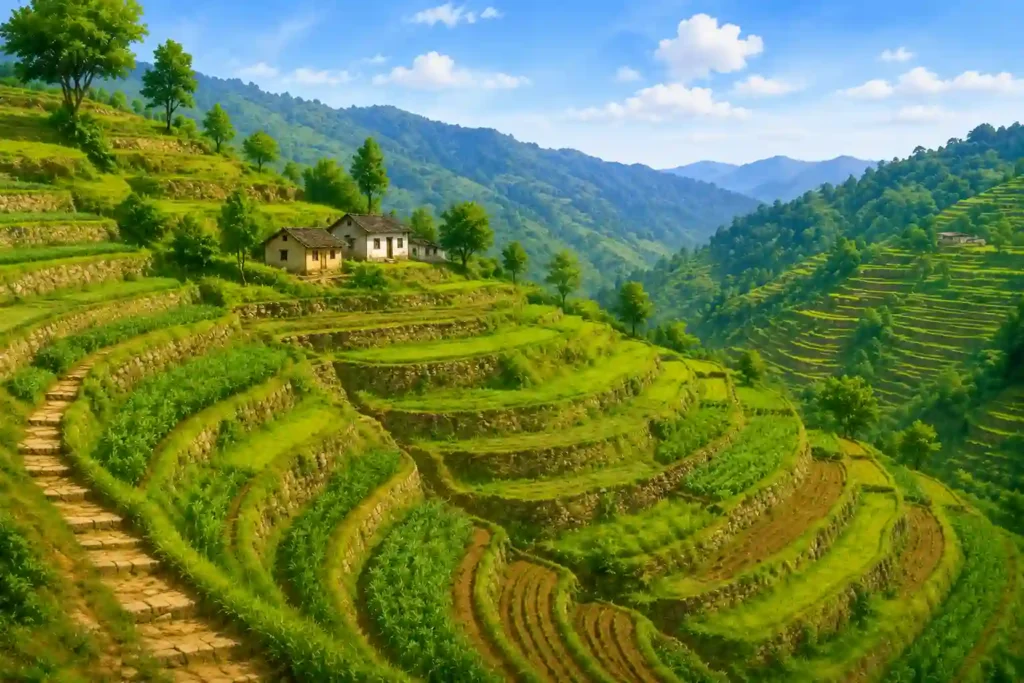
A. Strip cropping
B. Terrace farming
C. Shelter belts
D. Afforestation
Ans: B. Terrace farming
15. The method shown in the picture is mainly used to:
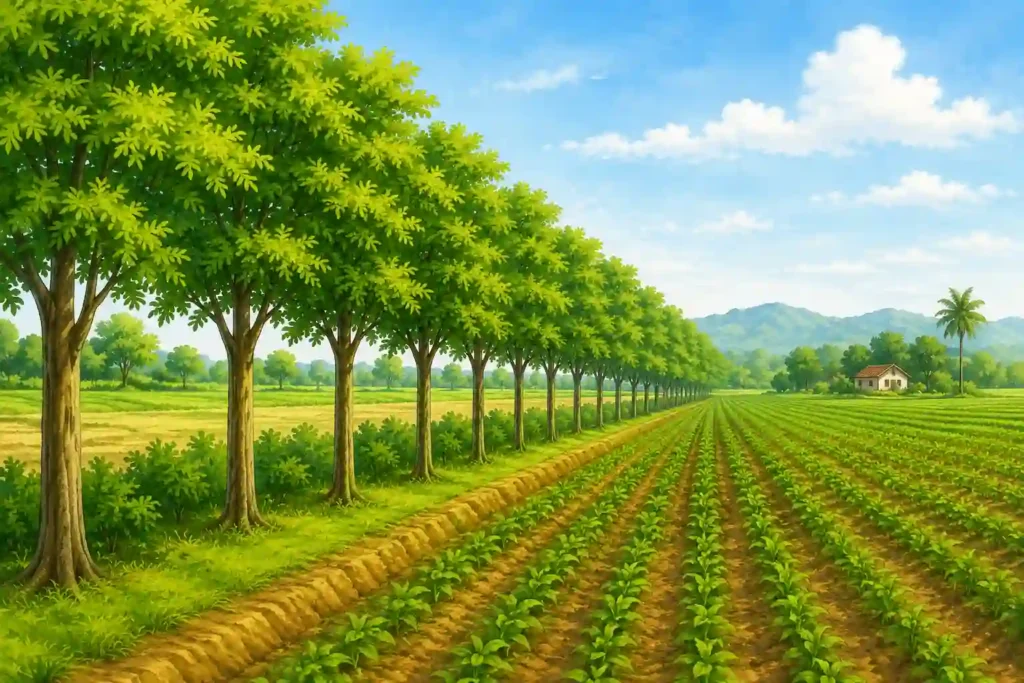
A. Increase mining
B. Reduce wind erosion
C. Build roads
D. Produce electricity
Ans: B. Reduce wind erosion
16. Which type of soil is mainly found in the highlighted region?
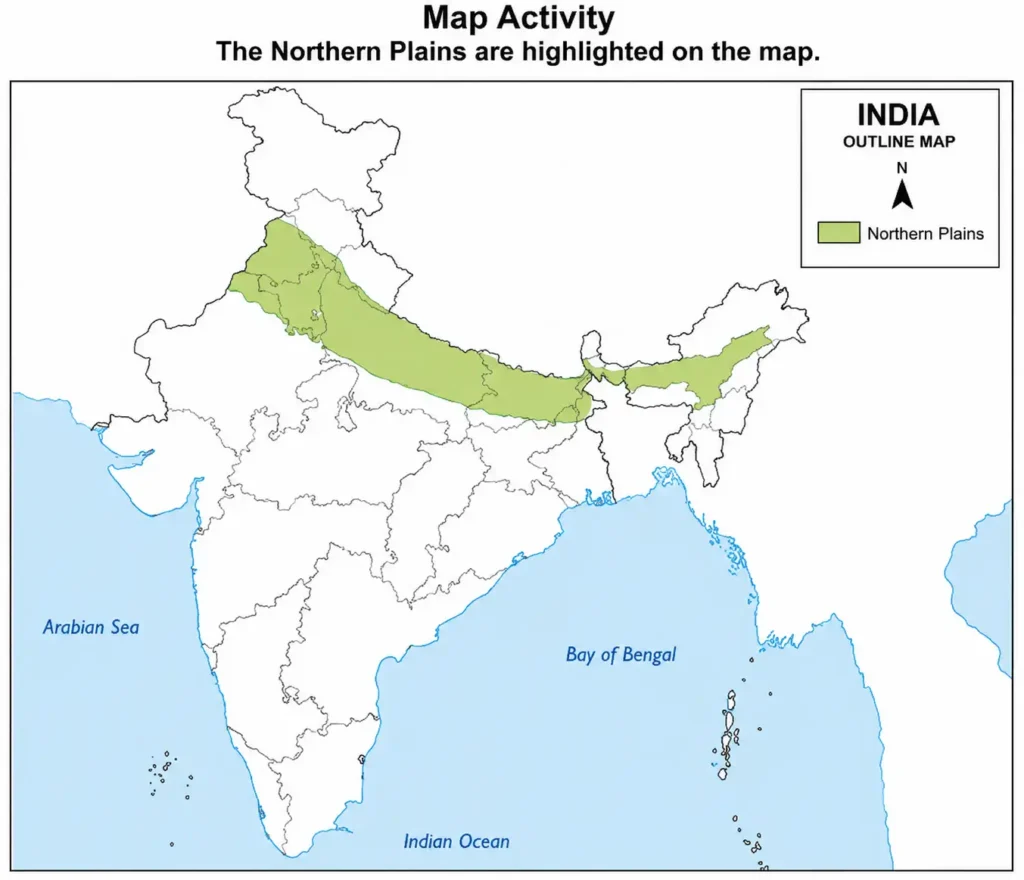
A. Arid Soil
B. Mountain Soil
C. Alluvial Soil
D. Black Soil
Ans: C. Alluvial Soil
2B. Very Short Type Questions and Answers
1. What is a resource?
Ans: A resource is anything that has value and can satisfy human needs. For example, water, forests, land, and minerals are resources because people use them for farming, industries, transport, and many other daily activities.
2. What are natural resources?
Ans: Natural resources are resources that are obtained directly from nature. For example, air, water, sunlight, forests, soil, and minerals are natural resources because humans use them without creating them.
3. What are human-made resources?
Ans: Human-made resources are resources created by people using natural resources and technology. For example, roads, bridges, buildings, machines, and dams are human-made resources that help improve transportation, production, and daily life.
4. What are human resources?
Ans: Human resources are people who use their knowledge, skills, and abilities to develop resources. For example, teachers, engineers, doctors, and farmers contribute to the growth and development of a country.
5. What are biotic resources?
Ans: Biotic resources are resources that come from living organisms. For example, forests, crops, fish, animals, and humans are biotic resources because they have life and provide many useful products and services.
6. What are abiotic resources?
Ans: Abiotic resources are resources that come from non-living things. For example, air, water, rocks, sunlight, and minerals are abiotic resources because they do not have life but are essential for human survival.
7. What are renewable resources?
Ans: Renewable resources are resources that can be replaced naturally in a short period. For example, sunlight, wind, water, and forests can be renewed through natural processes when they are used wisely.
8. What are non-renewable resources?
Ans: Non-renewable resources are resources that take millions of years to form and cannot be replaced quickly. For example, coal, petroleum, and natural gas are limited resources that should be used carefully.
9. What are potential resources?
Ans: Potential resources are resources that are available in a region but are not fully used at present. For example, solar energy in Rajasthan and wind energy in Gujarat have great potential for future development.
10. Why is land considered an important resource?
Ans: Land is considered an important resource because it supports agriculture, forests, industries, transport, and human settlements. It also provides the natural environment needed for plants, animals, and people to survive.
11. What is land degradation?
Ans: Land degradation is the decline in the quality and productivity of land due to natural or human activities. It reduces soil fertility and makes the land less suitable for farming and other useful purposes.
12. Name any two causes of land degradation.
Ans: Overgrazing and mining are two major causes of land degradation. These activities remove vegetation, damage the soil, and reduce the fertility and productivity of the land over time.
13. How does deforestation cause land degradation?
Ans: Deforestation causes land degradation by removing trees that hold the soil together. As a result, the exposed topsoil is easily washed away by water or blown away by wind.
14. How can land degradation be controlled?
Ans: Land degradation can be controlled by planting more trees, regulating mining, managing grazing properly, and treating industrial waste. These measures help protect the soil and improve the quality of land.
15. What is afforestation?
Ans: Afforestation is the planting of trees on barren or unused land to increase forest cover. It helps prevent soil erosion, improves the environment, and supports wildlife and biodiversity.
16. What is soil?
Ans: Soil is the uppermost layer of the Earth’s surface that supports plant growth. It contains minerals, organic matter, water, and air, making it essential for agriculture and natural vegetation.
17. How is soil formed?
Ans: Soil is formed through the weathering of rocks over a long period. Natural factors such as temperature, rainfall, wind, rivers, plants, and living organisms help break rocks into fine soil particles.
18. Why is soil important?
Ans: Soil is important because it provides nutrients and water for plants to grow. Healthy soil supports agriculture, forests, and ecosystems, making it essential for food production and human life.
19. Which soil is best suited for cotton cultivation?
Ans: Black soil is best suited for cotton cultivation because it retains moisture for a long time. It is also rich in minerals like lime, calcium carbonate, and potash, which help cotton plants grow well.
20. Name any two methods of soil conservation.
Ans: Terrace farming and contour ploughing are two important methods of soil conservation. These methods reduce the speed of flowing water and help prevent soil erosion, especially in hilly areas.
21. What is Agenda 21?
Ans: Agenda 21 is a global action plan that promotes sustainable development and environmental protection. It encourages countries to use natural resources wisely and improve the quality of life without harming nature.
22. Where and when was Agenda 21 adopted?
Ans: Agenda 21 was adopted at the Earth Summit held in Rio de Janeiro, Brazil, in 1992. Leaders from many countries agreed to work together for sustainable development and environmental conservation.
23. What is the main aim of sustainable development?
Ans: Sustainable development aims to meet the needs of the present without reducing the ability of future generations to meet their own needs. It promotes the balanced use of natural resources and environmental protection.
2C. Short Answer-type Questions
1. What are resources? Why are they important?
Ans: Resources are things available in nature that help us satisfy our needs. They become useful when people have the knowledge and technology to use them. Resources are important because they provide food, water, energy, raw materials, and shelter. They support agriculture, industries, transport, and daily life. Without resources, human survival and economic development would not be possible.
2. What are biotic and abiotic resources? Give examples.
Ans: Biotic resources are resources that come from living things. They include forests, animals, fish, and humans. Abiotic resources are non-living resources found in nature. They include air, water, rocks, soil, and minerals. Both types of resources are important because they help people meet their needs and support economic growth and environmental balance.
3. What is sustainable development? Why is it necessary?
Ans: Sustainable development means using natural resources carefully so that they remain available for future generations. It helps meet present needs without harming the environment. It is necessary because overuse of resources causes pollution, deforestation, and resource depletion. Sustainable development protects nature, maintains ecological balance, and ensures that future generations also have enough resources to live well.
4. What are renewable and non-renewable resources? Give examples.
Ans: Renewable resources are resources that can be replaced or renewed naturally in a short time. Examples include sunlight, wind, and water. Non-renewable resources take millions of years to form and cannot be replaced quickly. Examples include coal, petroleum, natural gas, and minerals. We should use non-renewable resources carefully because their supply is limited.
5. What is resource planning? Why is it important in India?
Ans: Resource planning means identifying, developing, and using resources wisely and carefully. It helps avoid waste and ensures fair use of resources. Resource planning is important in India because resources are not equally distributed across the country. Proper planning helps protect the environment, reduces regional inequalities, supports economic growth, and ensures resources are available for future generations.
6. What are the main methods of conserving land resources?
Ans: Land resources can be conserved by planting more trees, controlling soil erosion, reducing overgrazing, and using proper farming methods. Terrace farming and contour ploughing help protect soil on slopes. Proper waste disposal and careful use of fertilizers also reduce land degradation. These methods improve soil quality and help maintain the productivity of land for future use.
7. Why is soil considered an important resource?
Ans: Soil is an important natural resource because it supports the growth of crops, forests, and grasslands. It provides nutrients, water, and support to plants. Healthy soil is essential for agriculture, which provides food and raw materials. Soil also supports many living organisms and helps maintain ecological balance. Therefore, protecting soil is very important.
8. What are the major causes of soil erosion?
Ans: Soil erosion is the removal of the top fertile layer of soil by water, wind, or human activities. Major causes include deforestation, overgrazing, mining, construction work, and improper farming practices. Heavy rainfall and strong winds also increase soil erosion. This reduces soil fertility, lowers agricultural production, and damages the natural environment.
9. What are the key features of alluvial soil?
Ans:
- Alluvial soil is the most widespread and fertile soil in India.
- It is formed by the deposits of rivers.
- It contains enough potash, phosphoric acid, and lime.
- It is suitable for crops like wheat, rice, sugarcane, maize, and pulses.
- It is highly important for agriculture.
10. Differentiate between Khadar and Bangar soils.
Ans:
| Khadar | Bangar |
| Khadar is the newer alluvial soil. | Bangar is the older alluvial soil. |
| It is renewed every year by floods. | It is not renewed regularly by floods. |
| It is finer and more fertile. | It contains more kankar (calcium nodules) and is less fertile. |
11. Where is laterite soil found? What are its characteristics?
Ans:
- Laterite soil is found in Karnataka, Kerala, Tamil Nadu, Odisha, Assam, and parts of Madhya Pradesh.
- It develops in areas with high temperature and heavy rainfall.
- Heavy rain washes away its nutrients.
- It is acidic and contains less humus.
- With proper fertilizers, it is suitable for tea, coffee, and cashew.
12. Why is arid soil not naturally suitable for agriculture?
Ans: Arid soil is mainly found in western Rajasthan. It is sandy, dry, and often saline in nature. High temperatures cause rapid evaporation, leaving salt on the surface. The soil contains very little moisture and humus, making it less fertile. Although it is not naturally suitable for farming, irrigation and fertilizers can improve its productivity.
13. What is strip cropping? How does it help?
Ans: Strip cropping is a farming method in which crops are grown in long strips with strips of grass or other plants between them. These strips reduce the speed of strong winds and prevent the fertile topsoil from being blown away. This method helps control soil erosion and protects agricultural land, especially in dry and windy regions.
14. Define the term ‘shelter belts’ and their purpose.
Ans: Shelter belts are rows of trees planted along the edges of agricultural fields. They reduce the speed of strong winds and protect the fertile topsoil from wind erosion. Shelter belts also help stabilize sand dunes in desert regions such as western Rajasthan. They improve soil conservation and create better conditions for farming.
15. How do human activities cause soil erosion?
Ans: Human activities such as deforestation, overgrazing, mining, construction, and improper farming remove the natural vegetation cover from the land. Without this protective cover, wind and rain easily carry away the fertile topsoil. As a result, soil fertility decreases, agricultural production is affected, and the land becomes less productive over time.
16. What is the Exclusive Economic Zone (EEZ)?
Ans: The Exclusive Economic Zone (EEZ) is the sea area extending up to 200 nautical miles from a country’s coastline. Within this zone, the country has special rights to explore, use, and manage marine resources. Resources found beyond the EEZ are called international resources and can be used only according to international laws and agreements.
17. Why do some states in India suffer despite having abundant resources? Give examples.
Ans: Some states have rich natural resources but remain economically backward because they lack proper technology, infrastructure, investment, and planning. For example, Jharkhand, Chhattisgarh, and Madhya Pradesh have abundant mineral resources but still face development challenges. This shows that resources alone cannot ensure development without proper planning and effective management.
18. Mention the characteristics of forest soils.
Ans:
- Forest soils are found in hilly and mountainous regions.
- They develop under dense forests.
- Their texture changes with altitude and location.
- They are loamy and silty in valleys but coarse on upper slopes.
- In snow-covered areas, they become acidic and contain less humus.
19. Differentiate between gully erosion and sheet erosion.
Ans:
| Gully Erosion | Sheet Erosion |
| Gully erosion occurs when running water cuts deep channels in the soil. | Sheet erosion occurs when water flows over a large area and removes the top layer of soil. |
| It is commonly found in clayey soils. | It usually occurs on gentle slopes during heavy rainfall. |
| It makes the land uneven and unsuitable for farming. | It slowly reduces soil fertility by removing the fertile topsoil. |
20. Explain any two effective methods of soil conservation in hilly areas.
Ans:
- Terrace farming involves cutting wide steps on hill slopes to slow the flow of water and reduce soil erosion.
- Contour ploughing is done along the contour lines of hills instead of up and down the slope. This helps reduce water flow and protects the fertile topsoil from being washed away.
21. What is Agenda 21? What is its main objective?
Ans: Agenda 21 is a global action plan adopted at the Earth Summit held in Rio de Janeiro in 1992. Its main objective is to achieve sustainable development by protecting the environment, reducing poverty, improving the quality of life, and encouraging countries to use natural resources responsibly through international cooperation.
22. Differentiate between renewable and non-renewable resources.
Ans:
| Renewable Resources | Non-renewable Resources |
| Renewable resources can be renewed naturally in a short period. | Non-renewable resources take millions of years to form naturally. |
| They can be used repeatedly if managed properly. | They cannot be replaced within a human lifetime after use. |
| Solar energy, wind energy, and forests are examples of renewable resources. | Coal, petroleum, and natural gas are examples of non-renewable resources. |
2D. Case/Source based Questions and Answers
1. Case-Based Question: Sustainable Development
Read the source carefully and answer the questions that follow.
Natural resources are limited. Rapid industrial growth, population increase, and overuse of resources have caused environmental problems such as pollution, deforestation, and soil erosion. Sustainable development means using resources carefully so that present needs are met without reducing the ability of future generations to meet their own needs.
(i) What is meant by sustainable development?
Ans: Sustainable development means using natural resources wisely to meet present needs without harming the environment or reducing resources for future generations.
(ii) Which one of the following is an example of sustainable development?
a) Excessive mining
b) Deforestation
c) Rainwater harvesting
d) Overgrazing
Ans: (c) Rainwater harvesting
(iii) Why is sustainable development necessary? Explain in about 40–50 words.
Ans: Sustainable development is necessary because natural resources are limited. It helps reduce pollution, conserve forests, protect biodiversity, and ensure that future generations also have enough resources to meet their needs.
2. Case-Based Question: Resource Planning
Read the source carefully and answer the questions that follow.
India has rich natural resources, but they are not equally distributed. Some regions have abundant water, forests, and minerals, while others face shortages. Proper resource planning helps identify, develop, and use these resources wisely. It also promotes balanced regional development and supports sustainable economic growth.
(i) Why is resource planning necessary in India?
Ans: Resource planning is necessary because natural resources are unevenly distributed across different regions of India.
(ii) Which one of the following is the first step of resource planning?
(a) Conserving forests
(b) Surveying and mapping resources
(c) Building industries
(d) Exporting minerals
Ans: (b) Surveying and mapping resources
(iii) State any two objectives of resource planning.
Ans: Two objectives of resource planning are to ensure the proper use of natural resources and to reduce regional inequalities. It also supports balanced economic development and helps conserve resources for future generations.
3. Case-Based Question: Soil Erosion and Conservation
Read the source carefully and answer the questions that follow.
Soil erosion is the removal of the fertile top layer of soil by water, wind, or human activities. Deforestation, overgrazing, mining, and improper farming increase soil erosion. Methods such as afforestation, contour ploughing, terrace farming, and shelter belts help conserve soil.
(i) What is soil erosion?
Ans: Soil erosion is the removal of the fertile top layer of soil by water, wind, or human activities.
(ii) Which one of the following is a method of soil conservation?
(a) Overgrazing
(b) Afforestation
(c) Mining
(d) Deforestation
Ans: (b) Afforestation
(iii) Mention any two causes of soil erosion.
Ans: Two causes of soil erosion are deforestation and overgrazing. Both activities expose the soil to wind and water, making it easier for the fertile topsoil to be removed.
4. Source-Based Question: Classification of Resources
Read the source carefully and answer the questions that follow.
Resources can be classified in different ways. On the basis of origin, they are divided into biotic and abiotic resources. On the basis of exhaustibility, they are classified as renewable and non-renewable resources. This classification helps people understand the nature of resources and use them wisely.
(i) On what basis are resources classified as biotic and abiotic?
Ans: Resources are classified as biotic and abiotic on the basis of their origin.
(ii) Which one of the following is an abiotic resource?
(a) Forest
(b) Wildlife
(c) Water
(d) Fish
Ans: (c) Water
(iii) Differentiate between renewable and non-renewable resources.
Ans:
| Renewable Resources | Non-Renewable Resources |
| Renewable resources are natural resources that can be replenished or replaced naturally within a relatively short period if they are used wisely. | Non-renewable resources are natural resources that take millions of years to form and cannot be replaced within a human lifetime once they are exhausted. |
| These resources are generally available continuously because natural processes renew them. | These resources are available in limited quantities, and continuous use may lead to their complete depletion. |
| Renewable resources support sustainable development because they can be used repeatedly with proper conservation. | Non-renewable resources should be used carefully because they cannot be regenerated quickly after being used. |
| Examples of renewable resources include sunlight, wind, water, forests, and biomass. | Examples of non-renewable resources include coal, petroleum, natural gas, and minerals. |
5. Source-Based Question: Resources Based on Ownership
Read the source carefully and answer the questions that follow.
Resources may belong to individuals, communities, the nation, or international organisations. Private resources belong to individuals. Community-owned resources are shared by all members of a community. National resources belong to the country, while international resources are regulated by international institutions.
(i) What are private resources?
Ans: Private resources are owned by individuals or private organisations for their personal use.
(ii) Which one of the following is a community-owned resource?
(a) Private house
(b) Village pond
(c) Coal mine
(d) Factory
Ans: (b) Village pond
(iii) Give any two examples of national resources.
Ans: Two examples of national resources are forests and minerals found within the political boundaries of India.
6. Source-Based Question: Resources Based on Status of Development
Read the source carefully and answer the questions that follow.
On the basis of development, resources are classified as potential, developed, stock, and reserves. Potential resources are available but have not been fully used. Developed resources have been surveyed and are currently in use. Stock and reserves are available but cannot be fully used because of technological or conservation reasons.
(i) What are potential resources?
Ans: Potential resources are resources that are available in a region but have not yet been fully developed or used.
(ii) Which one of the following is a developed resource?
(a) A mineral deposit that has been surveyed and is being mined
(b) Wind energy that has not been used
(c) Water deep underground that cannot be used
(d) Forest land kept unused
Ans: (a) A mineral deposit that has been surveyed and is being mined
(iv) Why are potential resources important for future development?
Ans: Potential resources provide opportunities for future growth. As technology improves, these resources can be developed to meet increasing demands. Their proper use supports economic development while reducing pressure on existing resources.
2E. Long Questions and Answers
1. Explain the need for resource planning in India.
Ans: Resource planning is the process of identifying, developing, and using resources in a planned and scientific manner. It is essential in India because resources are limited and unevenly distributed across the country.
- Unequal distribution of resources: Some regions have abundant minerals, forests, and water, while others have very few natural resources. Proper planning helps reduce these regional differences.
- Prevents overuse and wastage: Careful planning ensures that resources are used efficiently instead of being exploited or wasted.
- Protects the environment: It helps control deforestation, pollution, and land degradation, maintaining ecological balance.
- Promotes balanced development: It supports the economic growth of all regions instead of benefiting only resource-rich areas.
- Ensures resources for the future: Conservation and planned use help meet the needs of future generations.
Thus, resource planning is necessary for sustainable development, environmental protection, and balanced economic growth.
2. What is sustainable development? Explain why it is important.
Ans: Sustainable development means meeting the needs of the present without reducing the ability of future generations to meet their own needs. It encourages economic development while protecting natural resources and the environment.
Importance of sustainable development:
- Conserves natural resources: It promotes the careful use of forests, water, minerals, and other valuable resources.
- Protects the environment: It reduces pollution, deforestation, and environmental degradation.
- Maintains ecological balance: It protects biodiversity and preserves natural ecosystems.
- Supports long-term economic growth: It encourages development without exhausting natural resources.
- Improves quality of life: It provides a healthy environment and sufficient resources for both present and future generations.
Therefore, sustainable development is essential for protecting nature while ensuring continuous economic and social progress.
3. Explain the classification of resources on the basis of ownership with examples.
Ans: Resources are classified into four categories on the basis of ownership. This classification helps us understand who owns the resources and who has the right to use them.
- Individual Resources: These resources are owned by private individuals. Examples include houses, agricultural land, wells, and vehicles. The owner has the legal right to use and manage them.
- Community-owned Resources: These resources belong to the entire community and are used by everyone. Examples include village ponds, public parks, playgrounds, grazing grounds, and burial grounds.
- National Resources: These resources belong to the nation. They include forests, rivers, minerals, roads, railways, and all resources found within the country’s political boundaries and Exclusive Economic Zone.
- International Resources: These resources lie beyond the Exclusive Economic Zone and are managed by international organisations. No country can use them without international agreement.
Thus, ownership determines how resources are managed, protected, and used for public welfare.
4. Explain the classification of resources on the basis of their status of development.
Ans: Resources are classified into four categories according to their stage of development. This classification helps in planning their proper use and conservation.
- Potential Resources: These resources are available in a region but are not fully used because suitable technology or demand is lacking. For example, solar and wind energy in Rajasthan and Gujarat.
- Developed Resources: These resources have been surveyed, and their quantity and quality are known. They are currently being used for economic development.
- Stock: These are resources that exist in nature but cannot be used because suitable technology is not yet available. For example, hydrogen and oxygen present in water cannot be widely used as energy sources.
- Reserves: These are part of stock that can be used with present technology but are carefully conserved for future use, such as water stored in dams and forests.
This classification helps ensure the sustainable use of resources.
5. Explain the causes of land degradation in India and suggest measures to control it.
Ans: Land degradation is the decline in the quality and productivity of land due to natural processes and human activities. It reduces agricultural output and harms the environment.
Causes of land degradation:
- Deforestation: Cutting down forests removes the protective cover of trees, making the soil loose and more vulnerable to erosion.
- Overgrazing: Excessive grazing destroys grass cover, exposing the land to wind and water erosion.
- Mining and quarrying: These activities damage the land surface, leave deep pits, and make the land unsuitable for farming.
- Industrial waste: Untreated industrial effluents and waste pollute the soil and reduce its fertility.
- Excessive use of chemicals: Overuse of chemical fertilisers and pesticides weakens soil quality over time.
Measures to control land degradation:
- Increase afforestation and reforestation.
- Control overgrazing in grazing lands.
- Reclaim and restore mined areas.
- Treat industrial waste before disposal.
- Promote organic farming, crop rotation, and proper soil conservation methods.
These measures improve soil quality, protect the environment, and ensure the sustainable use of land resources.
6. Explain the methods of soil conservation.
Ans: Soil conservation means protecting fertile soil from erosion and maintaining its fertility for future agricultural use. Since topsoil takes thousands of years to form, it should be conserved carefully.
- Afforestation: Planting more trees helps bind the soil with their roots, reduces erosion, and improves soil fertility.
- Contour ploughing: Farmers plough along the natural contours of hills, slowing rainwater flow and preventing the washing away of topsoil.
- Terrace farming: Step-like fields are made on hill slopes to reduce water runoff and conserve soil.
- Strip cropping: Different crops are grown in alternate strips to reduce the impact of strong winds and protect the soil.
- Shelter belts: Rows of trees are planted in dry regions to reduce wind speed and prevent wind erosion.
- Crop rotation and organic manure: These practices restore soil nutrients, improve soil structure, and maintain long-term fertility.
These methods protect the soil, increase crop production, and support sustainable agriculture.
7. Explain the importance of soil as a natural resource.
Ans: Soil is one of the most valuable natural resources because it supports agriculture, forests, and many forms of life. It is formed over thousands of years through natural processes, so it should be used and protected carefully.
- Supports agriculture: Soil provides water, nutrients, and minerals needed for the healthy growth of crops. It is the foundation of food production.
- Supports forests and vegetation: Trees, grasses, and other plants grow in soil, helping maintain biodiversity and ecological balance.
- Habitat for living organisms: Many insects, earthworms, bacteria, and microorganisms live in the soil. They improve soil fertility by breaking down organic matter.
- Stores water and nutrients: Soil absorbs rainwater and supplies moisture and essential nutrients to plants, supporting their growth.
- Supports economic development: Agriculture depends on fertile soil and provides food, raw materials, and employment to millions of people.
Therefore, conserving soil is essential for food security, environmental protection, and sustainable development.
8. Explain the factors responsible for the land-use pattern in India.
Ans: The land-use pattern in India refers to the way land is used for agriculture, forests, industries, settlements, and other purposes. It is influenced by both physical and human factors.
Physical factors:
- Relief: Mountains, plains, and plateaus determine whether land can be used for farming, forests, or settlements.
- Climate: Rainfall and temperature affect the type of crops grown and the use of land.
- Soil: Fertile soils are mainly used for agriculture, while less fertile soils may support forests or grazing.
- Availability of water: Areas with sufficient water are more suitable for farming and human settlements.
Human factors:
- Population growth: Increasing population creates a greater demand for land for housing, farming, and industries.
- Technology: Modern farming methods and irrigation improve land productivity.
- Urbanisation and industrialisation: Expansion of cities and industries changes agricultural land into residential and industrial areas.
- Government policies: Land reforms, development projects, and conservation programmes also influence land use.
Thus, the land-use pattern changes according to natural conditions and the growing needs of society.
9. Explain why conservation of resources is necessary.
Ans: Resource conservation means using natural resources carefully and preventing their unnecessary wastage. Since many natural resources are limited and take millions of years to form, their conservation is essential.
- Prevents resource depletion: Careful use ensures that valuable resources are not exhausted due to overexploitation.
- Protects the environment: Conservation reduces pollution, deforestation, land degradation, and loss of biodiversity.
- Maintains ecological balance: It helps preserve forests, wildlife, water bodies, and natural ecosystems.
- Supports sustainable development: Resources are used in a way that meets present needs without affecting future generations.
- Promotes economic growth: Conserved resources continue to support agriculture, industries, energy production, and employment for a long time.
Therefore, conserving natural resources is essential for environmental protection, balanced development, and the well-being of present and future generations.
10. Explain the role of resource conservation in sustainable development.
Ans: Resource conservation is the careful and planned use of natural resources to prevent their depletion and protect the environment. It plays a vital role in achieving sustainable development because natural resources are limited.
- Conserves valuable resources: It prevents the unnecessary use of forests, minerals, water, and fossil fuels.
- Protects the environment: Conservation reduces pollution, deforestation, soil erosion, and land degradation.
- Maintains ecological balance: It protects biodiversity, forests, wildlife, and natural ecosystems.
- Supports future generations: It ensures that natural resources remain available to meet the needs of future generations.
- Encourages sustainable economic growth: Conserved resources continue to support agriculture, industries, energy production, and employment without harming the environment.
Therefore, resource conservation is essential for balancing economic development with environmental protection and ensuring a better future for all.
Related Links
- Class 10 History Chapter 5: Print Culture and the Modern World Q&A
- Class 10 History Chapter 4: The Age of Industrialization Q&A
- Class 10 History Chapter 3: The Making of a Global World Q&A
- CBSE Class 10 History Chapter 2 Nationalism in India Questions and Answers
- CBSE 10 History Event and Processes Questions and Answers
- CBSE 10 Economics Consumer Rights Questions and Answers
- CBSE 10 Economics Globalisation and the Indian Economy Questions and Answers
- CBSE 10 Economics Money and Credit Questions and Answers
- CBSE 10 Economics Sectors of the Indian Economy Questions and Answers
- CBSE 10 Economics Development Questions and Answers