
The Book That Saved the Earth Solutions and Questions & Answers
Content Structure
- 1. About the author – Claire Boiko
- 2. Summary of the story The Book That Saved the Earth
- 3. Word meanings
- 4. NCERT Solutions
- 4A. Think about it
- 4B. Talk about it
- 5. Extra Questions and Answers of the poem The Book That Saved the Earth
- 5A. Multiple Choice Questions (MCQs)
- 5B. Fill in the blanks
- 5C. True and false
- 5D. One-sentence questions and answers
- 5E. Short Questions and Answers
- 5F. Long Questions and Answers
1. About the Author – Claire Boiko

Claire Boiko was an American children’s playwright, author, and actress best known for writing imaginative and humorous plays for young readers. She was born on 17 May 1925 Wellesley, Massachusetts, USA, she wrote more than seventy children’s plays and several books that have been performed in schools and theatres around the world. Her writing is known for its wit, creativity, and educational value. One of her most famous works, The Book That Saved the Earth, combines science fiction, comedy, and satire to convey the importance of books, knowledge, and intelligence. Claire Boiko passed away on 12 April 2019 at the age of 93, leaving behind a rich legacy in children’s literature and drama.
2. Summary of The Book That Saved the Earth
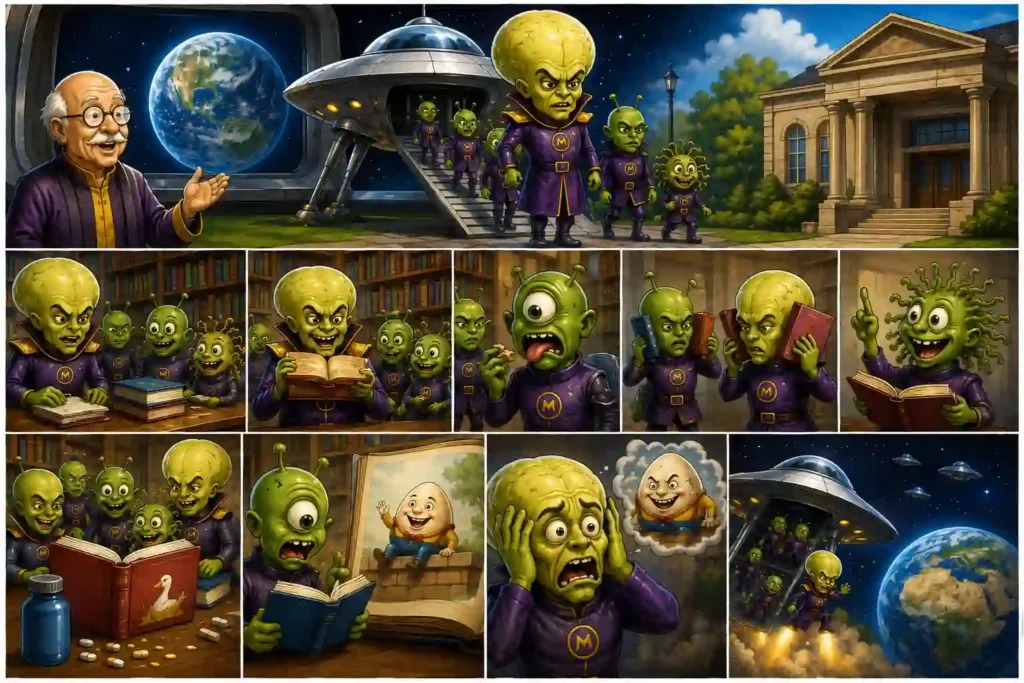
The Book That Saved the Earth is a humorous science-fiction play written by Claire Boiko. The story is narrated by a Historian in the twenty-fifth century from the Museum of Ancient History, where he recalls how Earth was saved from a Martian invasion during the twentieth century, known as the Era of the Book. The arrogant Mighty Think-Tank, who believes he is the most intelligent Martian because of his huge head, sends his team—Captain Omega, Lieutenant Iota, Sergeant Oop, and Apprentice Noodle—to Earth to learn about its people before conquering the planet. They land in the Centerville Public Library, where they find shelves full of books but fail to understand their purpose. Think-Tank first assumes the books are sandwiches and orders his crew to eat one, but Sergeant Oop tastes a corner and reports that it is inedible. Next, they think books are devices for communicating through the ears, but this idea also fails. Finally, Apprentice Noodle suggests that books are meant to be read with the eyes. After taking intelligence-boosting vitamin pills, the crew begins reading Mother Goose, a famous book of nursery rhymes. When Sergeant Oop reads the rhyme “Humpty Dumpty,” Think-Tank notices that the picture of Humpty resembles him and becomes convinced that the Earthlings already know about him and are planning to destroy him. Terrified by this misunderstanding, Think-Tank immediately cancels the invasion, orders all Martians to evacuate Mars, and flee to Alpha Centauri, leaving Earth completely safe. Thus, an ordinary children’s rhyme book, Mother Goose, unexpectedly saves the Earth from a Martian attack, showing that knowledge, books, and intelligence are more powerful than fear, pride, and ignorance.
3. Word meanings
| Word | Meaning |
| Invade | To enter a place by force to take control. |
| Era | A particular period of time. |
| Mighty | Very powerful or strong. |
| Acumen | Sharp intelligence and good judgment. |
| Generous | Kind and willing to give. |
| Crew | A group of people working together. |
| Exhibit | To show or display. |
| Apprentice | A learner or trainee. |
| Communication | The exchange of information. |
| Boost | To improve or increase. |
| Evacuate | To leave a place for safety. |
| Conquer | To take control of a place by force. |
| Arrogant | Having an exaggerated sense of one’s importance. |
| Wisdom | The ab |
4. NCERT Solutions
4A. Think about It
1. Noodle avoids offending Think-Tank but at the same time he corrects his mistakes. How does he manage to do that?
Ans: Noodle is a wise, polite, and intelligent assistant. He never directly tells Think-Tank that he is wrong because he knows that Think-Tank is proud and easily offended. Instead, he respectfully addresses him as “O Great and Mighty Think-Tank” and presents his ideas as suggestions rather than corrections. By speaking politely and carefully, Noodle helps Think-Tank realise his mistakes without hurting his ego. His patience, diplomacy, and presence of mind make him an effective adviser.
2. If you were in Noodle’s place, how would you handle Think-Tank’s mistakes?
Ans: If I were in Noodle’s place, I would remain calm, respectful, and patient while pointing out Think-Tank’s mistakes. Instead of criticising him directly, I would explain the facts with clear evidence and logical reasoning. I would encourage him to think carefully before making decisions and help him understand the correct information. This approach would maintain respect while preventing unnecessary misunderstandings.
3. Do you think books are being replaced by the electronic media? Can we do away with books altogether?
Ans: Electronic media has become a popular source of information because it is fast, convenient, and easily accessible. However, books continue to play an important role in education and personal development. Reading books improves concentration, imagination, vocabulary, and critical thinking in ways that electronic media often cannot. Therefore, although digital resources are useful, books cannot be completely replaced and will always remain valuable companions for learners.
4. Why are books referred to as a man’s best companion? Which is your favourite book and why? Write a paragraph about that book.
Ans: Books are called a man’s best companion because they provide knowledge, entertainment, inspiration, and guidance throughout life. They help us understand different cultures, improve our thinking, and develop good values. My favourite book is The Wings of Fire by A. P. J. Abdul Kalam. It is the inspiring autobiography of Dr. Kalam, which describes his humble beginnings, hard work, determination, and achievements. The book motivates readers to dream big, work honestly, and never give up despite difficulties. It teaches valuable lessons about perseverance, education, and service to the nation.
4B. Talk about It
1. In what ways does Think-Tank misinterpret innocent nursery rhymes as threats to the Martians? Can you think of any incidents where you misinterpreted a word or an action? How did you resolve the misunderstanding?
Ans: Think-Tank completely misunderstands the nursery rhymes in Mother Goose. When he sees the picture of Humpty Dumpty, he believes it resembles him and concludes that the Earthlings already know about the Martians. He also interprets the rhymes as secret messages and military plans against Mars. This misunderstanding fills him with fear and forces him to cancel the invasion of Earth. Similarly, I once misunderstood a friend’s short message and thought he was upset with me. Instead of making assumptions, I spoke to him directly and realised that he was simply busy. Honest communication helped us clear the misunderstanding.
2. The aliens in this play speak English. Do you think this is their language? What could be the language of the aliens?
Ans: The Martians speak English only because it makes the play easy for readers and audiences to understand. In reality, if intelligent aliens exist, they would probably have their own unique language based on sounds, symbols, gestures, or advanced methods of communication. Their language might even involve telepathy or digital signals instead of spoken words. Since no evidence of alien languages exists, we can only imagine what they might be like.
5. Extra Questions and Answers of the poem The Book That Saved the Earth
5A. Multiple Choice Questions (MCQs)
1. The events of the play are recalled from the ______ century.
a) Twentieth
b) Twenty-first
c) Twenty-fifth
d) Nineteenth
Ans: Twenty-fifth
2. Where is the Historian sitting while narrating the story?
a) A school
b) A museum
c) A library
d) A spaceship
Ans: A museum
3. The twentieth century is called the ________.
a) Era of Science
b) Era of the Machine
c) Era of the Book
d) Era of Space
Ans: Era of the Book
4. Who is the ruler of Mars?
a) Noodle
b) Sergeant Oop
c) Think-Tank
d) Captain Omega
Ans: Think-Tank
5. Why does Think-Tank consider himself the smartest Martian?
a) He has read many books.
b) He has a giant balloon-shaped head.
c) He is the oldest Martian.
d) He is the strongest Martian.
Ans: He has a giant balloon-shaped head.
6. What was the purpose of the Martians’ visit to Earth?
a) To make friends
b) To study Earth before invading it
c) To collect books
d) To visit museums
Ans: To study Earth before invading it.
7. Where do the Martians land on Earth?
a) A school
b) A railway station
c) Centerville Public Library
d) A park
Ans: Centerville Public Library
8. What do the Martians first think the books are?
a) Machines
b) Sandwiches
c) Weapons
d) Toys
Ans: Sandwiches
9. Who is ordered to taste the book?
a) Noodle
b) Captain Omega
c) Lieutenant Iota
d) Sergeant Oop
Ans: Sergeant Oop
10. Assertion (A): The Historian narrates the story from the twenty-fifth century.
Reason (R): He works in the Museum of Ancient History.
a) Both A and R are true, and R is the correct explanation of A.
b) Both A and R are true, but R is not the correct explanation of A.
c) A is true, but R is false.
d) A is false, but R is true.
Ans: b) Both A and R are true, but R is not the correct explanation of A.
11. Assertion (A): Think-Tank considered himself the greatest intelligence in the universe.
Reason (R): He was proud and overconfident.
a) Both A and R are true, and R is the correct explanation of A.
b) Both A and R are true, but R is not the correct explanation of A.
c) A is true, but R is false.
d) A is false, but R is true.
Ans: a) Both A and R are true, and R is the correct explanation of A.
12. Assertion (A): The Martians first believed that books were communication devices.
Reason (R): They had never seen books before.
a) Both A and R are true, and R is the correct explanation of A.
b) Both A and R are true, but R is not the correct explanation of A.
c) A is true, but R is false.
d) A is false, but R is true.
Ans: a) Both A and R are true, and R is the correct explanation of A.
13. Assertion (A): Think-Tank thought sandwiches were weapons.
Reason (R): He misunderstood everything he saw on Earth.
a) Both A and R are true, and R is the correct explanation of A.
b) Both A and R are true, but R is not the correct explanation of A.
c) A is true, but R is false.
d) A is false, but R is true.
Ans: a) Both A and R are true, and R is the correct explanation of A.
14. Assertion (A): The book Mother Goose saved the Earth.
Reason (R): Think-Tank misunderstood its nursery rhymes.
a) Both A and R are true, and R is the correct explanation of A.
b) Both A and R are true, but R is not the correct explanation of A.
c) A is true, but R is false.
d) A is false, but R is true.
Ans: a) Both A and R are true, and R is the correct explanation of A.
15. Assertion (A): Think-Tank was a wise and practical leader.
Reason (R): He made decisions after carefully examining facts.
a) Both A and R are true, and R is the correct explanation of A.
b) Both A and R are true, but R is not the correct explanation of A.
c) A is true, but R is false.
d) A is false, but R is true.
Ans: d) A is false, but R is true.
5B. Fill in the blanks
1. The play The Book That Saved the Earth was written by __________. (Claire Boiko)
2. The story is narrated by a __________. (Historian)
3. The Historian tells the story from the __________ century. (twenty-fifth)
4. The twentieth century was known as the __________. (Era of the Book)
5. Think-Tank was the mighty ruler of __________. (Mars)
6. Think-Tank believed he was the most __________ Martian. (intelligent)
7. The Martians landed at the __________ Public Library. (Centerville)
8. Mother Goose is a book of __________. (nursery rhymes)
9. The rhyme that frightened Think-Tank was __________. (Humpty Dumpty)
10. The Martians misunderstood the __________ meaning of the nursery rhymes. (literal)
11. The play ends with Earth being saved by a __________ book. (children’s)
12. Noodle was Think-Tank’s __________. (apprentice)
13. The play shows that __________ is more powerful than pride and ignorance. (knowledge)
5C. True and false
1. The Historian narrates the story from the twenty-fifth century. (True)
2. The Martians landed in a public library. (True)
3. Sergeant Oop enjoyed eating the book. (False)
4. The Martians first believed that books were sandwiches. (True)
5. Noodle suggested that books should be read with the eyes. (True)
6. The Martians used vitamin capsules to improve their intelligence. (True)
7. The book the Martians read was Mother Goose. (True)
8. Mo ther Goose is a science textbook. (False)
9. The nursery rhyme Humpty Dumpty frightened Think-Tank. (True)
10. Think-Tank believed that the Earthlings wanted to welcome the Martians. (False)
11. Think-Tank cancelled the invasion because he feared the Earthlings. (True)
12. The Martians decided to stay on Earth forever. (False)
5D. One-sentence questions and answers
1. Why is the play called The Book That Saved the Earth?
Ans: The play is called The Book That Saved the Earth because the nursery rhymes in Mother Goose frightened Think-Tank and prevented the Martians from invading Earth.
2. Why is the play considered humorous?
Ans: The play is humorous because the Martians repeatedly misunderstand books and nursery rhymes, creating funny situations through Think-Tank’s foolish assumptions.
3. Why did Think-Tank decide to postpone the invasion of Earth?
Ans: Think-Tank decided to postpone the invasion of Earth because he mistakenly believed that the Earthlings already knew about the Martians and were preparing to attack Mars.
4. Why did Think-Tank think that books were sandwiches?
Ans: Think-Tank thought that books were sandwiches because he believed that Earthlings were a primitive race whose main activity was eating.
5. What happened when Sergeant Oop tasted the book?
Ans: Sergeant Oop obeyed Think-Tank’s order, tasted the book, and reported that it was not good to eat.
6. How did Noodle help Think-Tank understand the purpose of books?
Ans: Noodle wisely suggested that books were meant for communication through the eyes, which helped Think-Tank order his crew to read them.
7. Why did the Martians take vitamin capsules?
Ans: The Martians took vitamin capsules because Think-Tank believed that they would make them intelligent enough to read the books.
8. Which book did the Martians read, and why was it important?
Ans: The Martians read Mother Goose, whose nursery rhymes frightened Think-Tank and unexpectedly saved the Earth from invasion.
9. Why did Think-Tank become frightened after reading “Humpty Dumpty”?
Ans: Think-Tank became frightened because he believed that the picture of Humpty Dumpty looked exactly like him and that the Earthlings knew all about Mars.
10. How did Mother Goose save the Earth?
Ans: Mother Goose saved the Earth because Think-Tank misunderstood its nursery rhymes and immediately cancelled his plan to invade Earth.
11. Describe the character of Noodle.
Ans: Noodle was Think-Tank’s intelligent, polite, and sensible apprentice whose wisdom and practical thinking helped the Martians understand the purpose of books.
12. Describe the character of Think-Tank.
Ans: Think-Tank was the proud, arrogant, and overconfident ruler of Mars whose foolish misunderstandings finally forced him to abandon his invasion of Earth.
13. Why does Think-Tank order the evacuation of Mars?
Ans: Think-Tank orders the evacuation of Mars because he wrongly believes that the nursery rhymes in Mother Goose prove that the Earthlings are preparing to attack Mars.
14. What qualities make Noodle a good adviser?
Ans: Noodle is a good adviser because he is intelligent, calm, polite, and wise, and he respectfully guides Think-Tank with practical and logical suggestions.
15. Why is the title suitable for the play?
Ans: The title The Book That Saved the Earth is suitable because the nursery rhyme book Mother Goose frightens Think-Tank into cancelling the Martian invasion and thus saves the Earth.
5E. Short Questions and Answers
1. Who was Think-Tank? Describe his personality.
Ans: Think-Tank was the mighty ruler of Mars and believed that he was the most intelligent being in the universe because of his large balloon-shaped head. He was proud, arrogant, and overconfident. He expected everyone to praise his intelligence and never accepted that he could be wrong. His habit of making quick assumptions without proper understanding led to several humorous mistakes. Although he appeared powerful, he became frightened very easily when he misunderstood the nursery rhymes, revealing that his confidence was based more on pride than on true wisdom.
2. Describe the character of Noodle.
Ans: Noodle is Think-Tank’s apprentice and is the wisest character in the play. He is intelligent, polite, patient, and respectful. Instead of directly correcting Think-Tank’s mistakes, he carefully presents his ideas as suggestions so that Think-Tank does not feel insulted. His calm behaviour and practical thinking help the Martians understand the purpose of books. Noodle’s wisdom stands in sharp contrast to Think-Tank’s arrogance and overconfidence. He proves that true intelligence lies in humility, observation, and logical reasoning rather than in boasting about one’s abilities.
3. Describe the character of Think-Tank.
Ans: Think-Tank is the mighty ruler of Mars and is known for his arrogance and excessive pride. He believes he is the smartest being in the universe simply because of his large head. He constantly expects praise from others and makes decisions without proper investigation. His wrong assumptions about books and nursery rhymes create humorous situations throughout the play. Although he appears confident and powerful, he quickly becomes frightened when he misunderstands Mother Goose. His character teaches that pride and ignorance often lead to foolish decisions.
4. Why is the play called The Book That Saved the Earth?
Ans: The play receives its title because an ordinary children’s book, Mother Goose, becomes the unexpected reason for saving Earth. When the Martians read its nursery rhymes, Think-Tank misunderstands their meaning and believes that the Earthlings have already discovered Mars and are planning to attack. Filled with fear, he immediately cancels his invasion plan and orders his crew to leave. Thus, instead of weapons or armies, a simple book saves the Earth, highlighting the importance of books, knowledge, and imagination.
5. Why is the play considered humorous?
Ans: The play is humorous because it is filled with funny misunderstandings and exaggerated situations. Think-Tank and his crew wrongly believe that books are sandwiches, communication devices, and secret military records. Their literal interpretation of nursery rhymes creates amusing confusion, especially when Think-Tank thinks Humpty Dumpty represents him. The characters’ strange behaviour, exaggerated confidence, and foolish conclusions make readers laugh while also teaching valuable lessons about knowledge, common sense, and the dangers of making assumptions without proper understanding.
6. Why did Think-Tank decide to postpone the invasion of Earth?
Ans: Think-Tank postponed the invasion because he became convinced that the Earthlings already knew everything about the Martians. After reading Mother Goose, he mistakenly believed that the nursery rhymes contained secret messages describing him and Mars. He feared that the Earthlings possessed superior intelligence and dangerous weapons. Thinking that an attack on Mars was about to begin, he ordered his crew to escape immediately. His fear and misunderstanding saved Earth from invasion without any battle taking place.
7. How did Sergeant Oop contribute to the story?
Ans: Sergeant Oop played an important role in the Martian mission because he carried out Think-Tank’s orders, even when they seemed foolish. He tasted the book when ordered and later became the first Martian to read Mother Goose. His reading of the nursery rhymes led Think-Tank to completely misunderstand their meaning. Although Sergeant Oop was obedient and sincere, his actions unintentionally caused Think-Tank’s fear and panic. As a result, his role indirectly helped save Earth from the planned invasion.
8. Why is Think-Tank called an arrogant leader?
Ans: Think-Tank is called an arrogant leader because he constantly believes that he is superior to everyone else. He expects his crew to praise his intelligence and never accepts the possibility that he might be wrong. Instead of carefully examining the books, he jumps to incorrect conclusions with complete confidence. His pride prevents him from thinking logically. Ironically, his arrogance leads him to misunderstand simple nursery rhymes and make foolish decisions that ultimately force him to abandon his mission.
9. What lesson does the play teach about books?
Ans: The play teaches that books are valuable sources of knowledge, wisdom, and imagination. Although the Martians fail to understand them, books possess the power to educate, entertain, and influence people’s thinking. Ironically, a simple nursery rhyme book becomes the reason why Earth escapes destruction. The story reminds readers that books should never be underestimated because they preserve knowledge and inspire learning. It encourages students to develop the habit of reading and appreciate the importance of literature in everyday life.
10. What role does the Historian play in the play?
Ans: The Historian acts as the narrator of the play and tells the audience about an important event from Earth’s past. Sitting in the Museum of Ancient History during the twenty-fifth century, he explains how Earth was once saved from a Martian invasion. His narration connects the past with the future and gives the story a historical perspective. Through his storytelling, readers learn that knowledge and books played a greater role in saving the planet than weapons or violence.
11. Why did the Martians fail in their mission?
Ans: The Martians failed in their mission because they misunderstood everything they observed on Earth. Instead of carefully studying books, they made incorrect assumptions based on imagination and pride. Think-Tank wrongly believed that books were sandwiches, then communication devices, and finally secret military records. His misunderstanding of the nursery rhymes filled him with unnecessary fear. As a result, he cancelled the invasion and ordered the Martians to flee, causing their mission to end in complete failure.
12. How does the play show the importance of common sense?
Ans: The play shows that common sense is more valuable than pride and false confidence. Think-Tank believes he is highly intelligent but repeatedly makes foolish decisions because he never examines facts carefully. On the other hand, Noodle uses observation, patience, and logical thinking to solve problems. His sensible suggestions gradually help the Martians understand the purpose of books. The contrast between these two characters teaches readers that true intelligence comes from practical reasoning rather than from boasting about one’s abilities.
13. Why does Think-Tank order the evacuation of Mars?
Ans: Think-Tank orders the evacuation of Mars because he wrongly believes that the Earthlings are preparing to attack the Martians. After reading Mother Goose, he thinks the nursery rhymes contain secret information about him and Mars. Feeling terrified, he concludes that Earth possesses superior intelligence and dangerous weapons. To save himself and his people, he orders everyone to leave Mars immediately and travel to Alpha Centauri. His fear, based entirely on misunderstanding, causes this dramatic decision.
14. Why is the title suitable for the play?
Ans: The title The Book That Saved the Earth is perfectly suitable because the entire story revolves around an ordinary book that unexpectedly prevents a Martian invasion. Think-Tank misunderstands the nursery rhymes in Mother Goose and becomes convinced that Earth is too powerful to attack. As a result, he abandons his mission and leaves peacefully. Since the book becomes the direct reason for Earth’s safety, the title accurately reflects the central event and message of the play.
15. What is the central idea of The Book That Saved the Earth?
Ans: The central idea of the play is that knowledge, wisdom, and books are more powerful than arrogance, ignorance, and violence. Through a series of humorous misunderstandings, the author shows how Think-Tank’s pride leads him to make foolish decisions. A simple nursery rhyme book becomes the reason for saving Earth from invasion. The play encourages readers to value books, think logically, remain humble, and avoid making judgments without proper understanding. These lessons make the story both entertaining and meaningful.
5F. Long Questions and Answers
1. Describe the character of Think-Tank. How does his personality influence the events of the play?
Ans: Think-Tank is the mighty ruler of Mars and one of the most memorable characters in The Book That Saved the Earth. He considers himself the most intelligent being in the universe simply because of his large balloon-shaped head. He is proud, arrogant, self-centred, and expects constant praise from his crew. Instead of examining facts carefully, he makes quick and foolish assumptions. He first mistakes books for sandwiches, then believes they are communication devices, and finally interprets nursery rhymes as secret messages about the Martians. His overconfidence prevents him from accepting logical explanations, while his ignorance leads to repeated mistakes. Ironically, despite his arrogance, he becomes frightened very easily when he thinks the Earthlings already know about him. This fear forces him to cancel the invasion and flee to Alpha Centauri. Through Think-Tank’s character, the author shows that pride without true wisdom leads to failure. His humorous mistakes also create the comic effect of the play and deliver the important message that knowledge, humility, and common sense are far more valuable than arrogance and false confidence.
2. Describe the role of Noodle in the play. Why is he considered wiser than Think-Tank?
Ans: Noodle is Think-Tank’s apprentice and the wisest character in the play. Although he serves the mighty ruler of Mars, he remains humble, polite, and practical. Unlike Think-Tank, Noodle never boasts about his intelligence. Instead, he carefully observes situations and offers thoughtful suggestions without hurting Think-Tank’s feelings. He politely proposes that books may be used for communication through the eyes, which eventually helps the Martians begin reading. Even while correcting Think-Tank’s mistakes, he uses respectful language so that his master does not feel insulted. Noodle’s calm behaviour, patience, and logical thinking stand in complete contrast to Think-Tank’s pride and overconfidence. He understands that true intelligence comes from observation, reasoning, and humility rather than self-praise. Although Think-Tank is the ruler, it is Noodle who repeatedly guides the mission in the right direction. Through his character, the author emphasises that wisdom is measured by good judgment, respect for others, and the ability to think clearly in difficult situations.
3. How does Mother Goose save the Earth from the Martian invasion? Explain.
Ans: Mother Goose, a simple collection of nursery rhymes, unexpectedly becomes the reason why Earth is saved from a Martian invasion. When Think-Tank and his crew enter the Centerville Public Library, they fail to understand the purpose of books. After several funny misunderstandings, they finally begin reading Mother Goose. However, instead of understanding the rhymes correctly, they interpret every line literally. When Sergeant Oop reads the rhyme “Humpty Dumpty,” Think-Tank notices that the picture resembles his own large head. He immediately concludes that the Earthlings already know about him and are secretly planning to attack Mars. Believing that humans possess superior intelligence and dangerous weapons, he becomes terrified and orders the Martians to abandon their invasion plans. He even commands everyone to evacuate Mars and move to Alpha Centauri. Thus, an ordinary children’s book becomes the unexpected hero of the story. The incident highlights the importance of books, imagination, and knowledge while showing how ignorance and misunderstanding can completely change the course of events.
4. Explain how humour is created in The Book That Saved the Earth.
Ans: Humour is one of the most important features of The Book That Saved the Earth. The author creates comedy mainly through the Martians’ misunderstandings and Think-Tank’s exaggerated confidence. The funniest situations arise when Think-Tank confidently declares that books are sandwiches and orders Sergeant Oop to eat one. Later, the Martians believe books are communication devices for the ears before finally deciding they should be read with the eyes. The greatest comic moment occurs when Think-Tank mistakes the nursery rhyme “Humpty Dumpty” as secret information about himself. His fear and panic become amusing because readers know that the rhymes are harmless children’s poems. The contrast between what the audience knows and what Think-Tank believes creates dramatic irony. The unusual names of the Martian characters and their strange behaviour also add to the comedy. Through humour, the author effectively teaches readers that arrogance, ignorance, and hasty conclusions often lead to embarrassing mistakes, while wisdom and knowledge lead to better understanding.
5. What lessons does The Book That Saved the Earth teach the readers?
Ans: The Book That Saved the Earth teaches several valuable lessons through its humorous science-fiction story. The most important lesson is that books are powerful sources of knowledge, wisdom, and imagination. A simple nursery rhyme book becomes the reason why Earth escapes destruction, showing that knowledge can achieve what weapons cannot. The play also warns against pride and overconfidence through Think-Tank’s character. His arrogance prevents him from thinking logically and leads him to make foolish decisions. In contrast, Noodle demonstrates that true intelligence comes from patience, humility, and careful observation. The story also encourages readers not to judge anything without proper understanding, as wrong assumptions often create unnecessary fear and confusion. Finally, the peaceful ending suggests that wisdom and understanding are better solutions than war and violence. Overall, the play inspires students to value books, remain humble, think critically, and use common sense in everyday life while appreciating the importance of learning and imagination.
6. Give a detailed account of the Martians’ visit to Earth.
Ans: Think-Tank, the mighty ruler of Mars, sends Captain Omega, Lieutenant Iota, Sergeant Oop, and Apprentice Noodle to Earth to collect information before invading the planet. They land in the Centerville Public Library and are surprised to find shelves filled with books. Since they have never seen books before, they make several incorrect guesses about them. Think-Tank first believes the books are sandwiches and orders Sergeant Oop to taste one. When that idea fails, they think the books are communication devices. Finally, Noodle suggests that books should be read with the eyes. After taking vitamin capsules, Sergeant Oop reads Mother Goose, but the Martians misunderstand the nursery rhymes. Think-Tank believes the Earthlings know everything about Mars and are planning an attack. Terrified, he cancels the invasion and orders the Martians to leave immediately. Thus, their mission ends in complete failure, and Earth is saved without any conflict.
7. Compare the characters of Think-Tank and Noodle.
Ans: Think-Tank and Noodle have completely opposite personalities. Think-Tank is proud, arrogant, and overconfident. He believes he is the most intelligent being in the universe and makes decisions without examining facts. His false confidence causes him to mistake books for sandwiches and nursery rhymes for secret military messages. On the other hand, Noodle is humble, wise, polite, and practical. He carefully studies every situation before giving advice. Instead of openly disagreeing with Think-Tank, he respectfully offers suggestions that gradually lead to the correct understanding. Think-Tank depends on pride, while Noodle depends on logic and observation. Ironically, although Think-Tank is the ruler, Noodle proves to be the truly intelligent character. Their contrast teaches that wisdom comes from humility, patience, and common sense rather than from power, appearance, or self-praise.
8. How does the play highlight the importance of books?
Ans: The play strongly emphasises the importance of books by making them the unexpected heroes of the story. The Martians cannot understand the purpose of books because they have never seen them before. They wrongly believe that books are food, communication devices, and secret military records. However, a simple nursery rhyme book, Mother Goose, ultimately saves Earth from destruction. Think-Tank’s misunderstanding of the rhymes convinces him that Earthlings are more powerful than the Martians. As a result, he abandons his invasion plan. Through this humorous incident, the author shows that books are not ordinary objects but valuable sources of knowledge, imagination, and learning. They preserve ideas, educate people, and influence history. The play encourages readers to develop a love for reading and appreciate the lasting value of literature.
9. Explain the significance of the title The Book That Saved the Earth.
Ans: The title The Book That Saved the Earth is meaningful because it reflects the central incident of the play. The Martians arrive on Earth intending to invade it, but everything changes after they begin reading Mother Goose. Think-Tank wrongly believes that the nursery rhymes describe him and contain secret military information about Mars. Filled with fear, he immediately cancels the invasion and orders all Martians to flee. Thus, an ordinary children’s rhyme book becomes the reason why Earth remains safe. The title also symbolises the power of knowledge over violence. Instead of armies or advanced weapons, it is a simple book that prevents war. The title reminds readers that books possess the ability to educate, inspire, and even change history through knowledge and imagination.
10. What qualities of Noodle make him an ideal assistant?
Ans: Noodle possesses several qualities that make him an ideal assistant. He is intelligent, respectful, patient, and practical. Unlike Think-Tank, he carefully observes situations before offering advice. He never argues with his master or openly points out his mistakes. Instead, he politely suggests better ideas that help solve problems without hurting Think-Tank’s pride. His calm behaviour allows him to think clearly even in confusing situations. He also values logic over assumptions and remains humble despite his intelligence. Through Noodle’s character, the author shows that good leadership requires wise advisers who combine knowledge with politeness, patience, and common sense.
Related Links
- Class 10 History Chapter 5: Print Culture and the Modern World Q&A
- Class 10 History Chapter 4: The Age of Industrialization Q&A
- Class 10 History Chapter 3: The Making of a Global World Q&A
- CBSE Class 10 History Chapter 2 Nationalism in India Questions and Answers
- CBSE 10 History Event and Processes Questions and Answers
- CBSE 10 Economics Consumer Rights Questions and Answers
- CBSE 10 Economics Globalisation and the Indian Economy Questions and Answers
- CBSE 10 Economics Money and Credit Questions and Answers
- CBSE 10 Economics Sectors of the Indian Economy Questions and Answers
- CBSE 10 Economics Development Questions and Answers