
Class 10 History Chapter 4 | The Age of Industrialization Important Questions and Answers
Content Structure
- 1. NCERT Solutions
- 1A. Write in Brief
- 1B. Discuss
- 2. Extra Questions and Answers
- 2A. Multiple Choice Questions (MCQs)
- 2B. Very Short Type Questions and Answers
- 2C. Short Answer-type Questions
- 2D. Case/Source-based Questions and Answers
- 2E. Long Questions and Answers
1. NCERT Solutions
1A. Write in Brief
a) Women workers in Britain attacked the Spinning Jenny.
Ans: Women workers attacked the Spinning Jenny because it reduced the demand for hand spinning. The machine could spin many threads at the same time, so fewer workers were needed. Women feared losing their jobs and income. Since many women depended on hand spinning for their livelihood, they saw the machine as a threat to their employment. Therefore, they protested against the Spinning Jenny.
b) In the seventeenth century merchants from towns in Europe began employing peasants and artisans within the villages.
Ans: Merchants began employing peasants and artisans in villages because town guilds controlled production and trade. These restrictions made it difficult for merchants to expand their production in towns. Villages provided cheap labour and enough space for production. Peasants and artisans also needed extra income. Therefore, merchants supplied raw materials to rural families and collected finished goods for sale in international markets.
c) The port of Surat declined by the end of the eighteenth century.
Ans: The port of Surat declined because European trading companies gradually gained control over trade and reduced the importance of traditional trading routes. The East India Company developed new ports such as Bombay and Calcutta. Trade through Surat decreased, and its merchants and shipowners faced growing difficulties. As a result, the volume of trade through Surat declined sharply by the end of the eighteenth century.
d) The East India Company appointed gomasthas to supervise weavers in India.
Ans: The East India Company appointed gomasthas to supervise weavers, collect textile supplies, and check the quality of cloth. They gave advances to weavers and forced them to sell their finished goods to the Company at fixed prices. The gomasthas also prevented weavers from dealing with other buyers. In this way, the Company controlled textile production and ensured a regular supply of cotton and silk cloth.
2. Write True or False against each statement:
Ans:
| Statement | Answer |
| a) At the end of the nineteenth century, 80 per cent of the total workforce in Europe was employed in the technologically advanced industrial sector. | False |
| b) The international market for fine textiles was dominated by India till the eighteenth century. | True |
| c) The American Civil War resulted in the reduction of cotton exports from India. | False |
| d) The introduction of the fly shuttle enabled handloom workers to improve their productivity. | True |
3. Explain what is meant by proto-industrialisation.
Ans: Proto-industrialisation refers to the period before factories became common, when merchants produced goods for the international market by employing peasants and artisans in villages. They supplied raw materials to rural workers and collected the finished goods for sale. This system helped prepare the way for the rise of modern industries.
1B. Discuss
1. Why did some industrialists in nineteenth-century Europe prefer hand labour over machines?
Ans: Some industrialists in nineteenth-century Europe preferred hand labour over machines for several reasons. First, human labour was easily available and cheap because many people were looking for jobs. Second, machines were expensive to buy, install, and maintain. Small industrialists could not always afford them. Third, some industries produced goods according to the special needs of customers. Skilled workers could make different designs and shapes more easily than machines. In some industries, production was seasonal, so employers preferred to hire workers only when demand increased. Hand labour also allowed industrialists to produce different types of goods according to market requirements. Although machines increased production, they were not suitable or affordable for every industry. Therefore, many industrialists continued to use hand labour because it was flexible, economical, and useful for producing specialised goods.
2. How did the East India Company procure regular supplies of cotton and silk textiles from Indian weavers?
Ans: The East India Company appointed paid servants called gomasthas to supervise Indian weavers and collect regular supplies of cotton and silk textiles. The Company gave advances to weavers so that they could buy raw materials and produce cloth. After receiving the advance, weavers had to hand over the finished goods to the Company at fixed prices. The gomasthas closely monitored the weavers and ensured that they followed the Company’s instructions. The Company also prevented weavers from selling their cloth to other traders. Earlier, weavers had dealt with different buyers, but the Company’s control reduced their freedom. The gomasthas sometimes treated weavers harshly and used pressure to obtain the required textiles. In this way, the East India Company established control over textile production and ensured a regular supply of cotton and silk goods for its trade.
3. Imagine that you have been asked to write an article for an encyclopaedia on Britain and the history of cotton. Write your piece using information from the entire chapter.
Ans: Britain and the History of Cotton
The cotton industry played an important role in the industrialisation of Britain. During the eighteenth century, new inventions such as the spinning jenny and the power loom increased cotton production. Factories used machines and steam power to produce cloth on a large scale. Britain imported raw cotton from different countries, including India, and sold machine-made textiles in international markets. The growth of British cotton industries affected Indian weavers, who faced competition from cheaper British goods. During the nineteenth century, factories expanded, and cotton became one of Britain’s major industries. However, industrialisation did not completely replace hand labour, as some goods required skilled workers. The First World War changed production and trade patterns. The history of cotton shows how machines, factories, trade, and colonial policies influenced industrial development in Britain and other parts of the world.
4. Why did industrial production in India increase during the First World War?
Ans: Industrial production in India increased during the First World War because British factories were busy producing goods for the war. As a result, imports from Britain decreased, and Indian factories received more opportunities to supply goods to the local market. Indian industries were asked to produce uniforms, jute bags, cloth, and other materials needed by the army. Existing factories increased their working hours and production, while new factories were also established. The demand for industrial products grew during the war years. The reduction in imported goods allowed Indian manufacturers to face less competition from British products in some markets. More workers were employed in factories, and industrial production expanded. The war therefore created new opportunities for Indian industries and encouraged their growth. However, this increase was strongly connected to wartime demand and did not remove all the challenges faced by Indian industrialists and workers.
2. Extra Questions and Answers
2A. Multiple Choice Questions (MCQs)
1. The term “industrialisation” refers to:
a) The decline of agriculture
b) The growth of industries and machine-based production
c) The end of international trade
d) The replacement of cities by villages
Ans: b) The growth of industries and machine-based production
2. Who invented the Spinning Jenny?
a) James Watt
b) Richard Arkwright
c) James Hargreaves
d) Samuel Crompton
Ans: c) James Hargreaves
3. The Spinning Jenny was invented in:
a) 1733
b) 1764
c) 1781
d) 1854
Ans: b) 1764
4. Who invented the fly shuttle?
a) John Kay
b) James Hargreaves
c) Richard Arkwright
d) James Watt
Ans: a) John Kay
5. The fly shuttle was invented in:
a) 1733
b) 1764
c) 1781
d) 1850
Ans: a) 1733
6. Who developed the water frame?
a) Samuel Crompton
b) Richard Arkwright
c) James Hargreaves
d) John Kay
Ans: b) Richard Arkwright
7. Who invented the spinning mule?
a) Samuel Crompton
b) James Watt
c) Richard Arkwright
d) John Kay
Ans: a) Samuel Crompton
8. Which industry was the first symbol of the new industrial age in Britain?
a) Iron and steel
b) Cotton
c) Shipbuilding
d) Chemical
Ans: b) Cotton
9. What was the main source of power for many early factories?
a) Solar energy
b) Water and steam power
c) Wind turbines
d) Electricity only
Ans: b) Water and steam power
10. Which invention improved the production of iron and steel?
a) Steam engine
b) Spinning Jenny
c) Fly shuttle
d) Telegraph
Ans: a) Steam engine
11. Who improved the steam engine and made it more useful for industrial production?
a) James Watt
b) James Hargreaves
c) John Kay
d) Samuel Crompton
Ans: a) James Watt
12. What was the main reason for the growth of factories in Britain?
a) The decline of trade
b) The availability of machines, capital, and growing demand for goods
c) The end of cotton production
d) The shortage of workers
Ans: b) The availability of machines, capital, and growing demand for goods
13. Which country was famous for producing fine cotton and silk textiles before industrialisation?
a) India
b) Russia
c) Australia
d) Canada
Ans: a) India
14. Which European trading company established control over Indian textile production?
a) Dutch East India Company
b) East India Company
c) French Trading Company
d) British Textile Association
Ans: b) East India Company
15. Which port became more important as the importance of Surat declined?
a) Bombay
b) Masulipatnam
c) Hooghly
d) Cochin
Ans: a) Bombay
16. Which country dominated the international market for fine textiles until the eighteenth century?
a) Britain
b) India
c) Germany
d) Japan
Ans: b) India
17. What happened to cotton exports from India during the American Civil War?
a) They declined sharply
b) They increased because Britain needed more raw cotton
c) They stopped permanently
d) They were replaced by silk
Ans: b) They increased because Britain needed more raw cotton
18. Which Indian industrialist established a successful cotton mill in Bombay?
a) Dwarkanath Tagore
b) J.N. Tata
c) Jamsetji Tata
d) Seth Hukumchand
Ans: c) Jamsetji Tata
19. The first cotton mill in Bombay was established in:
a) 1854
b) 1874
c) 1905
d) 1914
Ans: a) 1854
20. Which industry grew rapidly in Bengal during the nineteenth century?
a) Jute industry
b) Automobile industry
c) Aircraft industry
d) Computer industry
Ans: a) Jute industry
21. Who set up the first Indian jute mill in Calcutta?
a) Seth Hukumchand
b) Jamsetji Tata
c) Dwarkanath Tagore
d) James Watt
Ans: a) Seth Hukumchand
22. Which industry became an important source of employment in India during the early twentieth century?
a) Cotton textiles
b) Space technology
c) Aircraft manufacturing
d) Computer software
Ans: a) Cotton textiles
23. Assertion (A): Industrialists in nineteenth-century Europe did not always prefer machines.
Reason (R): Hand labour was useful for specialised products and seasonal production.
a) Both A and R are true, and R is the correct explanation of A.
b) Both A and R are true, but R is not the correct explanation of A.
c) A is true, but R is false.
d) A is false, but R is true.
Ans: a) Both A and R are true, and R is the correct explanation of A.
24. Assertion (A): Proto-industrialisation developed before the rise of factories.
Reason (R): Merchants organised production by employing peasants and artisans in villages.
a) Both A and R are true, and R is the correct explanation of A.
b) Both A and R are true, but R is not the correct explanation of A.
c) A is true, but R is false.
d) A is false, but R is true.
Ans: a) Both A and R are true, and R is the correct explanation of A.
25. Assertion (A): The fly shuttle improved the productivity of handloom workers.
Reason (R): It allowed the weaver to operate the shuttle quickly and increased the speed of weaving.
a) Both A and R are true, and R is the correct explanation of A.
b) Both A and R are true, but R is not the correct explanation of A.
c) A is true, but R is false.
d) A is false, but R is true.
Ans: a) Both A and R are true, and R is the correct explanation of A.
26. Assertion (A): Indian industrial production increased during the First World War.
Reason (R): British factories were busy producing war supplies, so imports of British goods into India declined.
a) Both A and R are true, and R is the correct explanation of A.
b) Both A and R are true, but R is not the correct explanation of A.
c) A is true, but R is false.
d) A is false, but R is true.
Ans: a) Both A and R are true, and R is the correct explanation of A.
27. Assertion (A): Handloom weaving completely disappeared in India after the arrival of British machine-made cloth.
Reason (R): Some handloom weavers continued producing specialised goods and fine designs.
a) Both A and R are true, and R is the correct explanation of A.
b) Both A and R are true, but R is not the correct explanation of A.
c) A is true, but R is false.
d) A is false, but R is true.
Ans: d) A is false, but R is true.
28. Which of the following correctly differentiates proto-industrialisation from factory production?
| Proto-industrialisation | Factory production |
| a) Production in villages through households | Production in large factories |
| b) Production only by machines | Production only by peasants |
| c) No role of merchants | No use of capital |
| d) Production only for local use | Production without workers |
Ans: a) Production in villages through households | Production in large factories
29. Which of the following correctly differentiates gomasthas from weavers?
a) Gomasthas supervised production; weavers produced cloth.
b) Gomasthas produced raw cotton; weavers collected taxes.
c) Gomasthas were merchants; weavers were factory owners.
d) Both performed exactly the same work.
Ans: a) Gomasthas supervised production; weavers produced cloth.
Read the passage and answer Questions 56–60.
Before factories became common, merchants in Europe often organised production in villages. They supplied raw materials to peasants and artisans and collected the finished goods. This system helped merchants produce goods for the growing international market. It was known as proto-industrialisation. Later, machines and factories changed the scale and speed of production.
30. The system described in the passage is called:
a) Industrial capitalism
b) Proto-industrialisation
c) Commercial farming
d) Plantation production
Ans: b) Proto-industrialisation
31. Why did merchants organise production in villages?
a) To avoid urban guild restrictions and obtain labour
b) To stop international trade
c) To reduce the supply of raw materials
d) To close all workshops
Ans: a) To avoid urban guild restrictions and obtain labour
32. Who mainly worked in this system?
a) Peasants and artisans
b) Only factory managers
c) Only government officials
d) Only soldiers
Ans: a) Peasants and artisans
33. What did merchants provide to rural workers?
a) Raw materials
b) Railway tickets
c) Factory buildings only
d) Land revenue
Ans: a) Raw materials
34. What was one major result of proto-industrialisation?
a) It helped prepare the way for the rise of modern industries.
b) It ended all international trade.
c) It stopped the use of hand labour.
d) It destroyed all village production.
Ans: a) It helped prepare the way for the rise of modern industries.
2B. Very Short Type Questions and Answers
1. What is proto-industrialisation?
Ans: Proto-industrialisation was the system of production before factories became common. Merchants supplied raw materials to peasants and artisans in villages and collected the finished goods for sale in international markets.
2. Who invented the fly shuttle? What was its advantage?
Ans: John Kay invented the fly shuttle in 1733. It helped handloom workers increase the speed of weaving and produce more cloth in less time. It improved the productivity of traditional weavers.
3. Why did women workers attack the Spinning Jenny?
Ans: Women workers attacked the Spinning Jenny because they feared that the machine would reduce the demand for hand spinning. They believed that machines would take away their jobs and make them unemployed.
4. Who invented the spinning mule?
Ans: Samuel Crompton invented the spinning mule. It combined the advantages of the Spinning Jenny and the water frame and produced stronger and finer cotton yarn.
5. Who improved the steam engine?
Ans: James Watt improved the steam engine. His improvements made steam power more useful for industrial production and helped factories operate machines more efficiently.
6. Why did merchants employ peasants and artisans in villages?
Ans: Merchants employed peasants and artisans in villages because urban guilds imposed restrictions on production and trade. Villages provided labour, and rural workers could produce goods for merchants who sold them in wider markets.
7. Why was cotton important in the Industrial Revolution?
Ans: Cotton became important because its production increased rapidly with the use of machines and factories. Cotton textiles were produced in large quantities, became cheaper, and were sold in domestic and international markets.
8. Name two famous Indian textiles.
Ans: Muslin and calico were two famous Indian textiles. Muslin was a fine cotton cloth, while calico was a type of cotton textile associated with Calicut on the Malabar Coast.
9. What was calico?
Ans: Calico was a type of cotton textile originally associated with Calicut on the Malabar Coast. It became popular in international markets because of its quality and attractive designs.
10. Why did the East India Company appoint gomasthas?
Ans: The Company appointed gomasthas to establish direct control over weavers and ensure regular supplies of cotton and silk textiles. They supervised production, collected cloth, and checked its quality.
11. How did the East India Company control Indian weavers?
Ans: The Company gave advances to weavers to buy raw materials. In return, weavers had to produce cloth for the Company and sell it at fixed prices. They were not free to sell to other buyers.
12. What was the effect of the Company’s control on weavers?
Ans: The Company’s control reduced the independence of weavers. They received low prices, faced harsh treatment by gomasthas, and were forced to work according to the Company’s conditions.
13. Name two important ports that grew under British control.
Ans: Bombay and Calcutta became important ports under British control. They developed as major centres of trade and connected India with international markets.
14. Why did Indian weavers lose their traditional markets?
Ans: Indian weavers lost their traditional markets because British machine-made cotton goods entered India and other markets. These cheaper goods created strong competition and reduced the demand for Indian handloom cloth.
15. What was the American Civil War?
Ans: The American Civil War was fought in the United States from 1861 to 1865. It disrupted the supply of American cotton to Britain and increased the demand for cotton from other countries.
16. Why did cotton prices rise during the American Civil War?
Ans: Cotton prices rose because the supply of American cotton to Britain was disrupted. As the demand for cotton remained high, Indian cotton became more valuable in the international market.
17. When was the first cotton mill established in Bombay?
Ans: The first cotton mill in Bombay was established in 1854. It marked an important beginning in the growth of modern cotton industries in India.
18. Which industry grew rapidly in Bengal during the nineteenth century?
Ans: The jute industry grew rapidly in Bengal during the nineteenth century. Bengal became an important centre of jute production because of the availability of raw materials and suitable transport facilities.
19. Name two goods supplied by Indian factories during the First World War.
Ans: Indian factories supplied jute bags and cloth for army uniforms during the First World War. They also produced tents and other goods needed for war supplies.
20. Why did handloom weaving survive in India?
Ans: Handloom weaving survived because weavers produced specialised goods and fine designs that machines could not easily make. Some customers preferred handmade textiles for their quality, beauty, and traditional workmanship.
21. Why did manufacturers use images of gods and goddesses in advertisements?
Ans: Indian manufacturers used images of gods and goddesses to make their products familiar and acceptable to Indian consumers. Such images also helped connect products with Indian culture and traditions.
22. What was the importance of the Swadeshi movement for Indian industries?
Ans: The Swadeshi movement encouraged people to use Indian-made goods and boycott foreign products. This increased support for Indian industries and helped create demand for locally produced goods.
23. What was the importance of the international market for Indian textiles?
Ans: The international market was important because Indian cotton and silk textiles were in high demand in Europe, Asia, and other regions. Indian weavers earned income by producing fine cloth, while merchants and trading companies gained profits from its export.
24. Why did the East India Company want to eliminate the existing traders and brokers?
Ans: The Company wanted direct control over the weavers and the textile trade. Existing traders and brokers could bargain with weavers and supply cloth to different buyers. By removing them, the Company could control production, prices, and the regular supply of textiles.
25. Why did Indian manufacturers use advertisements to promote their products?
Ans: Indian manufacturers used advertisements to create demand for their goods and compete with imported products. Advertisements presented Indian-made goods as desirable and connected them with Indian culture, traditions, and national pride.
2C. Short Answer-type Questions
1. Explain the main features of proto-industrialisation.
Ans: Proto-industrialisation was the system of production before factories became common. Merchants supplied raw materials to peasants and artisans living in villages. These workers produced goods at home, while merchants collected and sold them in international markets. This system helped merchants expand production beyond towns and prepared the way for the rise of modern industries.
2. How did the Industrial Revolution change the production of cotton textiles in Britain?
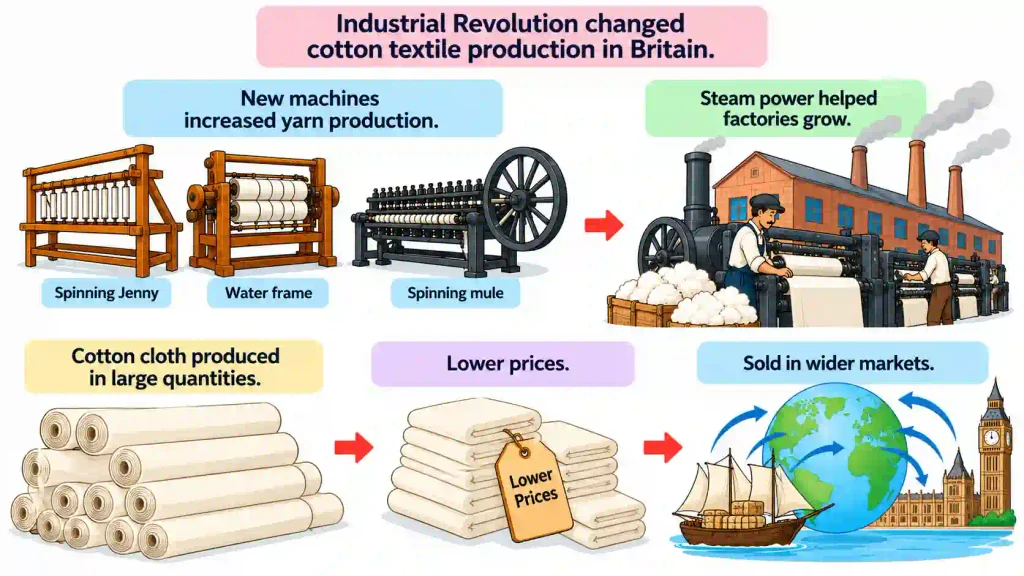
Ans: The Industrial Revolution changed cotton production through new machines and factories. Inventions such as the Spinning Jenny, water frame, and spinning mule increased the production of yarn. The use of steam power also helped factories grow. Cotton cloth could now be produced in large quantities, at lower prices, and sold in wider markets.
3. Describe the importance of inventions in the textile industry.
Ans: Inventions greatly improved the speed and quantity of textile production. The fly shuttle increased weaving speed, while the Spinning Jenny allowed one worker to spin several threads. The water frame and spinning mule improved yarn production. These inventions reduced production time and helped the textile industry develop into a major modern industry.
4. Why was Britain considered the centre of the Industrial Revolution?
Ans: Britain became the centre of the Industrial Revolution because it had capital, natural resources, skilled workers, and growing markets. It developed important industries such as cotton and iron. New inventions, steam power, and improved transport helped production grow. Britain’s merchants and industrialists also invested money in factories and international trade.
5. Explain the role of technology in the development of the iron and steel industry.
Ans: Technology helped the iron and steel industry grow by improving production methods and increasing output. The use of coal, steam power, and new machines made it possible to produce iron on a larger scale. Iron was needed for machines, tools, railways, and buildings. Thus, technological development supported the growth of modern industries.
6. What were the effects of British policies on Indian weavers?
Ans: British policies caused serious difficulties for Indian weavers. They lost their freedom to sell cloth to different buyers and were forced to work under the Company’s conditions. They often received low prices and faced harsh treatment by gomasthas. Later, British machine-made cloth entered Indian markets, reducing the demand for Indian handloom textiles.
7. Why did Indian textiles lose their international markets in the nineteenth century?
Ans: Indian textiles lost many international markets because British machine-made cotton goods became cheaper and were exported in large quantities. British policies also restricted Indian textile production and trade. Indian weavers faced competition from imported cloth and declining demand. As a result, many traditional textile producers lost their markets and sources of income.
8. Describe the growth of modern industries in India before the First World War.
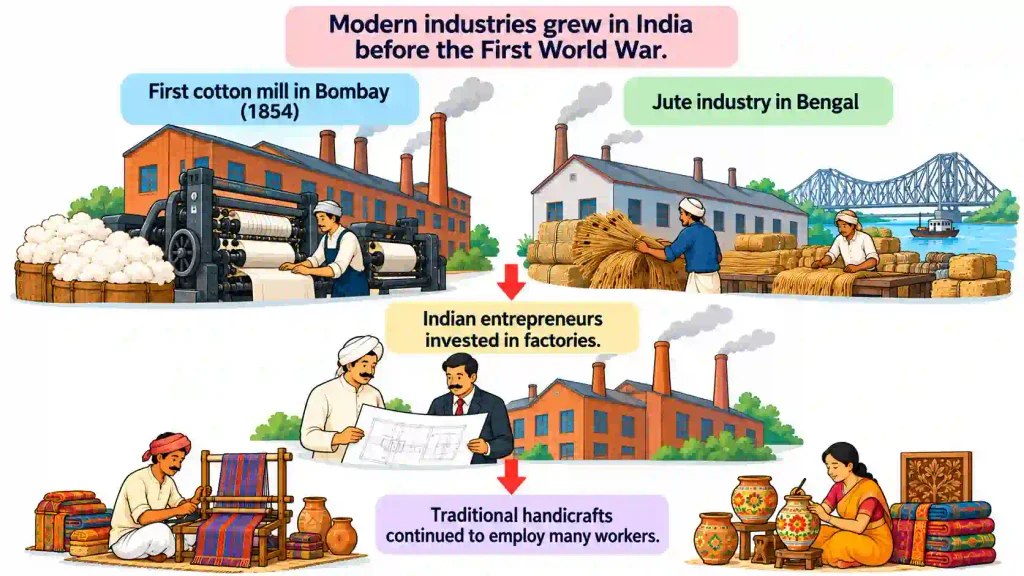
Ans: Modern industries began to grow in India during the nineteenth century. The first cotton mill was established in Bombay in 1854, and the jute industry developed in Bengal. Indian entrepreneurs invested in factories and production. However, industrial growth was limited, and traditional handicrafts continued to employ many workers across the country.
9. How did the First World War affect Indian industrial production?
Ans: The First World War increased industrial production in India. British factories were busy producing war supplies, so imports of British goods declined. Indian factories received orders for jute bags, cloth for army uniforms, tents, and other materials. Existing factories worked longer hours, new workers were employed, and new factories were established.
10. How did advertisements help in the growth of industrialisation?
Ans: Advertisements helped manufacturers create demand for their products and attract buyers. They made goods appear desirable and encouraged people to purchase them. Indian manufacturers often used images of gods, goddesses, and national symbols to connect products with Indian culture. Advertisements therefore helped promote manufactured goods and expand markets.
11. Explain the importance of the Swadeshi movement for Indian industries.
Ans: The Swadeshi movement encouraged people to use Indian-made goods and boycott foreign products. It created greater demand for Indian textiles and other manufactured goods. The movement also promoted national pride and supported Indian entrepreneurs. In this way, it helped Indian industries gain public support and encouraged the growth of local production.
12. Explain the relationship between industrialisation and the growth of cities.
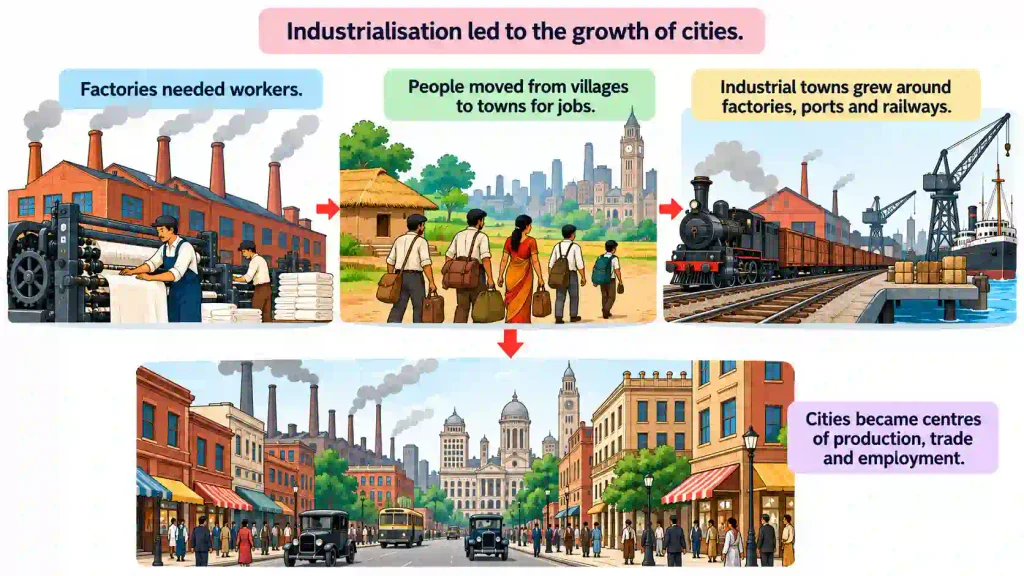
Ans: Industrialisation encouraged the growth of cities because factories needed workers, transport, and markets. People migrated from villages to towns in search of employment. Industrial towns developed around factories, ports, and railway centres. As industries expanded, cities became important centres of production, trade, and employment.
13. Explain how the growth of factories affected workers.
Ans: The growth of factories created employment opportunities, but workers often faced difficult conditions. They worked for long hours and received low wages. Employment was sometimes uncertain, especially when demand was seasonal. Women and children also worked in factories. Despite these difficulties, factories attracted many people seeking jobs and a regular income.
14. Why did merchants move production to the countryside?
Ans: Merchants moved production to the countryside because urban guilds controlled production and did not allow easy entry to new producers. In villages, merchants could easily employ peasants and artisans and increase production for wider markets.
15. Why did women workers oppose the Spinning Jenny?
Ans: Women were mainly employed in spinning work. They feared that the Spinning Jenny would allow one worker to do the work of many people. As a result, they believed that the machine would take away their jobs and opposed it.
16. What was the importance of the steam engine in industrialisation?
Ans: The steam engine provided a powerful and steady source of energy for industries. It helped factories operate machines on a large scale. James Watt improved the steam engine, making it more useful for industrial production.
17. Why was cotton important during the early Industrial Revolution?
Ans: Cotton became the first major symbol of the Industrial Revolution because its production increased rapidly. New machines improved spinning and weaving, while cotton cloth was cheap, comfortable, and widely demanded in different markets.
2D. Case/Source-based Questions and Answers
Case/Source 1: Proto-Industrialisation
Read the source carefully and answer the questions that follow:
Before factories appeared, there was large-scale production for an international market. This system was known as proto-industrialisation. Merchants supplied money and raw materials to peasants and artisans living in villages. The finished goods were collected by merchants and sold in wider markets. This system helped merchants increase production without setting up factories.
1. What is meant by proto-industrialisation?
Ans: Proto-industrialisation refers to the system of large-scale production that existed before the establishment of factories. Under this system, merchants supplied raw materials and money to peasants and artisans living in villages. These workers produced goods in their homes, and merchants collected the finished products. The goods were then sold in local, national, and international markets. Thus, proto-industrialisation connected rural workers with wider markets.
2. Why did merchants employ peasants and artisans in villages?
Ans: Merchants employed peasants and artisans in villages because urban guilds controlled production and restricted the entry of new producers. It was difficult for merchants to expand production freely in towns. The countryside provided a large number of workers who were willing to work for additional income. By employing rural workers, merchants could increase production and meet the growing demand for goods in national and international markets.
3. How did proto-industrialisation benefit merchants?
Ans: Proto-industrialisation benefited merchants by allowing them to organise large-scale production without establishing factories. Merchants supplied raw materials and money to rural workers, collected the finished goods, and sold them in different markets. They controlled the entire production process and earned profits from trade. This system also helped them expand their business and meet the growing demand for manufactured goods.
Case/Source 2: The Role of Guilds
Read the source carefully and answer the questions that follow:
In the towns of Europe, production was controlled by guilds. Guilds were associations of producers and craftsmen. They controlled competition, regulated prices, maintained quality, and trained new workers. They also restricted the entry of new people into the profession. Therefore, merchants often turned to the countryside to organise production.
4. What were guilds?
Ans: Guilds were associations of producers and craftsmen formed in European towns. They controlled the methods of production and maintained the quality of goods. Guilds also regulated prices, controlled competition, and trained new workers. They restricted outsiders from entering the profession easily. Because of their strict control over urban production, merchants often found it difficult to expand their business in towns.
5. Why did guilds create problems for merchants?
Ans: Guilds created problems for merchants because they strictly controlled production in towns. They regulated prices, maintained rules, and restricted the entry of new producers. These restrictions prevented merchants from freely expanding production and employing more workers. Therefore, merchants began to organise production in the countryside, where peasants and artisans could work for them without the strict control of urban guilds.
6. Mention the important functions of guilds.
Ans: Guilds performed several important functions in European towns. They controlled the quality and methods of production, regulated prices, and restricted unnecessary competition. They also trained new workers and protected the interests of established craftsmen. In addition, guilds prevented outsiders from entering the profession easily. Through these activities, guilds maintained control over urban production and trade.
Case/Source 3: Inventions and Machines
Read the source carefully and answer the questions that follow:
Many inventions changed the process of textile production during the Industrial Revolution. The Spinning Jenny, invented by James Hargreaves in 1764, allowed one worker to spin several threads at the same time. The machine increased productivity but created fear among workers. Women who worked as spinners believed that the machine would take away their jobs.
7. Who invented the Spinning Jenny? When was it invented?
Ans: The Spinning Jenny was invented by James Hargreaves in 1764. It was an important invention in the textile industry because it allowed one worker to spin several threads at the same time. Earlier, a worker could spin only one thread at a time. The Spinning Jenny increased the speed of spinning and helped manufacturers produce more yarn in less time.
8. Why did workers oppose the Spinning Jenny?
Ans: Workers opposed the Spinning Jenny because they feared that machines would replace human labour. Women were mainly employed in spinning work, and they believed that one machine could perform the work of several spinners. They feared losing their jobs and sources of income. Therefore, many workers considered the machine a threat to their livelihood and protested against its use.
9. How did machines change the process of production?
Ans: Machines changed the process of production by increasing the speed, quantity, and efficiency of manufacturing. They allowed goods to be produced on a large scale in less time and often reduced production costs. Machines also helped factories meet the growing demand for goods. However, their introduction created fear among workers because machines reduced the need for certain types of manual labour and threatened traditional jobs.
Case/Source 4: The Steam Engine
Read the source carefully and answer the questions that follow:
The steam engine became an important source of power during industrialisation. James Watt improved the steam engine and made it more useful for industries. Steam power was used to operate machines and increase production. It helped factories work on a large scale and reduced their dependence on human and animal power.
10. Why was the steam engine important for industrialisation?
Ans: The steam engine was important for industrialisation because it provided a powerful and regular source of energy. It was used to operate machines in factories and increase the speed of production. Steam power helped industries produce goods on a large scale and reduced their dependence on human, animal, and water power. It also supported the growth of modern factories and transport systems.
11. Who improved the steam engine? Why was his improvement important?
Ans: James Watt improved the steam engine and made it more efficient and useful for industrial purposes. His improvement allowed the engine to provide a more reliable source of power for factories. It could be used to operate machines continuously and helped industries increase production. The improved steam engine became one of the important sources of energy during the Industrial Revolution.
Case/Source 5: Indian Textiles Before Industrialisation
Read the source carefully and answer the questions that follow:
Before the rise of British industries, Indian cotton textiles were famous throughout the world. Indian muslin and calico were known for their fine quality, softness, beautiful designs, and attractive colours. Indian textiles were exported to many countries in Asia, Africa, and Europe. They were in great demand in international markets.
12. Why were Indian cotton textiles famous in the world?
Ans: Indian cotton textiles were famous throughout the world because of their excellent quality, softness, fine texture, beautiful designs, and attractive colours. Indian weavers produced a wide variety of fabrics suitable for different markets. Textiles such as muslin and calico were highly valued by foreign traders and consumers. Indian cotton goods were exported to many countries in Asia, Africa, and Europe.
13. Name two famous Indian cotton textiles and describe them.
Ans: Two famous Indian cotton textiles were muslin and calico. Muslin was a very fine, soft, and lightweight cotton fabric known for its delicate texture. Calico was another popular cotton textile, often recognised for its attractive printed designs and patterns. Both fabrics were in high demand in international markets because of their quality and beauty.
14. Why did European traders want Indian textiles?
Ans: European traders wanted Indian textiles because Indian cotton fabrics were of superior quality and had attractive designs, colours, and textures. They were soft, comfortable, and suitable for different types of clothing. Indian textiles were highly popular among European consumers and could be sold at good profits. Therefore, European trading companies imported large quantities of Indian cotton goods.
2E. Long Questions and Answers
1. What is industrialisation? Explain the main changes brought by industrialisation in Britain.
Ans: Industrialisation refers to the development of industries and the use of machines for large-scale production. It began in Britain in the eighteenth century. Before industrialisation, most goods were made by hand in homes and small workshops. With the growth of factories, machines were used to produce goods faster and in larger quantities. The cotton industry developed rapidly, and inventions such as the spinning jenny and steam engine increased production. Factories provided jobs to many workers, and people moved from villages to towns in search of employment. Transport and trade also expanded. However, industrialisation created difficult working conditions for many workers. They worked for long hours and received low wages. Women and children were also employed in factories. Thus, industrialisation increased production and economic growth, but it also brought problems for workers.
2. Explain the effects of industrialisation on the lives of workers in Britain.
Ans: Industrialisation brought both opportunities and difficulties for workers in Britain. Factories created employment, and many people moved from villages to towns to find jobs. However, factory workers often faced poor working conditions. They had to work for long hours and received low wages. The factories were sometimes unsafe, and accidents were common. Women and children were employed because they could be paid less than adult men. Many workers lived in crowded and unhealthy areas near factories. Their lives were uncertain because they depended on regular employment. During periods of low demand, workers could lose their jobs. Some workers protested against machines because they believed machines were taking away their employment. Over time, workers formed organisations and demanded better wages and working conditions. Industrialisation increased production and employment but also created serious problems for the working class.
3. Who were the Luddites? Why did they oppose machines?
Ans: The Luddites were a group of English workers who protested against the use of machines during the early nineteenth century. They were mainly skilled workers, such as textile workers, who feared that machines would reduce their employment and wages. New machines allowed manufacturers to produce goods more cheaply, and some machines could perform work that had earlier required skilled workers. As a result, workers feared losing their jobs and social status. The Luddites attacked machines to protest against unemployment, low wages, and poor working conditions. Their movement was not simply against technology. They also demanded protection for their livelihoods and better treatment from employers. The Luddite protests show that industrialisation created conflict between industrialists and workers. Workers were concerned about the effects of machines on their income and employment.
4. Explain the importance of the cotton industry in the development of industrialisation in Britain.
Ans: The cotton industry played a major role in the development of industrialisation in Britain. During the eighteenth century, the demand for cotton textiles increased in domestic and international markets. New inventions improved the processes of spinning and weaving cotton. Machines such as the spinning jenny increased yarn production, while the power loom helped in weaving cloth. The use of steam power supported the growth of factories. Cotton production became faster and more organised. The expansion of the cotton industry created employment in factories and increased the demand for raw cotton. Britain imported cotton from different parts of the world, including India. British manufacturers produced large quantities of cotton cloth for sale in foreign markets. The cotton industry helped Britain become a leading industrial power, but its growth also affected traditional textile producers in India.
5. How did the East India Company control the textile industry in India?
Ans: The East India Company gradually established control over India’s textile trade and production. After gaining political power in Bengal, the Company tried to control the supply of cotton and silk textiles. It appointed paid servants called gomasthas to supervise weavers. These gomasthas gave advances to weavers and forced them to sell their cloth to the Company. Weavers often had to accept low prices and could not freely sell their products to other traders. The Company also prevented competition from other buyers. Its officials used their power to control the production and collection of textiles. Many weavers complained about unfair treatment and pressure from Company officials. As a result, traditional weavers lost their freedom and faced financial difficulties. The Company’s control weakened the earlier system of independent textile trade and changed the working conditions of Indian artisans.
6. What problems were faced by Indian weavers under the East India Company?
Ans: Indian weavers faced many problems under the control of the East India Company. The Company appointed gomasthas to supervise the weavers and control textile production. Weavers were often given advances and required to produce cloth according to the Company’s instructions. They had to sell their products to the Company at fixed prices, which were frequently low. They were also prevented from selling their goods to other buyers. The gomasthas sometimes treated weavers harshly and used pressure to ensure that they followed the Company’s orders. Weavers lost their independence and faced difficulties in earning a fair income. Some weavers tried to leave their villages or take up other occupations. The Company’s control, along with increasing competition from British machine-made textiles, created serious challenges for Indian textile producers.
7. Explain how British manufactured goods affected Indian textile producers.
Ans: The growth of British industries had a major effect on Indian textile producers. British factories began producing large quantities of cotton cloth using machines. These goods were cheaper and were sold in markets across the world. British manufactured textiles entered the Indian market and competed with Indian handwoven cloth. Indian weavers found it difficult to compete with the low prices of machine-made goods. Their demand decreased, and many experienced a fall in income. British trade policies also favoured British manufacturers. Indian textiles faced restrictions in some foreign markets, while British goods were sold in India. As a result, many Indian weavers lost their traditional markets and struggled to maintain their livelihoods. Some moved to agriculture or other occupations. The growth of British textile industries contributed to the decline of several traditional Indian textile-producing communities.
8. What was the role of the first cotton mill in Bombay in the growth of modern industries in India?
Ans: The first cotton mill in Bombay was established in 1854. Its development marked an important step in the growth of modern industries in India. Bombay had several advantages, including access to ports, cotton-producing regions, and trading networks. The cotton textile industry expanded in Bombay during the nineteenth century. Indian entrepreneurs invested in mills, and the demand for cotton textiles increased. The American Civil War from 1861 to 1865 also increased the demand for Indian raw cotton because supplies from the United States were disrupted. As more mills were established, factory employment increased. Workers from different parts of India came to Bombay in search of jobs. The growth of cotton mills contributed to urbanisation and the development of industrial communities. However, workers often faced long working hours, low wages, and difficult living conditions.
9. Explain the role of Indian entrepreneurs in the development of industries during colonial rule.
Ans: Indian entrepreneurs played an important role in the development of industries during colonial rule. They invested their money in factories, trade, and other industrial activities. Some merchants became successful industrialists through their involvement in internal and international trade. In the cotton textile industry, Indian business communities established mills in Bombay and other regions. They invested in machines and employed workers to produce textiles on a large scale. Other Indian entrepreneurs invested in jute, coal, and related industries. Indian industrialists faced several difficulties, including limited access to capital, colonial trade policies, and competition from British companies. Despite these challenges, they contributed to the growth of modern industries in India. Their investments increased employment and helped create an industrial business class. Their activities supported the gradual growth of Indian industrial production during the colonial period.
10. Why did the First World War create new opportunities for Indian industries?
Ans: The First World War created new opportunities for Indian industries because British industries were busy producing goods for the war. As a result, the supply of imported goods to India decreased. Indian factories received more orders to produce uniforms, jute bags, cloth, and other materials required by the army. Existing factories increased production, and new factories were established. The demand for Indian industrial products grew during the war years. The war also reduced competition from some imported British goods in the Indian market. Indian industrialists could therefore expand their production and find new customers. However, this growth was connected to wartime demand and did not remove all the difficulties faced by Indian industries. The war changed trade patterns and encouraged the development of some Indian manufacturing sectors. It became an important stage in the growth of industrial production in India.
11. Explain the importance of advertisements in promoting industrial goods.
Ans: Advertisements played an important role in promoting industrial goods during the period of industrialisation. Manufacturers used advertisements to attract customers and increase the sale of their products. Advertisements appeared in newspapers, magazines, posters, calendars, and other public places. They presented products as modern, useful, and better than competing goods. Labels and attractive images helped companies create a special identity for their products. In India, British manufacturers used advertisements to promote imported goods, including Manchester cotton textiles. Indian producers also used advertisements to attract customers and promote their own products. Advertisements influenced people’s buying habits and helped manufacturers reach wider markets. They also connected products with ideas of quality, modernity, and national identity. Thus, advertisements became an important tool of marketing and competition between manufacturers.
12. Explain the changes in the Indian textile industry during the nineteenth century.
Ans: The Indian textile industry experienced major changes during the nineteenth century. Before British industrial expansion, India was a leading producer and exporter of handwoven textiles. Indian cotton and silk goods were sold in different international markets. As the East India Company gained control over trade, it placed restrictions on weavers and controlled the supply of textiles. Later, British machine-made cloth entered Indian markets and created strong competition for Indian handloom producers. Many weavers lost their traditional customers and experienced a fall in income. Some moved to agriculture or other occupations. However, handloom production did not disappear completely. Indian producers continued to make specialised textiles for local and international customers. The growth of modern cotton mills in Bombay and other regions also changed the industry. The nineteenth century saw both the decline of traditional textile markets and the development of modern industrial production.
Related Links
- Class 10 History Chapter 4: The Age of Industrialization Q&A
- Class 10 History Chapter 3: The Making of a Global World Q&A
- CBSE Class 10 History Chapter 2 Nationalism in India Questions and Answers
- CBSE 10 History Event and Processes Questions and Answers
- CBSE 10 Economics Consumer Rights Questions and Answers
- CBSE 10 Economics Globalisation and the Indian Economy Questions and Answers
- CBSE 10 Economics Money and Credit Questions and Answers
- CBSE 10 Economics Sectors of the Indian Economy Questions and Answers
- CBSE 10 Economics Development Questions and Answers
- CBSE 10 Social Science Lifelines of National Economy Questions and Answers