
WB Board Class 10 Hydrosphere Questions and Answers
WBBSE Class 10 Geography Chapter 3 Hydrosphere Questions and Answers
Content Structure
- 1. Multiple choice questions and answers (MCQs)
- 2. Very short-type questions and answers
- 2A. Fill in the blanks
- 2B. True or false
- 2C. Very short-type questions and answers
- 3. Short-type questions and answers
- 4. Analytical questions and answers
- 5. Explanatory questions and answers
1. Multiple choice questions and answers (MCQs) [1 mark each]
1. The rise and fall of sea level is known as
a) Ocean current
b) Wave
c) Tide
d) Cyclone
Ans: c) Tide
2. The largest ocean of the world is
a) Atlantic Ocean
b) Pacific Ocean
c) Indian Ocean
d) Arctic Ocean
Ans: b) Pacific Ocean
3. Which current is a warm current?
a) Labrador Current
b) Canary Current
c) Benguela Current
d) Gulf Stream
Ans: d) Gulf Stream
4. The meeting of warm and cold currents creates
a) Cyclone
b) Dense fog
c) Earthquake
d) Tsunami
Ans: b) Dense fog
5. The deepest ocean trench of the world is
a) Java Trench
b) Tonga Trench
c) Mariana Trench
d) Peru Trench
Ans: c) Mariana Trench
6. The Sargasso Sea is located in the
a) Indian Ocean
b) Pacific Ocean
c) Atlantic Ocean
d) Arctic Ocean
Ans: c) Atlantic Ocean
7. The main food of marine fish is
a) Seaweed
b) Coral
c) Plankton
d) Sand
Ans: c) Plankton
8. Spring tides occur during
a) First quarter
b) Third quarter
c) New moon and full moon
d) Crescent moon
Ans: c) New moon and full moon
2. Very short-type questions and answers
2A. Fill in the blanks [1 mark each]
1. The hydrosphere includes all the __________ present on the earth. (water)
2. The deepest ocean trench in the world is the __________ Trench. (Mariana)
3. The main controlling factor of ocean currents is __________ winds. (planetary)
4. The famous fishing ground Grand Bank is located near __________. (Newfoundland)
5. The __________ Current is a cold current flowing along the coast of Africa. (Benguela)
6. Spring tides occur during the __________ moon and full moon. (new)
7. Neap tides occur during the __________ and third quarter of the moon. (first)
8. The tidal bore in West Bengal occurs in the __________ River. (Hooghly)
2B. True or false [1 mark each]
1. The Pacific Ocean is the largest ocean in the world. (True)
2. The Gulf Stream is a cold ocean current. (False)
3. The Hooghly River experiences tidal bores. (True)
4. The Sargasso Sea is located in the Indian Ocean. (False)
5. Neap tides occur during the first and third quarter of the moon. (True)
6. The deepest ocean trench is the Mariana Trench. (True)
7. Ocean currents have no influence on climate. (False)
2C. Very short-type questions answers [1 mark each]
1. Which two currents combine to form the Agulhas Current?
Ans: The Mozambique Current and the East Madagascar Current combine to form the Agulhas Current.
2. What is the movement of ocean water from one place to another called?
Ans: The movement of ocean water from one place to another in a definite direction is called an ocean current.
3. What are the waves splashing on the coast of the ocean called?
Ans: The waves that splash on the coast of the ocean are called breaking waves.
4. What is the main food of marine fish?
Ans: The main food of marine fish is plankton, which are tiny plants and animals floating in the sea.
5. What is the stagnant water within the ocean where seaweeds grow called?
Ans: The stagnant water within the ocean where seaweeds grow is called the Sargasso Sea.
6. What are the small waves that help to form the coast called?
Ans: The small waves that help to form the coast are called constructive waves.
7. What is the upward and downward movement of ocean water called?
Ans: The upward and downward movement of ocean water is called a wave.
8. Name an ocean current of the Atlantic Ocean.
Ans: The Gulf Stream is an important ocean current of the Atlantic Ocean.
9. Which hemisphere has the maximum volume of water bodies?
Ans: The Southern Hemisphere contains the maximum volume of water bodies and is therefore called the Water Hemisphere.
10. Name the deepest ocean trench of the world.
Ans: The Mariana Trench is the deepest ocean trench in the world.
11. Name a submerged bar in the Atlantic Ocean.
Ans: The Grand Bank of Newfoundland is a famous submerged bar in the Atlantic Ocean.
12. What are the backwash waves also known as?
Ans: Backwash waves are also known as destructive waves.
13. What are the small waves that help to form the coast called?
Ans: The small waves that help to form the coast are called constructive waves.
14. Which hemisphere has the maximum volume of water bodies?
Ans: The Southern Hemisphere has the maximum volume of water bodies.
15. Which is the main controlling factor of ocean currents?
Ans: The planetary winds are the main controlling factor of ocean currents.
3. Short-type questions and answers [2 marks each]
1. What is apogee?
Ans: Apogee is the position of the moon when it is farthest from the earth in its orbit.
2. What is Hydrosphere?
Ans: The hydrosphere refers to all the water present on the earth. It includes oceans, seas, rivers, lakes, glaciers, groundwater and water vapour in the atmosphere.
3. What is perigee?
Ans: Perigee is the position of the moon when it is nearest to the earth in its orbit.
4. What is tidal bore?
Ans: A tidal bore is a strong wave of water that moves upstream in a river during high tide. It occurs when the tidal water enters a narrow and shallow river channel with great force.
5. What is apogean tide?
Ans: An apogean tide occurs when the moon is farthest from the earth at apogee, resulting in weaker tides.
6. What is ocean current?
Ans: An ocean current is a large stream of seawater that flows continuously in a definite direction in the ocean.
7. What is secondary tide?
Ans: A secondary tide is the tide caused mainly by the gravitational pull of the sun on the earth’s oceans.
8. What is perigean tide?
Ans: A perigean tide is the tide that occurs when the moon is closest to the earth at perigee. At this time the tidal force becomes stronger and higher tides are produced.
9. What is warm current?
Ans: A warm current is an ocean current that flows from the equatorial region toward higher latitudes and increases the temperature of nearby coastal areas.
10. What is primary tide?
Ans: A primary tide is the tide mainly produced by the gravitational pull of the moon on the earth’s oceans.
11. What is neap tide?
Ans: A neap tide occurs when the sun and moon are at right angles to the earth during the first and third quarter of the moon, producing lower tides.
12. What is cold current?
Ans: A cold current is an ocean current that flows from the polar regions toward the equator and lowers the temperature of nearby coastal areas.
13. What is syzygy?
Ans: Syzygy is the position when the sun, moon and earth lie in a straight line during new moon and full moon.
14. What is spring tide?
Ans: A spring tide occurs when the sun, moon and earth lie in a straight line during the new moon and full moon, producing very high tides.
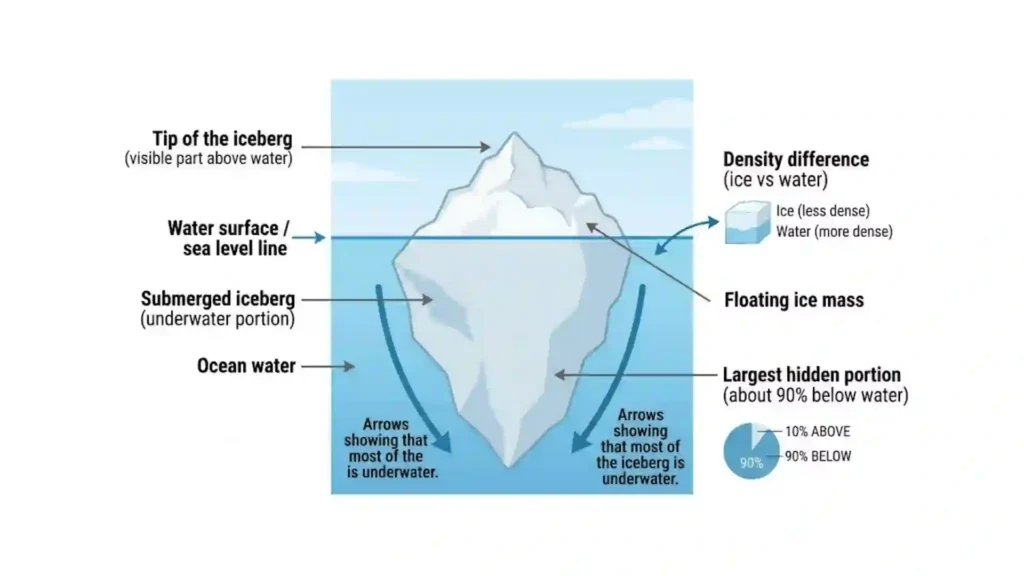
15. What are icebergs?
Ans: Icebergs are large floating masses of ice that break off from glaciers or ice sheets and drift in the ocean.
4. Analytical questions and answers [3 marks each]
1. Name the different ocean currents of the South Atlantic Ocean.
Ans: The main currents of the South Atlantic Ocean are:
- Brazil Current – It is a warm ocean current that flows southward along the eastern coast of South America.
- Falkland (Malvinas) Current – It is a cold current that flows northward from the Antarctic region along the eastern coast of South America.
- Benguela Current – It is a cold ocean current that flows northward along the south-west coast of Africa and brings cool water to the coastal region.
- South Equatorial Current – It is a warm current that flows westward across the Atlantic Ocean south of the equator.
- West Wind Drift – It is a cold current that flows from west to east in the southern part of the Atlantic Ocean under the influence of strong westerly winds.
2. What are the factors influencing nature and movement of ocean currents?
Ans: The nature and movement of ocean currents are influenced by several factors. The most important factor is the planetary winds which push the ocean water in a particular direction. Differences in temperature between the equator and polar regions also cause water to move from warmer to colder areas. Variation in salinity changes the density of seawater and creates movement. The rotation of the earth produces the Coriolis effect which deflects the currents. The shape of coastlines and ocean basins also influences the direction and flow of ocean currents.
3. Why are ocean currents generated?
Ans: Ocean currents are generated due to the action of several natural forces. The most important cause is the blowing of planetary winds over the ocean surface. Differences in temperature and salinity also create variations in water density that cause movement. The rotation of the earth produces the Coriolis effect which changes the direction of currents. The shape of continents and ocean basins also influences their flow.
4. Why is Grand Bank famous for commercial fishing?
Ans: Grand Bank is famous for commercial fishing because warm and cold ocean currents meet in this region. The Gulf Stream and the Labrador Current bring large quantities of nutrients from the deep ocean. These nutrients promote the growth of plankton which serve as food for fish. As a result, a large variety of fish are found here, making it one of the richest fishing grounds in the world.
5. What are the general characteristics of ocean currents?
Ans: Ocean currents are large masses of seawater that flow continuously in definite directions. They are mainly driven by planetary winds and differences in temperature and salinity. Ocean currents are of two types—warm currents and cold currents. Warm currents flow from the equatorial regions toward higher latitudes, while cold currents flow from polar regions toward the equator. Ocean currents greatly influence the climate of coastal regions and marine life.
6. Why is a developed commercial fishing ground found along the coast of Japan?
Ans: The coast of Japan is an important fishing ground because the warm Kuroshio current meets the cold Oyashio current near the Japanese coast. The mixing of these two currents brings nutrients to the ocean surface. These nutrients support the growth of plankton which attract large numbers of fish. Therefore, the coastal waters of Japan are very rich in marine life and fishing activities.
7. Why are dense fog and storms formed near Newfoundland coast?
Ans: Dense fog and storms are formed near the coast of Newfoundland because the warm Gulf Stream current meets the cold Labrador current in this region. The mixing of warm and cold water causes condensation of moisture in the air which produces dense fog. This condition also creates unstable weather leading to storms. Therefore, the Newfoundland coast experiences frequent fog and stormy weather.
8. Why is the coast of Newfoundland considered dangerous for navigation?
Ans: The coast of Newfoundland is considered dangerous for navigation because dense fog frequently forms in this region. This fog is produced by the meeting of the warm Gulf Stream and cold Labrador Current. In addition, large icebergs carried by the Labrador Current move into this area. These conditions make navigation difficult and hazardous for ships.
9. Why is Newfoundland a famous fishing ground?
Ans: Newfoundland is a famous fishing ground because the warm Gulf Stream and cold Labrador Current meet near the Grand Bank. This mixing brings nutrients from deep waters to the surface. These nutrients help in the growth of plankton which attract large numbers of fish. Therefore, this region supports large-scale fishing activities.
10. Write the difference between spring tide and neap tide.
Ans:
| Spring Tide | Neap Tide |
|---|---|
| Spring tides occur when the Sun, Moon, and Earth lie in a straight line during the new moon and full moon. | Neap tides occur when the Sun and Moon are at right angles with the Earth during the first and third quarters of the moon. |
| During spring tides, the gravitational pull of the Sun and Moon combine together. | During neap tides, the gravitational forces of the Sun and Moon partly cancel each other. |
| Spring tides produce very high tides and very low tides. | Neap tides produce lower high tides and higher low tides. |
| Spring tides create the greatest difference between high tide and low tide. | Neap tides create the least difference between high tide and low tide. |
11. Explain why Greenland is colder than Norway though they are in the same latitude.
Ans: Greenland is colder than Norway even though both lie in the same latitude because of the influence of ocean currents. The cold Labrador Current flows along the coast of Greenland and lowers its temperature. On the other hand, the warm North Atlantic Drift flows along the coast of Norway and raises its temperature. Therefore, Norway experiences a milder climate while Greenland remains much colder.
12. Why are fishing grounds seen in the coastal areas of Japan?
Ans: Fishing grounds are found in the coastal areas of Japan because of the meeting of the warm Kuroshio current and the cold Oyashio current. The mixing of these currents brings nutrients to the surface water. These nutrients encourage the growth of plankton which serve as food for fish. As a result, the coastal waters of Japan become rich fishing grounds.
5. Explanatory questions and answers [5 marks each]
1. Discuss the effects of ocean currents.
Ans: Ocean currents have a profound influence on both the natural environment and human activities.
- Influence on Climate: Ocean currents greatly affect the climate of coastal regions. Warm currents raise the temperature of nearby land areas and create milder climates, while cold currents reduce temperatures and make the climate cooler.
- Effect on Rainfall: Ocean currents also influence the distribution of rainfall. Warm currents increase moisture in the air and lead to greater rainfall, whereas cold currents produce dry air conditions and reduce precipitation.
- Fog Formation: Where warm and cold currents meet, dense fog often forms because warm moist air cools rapidly when it comes into contact with colder water. Such foggy areas can be dangerous for ships and navigation.
- Rich Fishing Grounds: These meeting points of warm and cold currents bring nutrient-rich water from the deeper parts of the ocean to the surface. This encourages the growth of plankton and supports large populations of fish, creating excellent fishing grounds.
- Importance for Navigation: Ocean currents are very important for marine transportation. Ships can travel faster and save fuel when moving with favourable currents, while unfavourable currents may slow down ships and increase travel time.
2. Write the importance of tides.
Ans: Tides are the periodic rise and fall of sea level caused mainly by the gravitational pull of the Moon and the Sun. Tides are important in many ways:
- Aid in Navigation: During high tides the water level in ports and harbours rises. This increased depth allows large ships and vessels to enter and leave harbours safely without running aground.
- Fishing Activities: Tides help fishermen in catching fish because tidal movements bring fish closer to the shore. Fishermen often plan their fishing activities according to the timing of high and low tides.
- Cleaning of Harbours: Tidal movements help remove accumulated sediments, waste materials and pollutants from harbours and coastal regions. This natural cleaning process helps maintain cleaner and safer waterways.
- Tidal Energy: The rise and fall of tides can be used to produce electricity through tidal power plants. This energy source is renewable and environmentally friendly.
- Formation of Coastal Landforms: Continuous tidal movements shape coastal features such as tidal flats, estuaries and salt marshes. These landforms are important ecosystems that support many plant and animal species.
- Salt Production: In many coastal areas tidal water is collected in shallow ponds known as salt pans. When the water evaporates under the sun, salt crystals are left behind and collected for human use.
3. Write different effects of ocean currents.
Ans: Ocean currents have a significant influence on climate, marine life and human activities. The major effects of ocean currents are:
- Influence on Climate: Warm ocean currents increase the temperature of nearby coastal regions and make the climate milder, especially during winter. Cold ocean currents lower the temperature of nearby coastal areas and create cooler climatic conditions.
- Rainfall Distribution: Warm ocean currents increase evaporation because warm water releases more moisture into the atmosphere. This moisture later falls as rainfall in coastal regions. On the other hand, cold currents reduce evaporation and therefore reduce rainfall.
- Formation of Deserts: Cold ocean currents flowing along the western margins of continents often create dry and stable air conditions. These conditions prevent cloud formation and rainfall, leading to the formation of coastal deserts such as the Atacama Desert in South America and the Namib Desert in Africa.
- Fog Formation: When warm ocean currents meet cold ocean currents, the warm moist air above the warm current cools rapidly. This cooling forms dense fog in the region. Such foggy conditions often create problems for ships and navigation.
- Rich Fishing Grounds: The meeting of warm and cold currents brings nutrient-rich water from the deeper parts of the ocean to the surface. These nutrients support the growth of plankton, which becomes food for fish. As a result, these areas become very productive fishing grounds.
- Navigation: Ocean currents can assist or hinder sea transportation. Ships traveling in the direction of ocean currents can move faster and save fuel, while ships moving against the current may slow down and require more fuel.
Related Links
- WBBSE 10 Result 2026
- Satellite Imageries and Topographical Maps
- Transport and communication system in India
- Population of India
- Industries in India
- Agriculture in India
- Natural Vegetation of India
- Soils in India
- Climate of India
- Water resources of India