
Homophones in English: Meaning, Examples and Word List
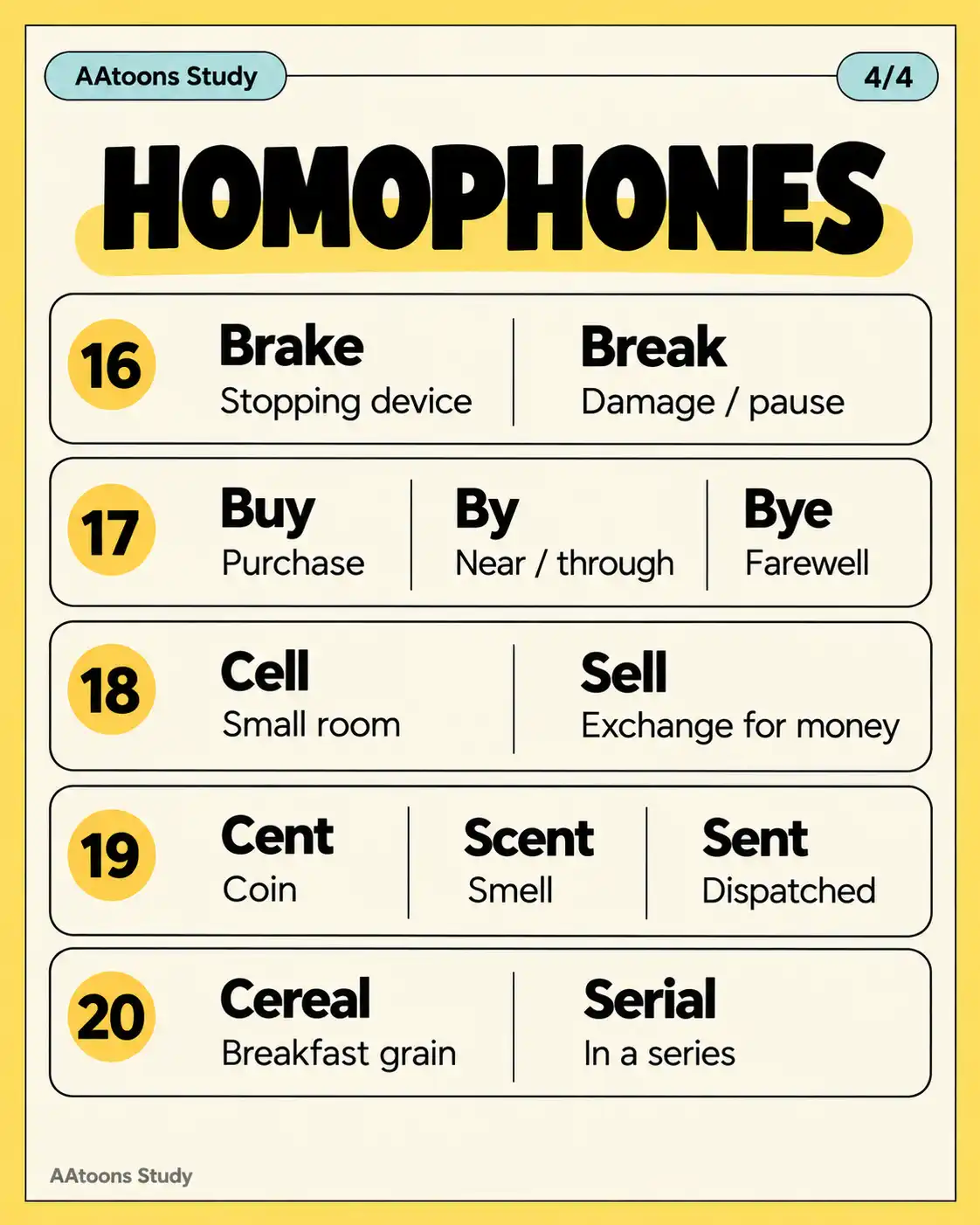
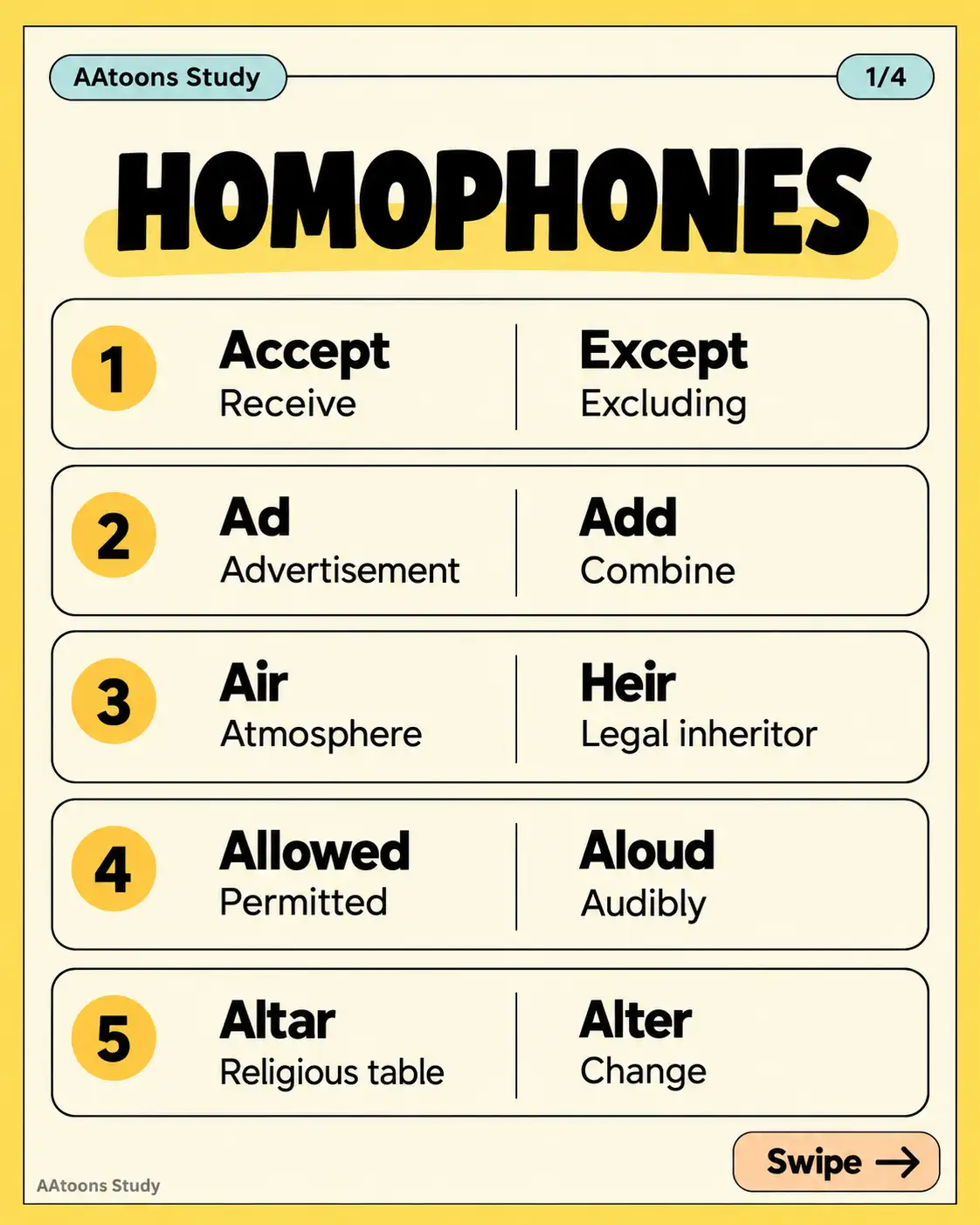
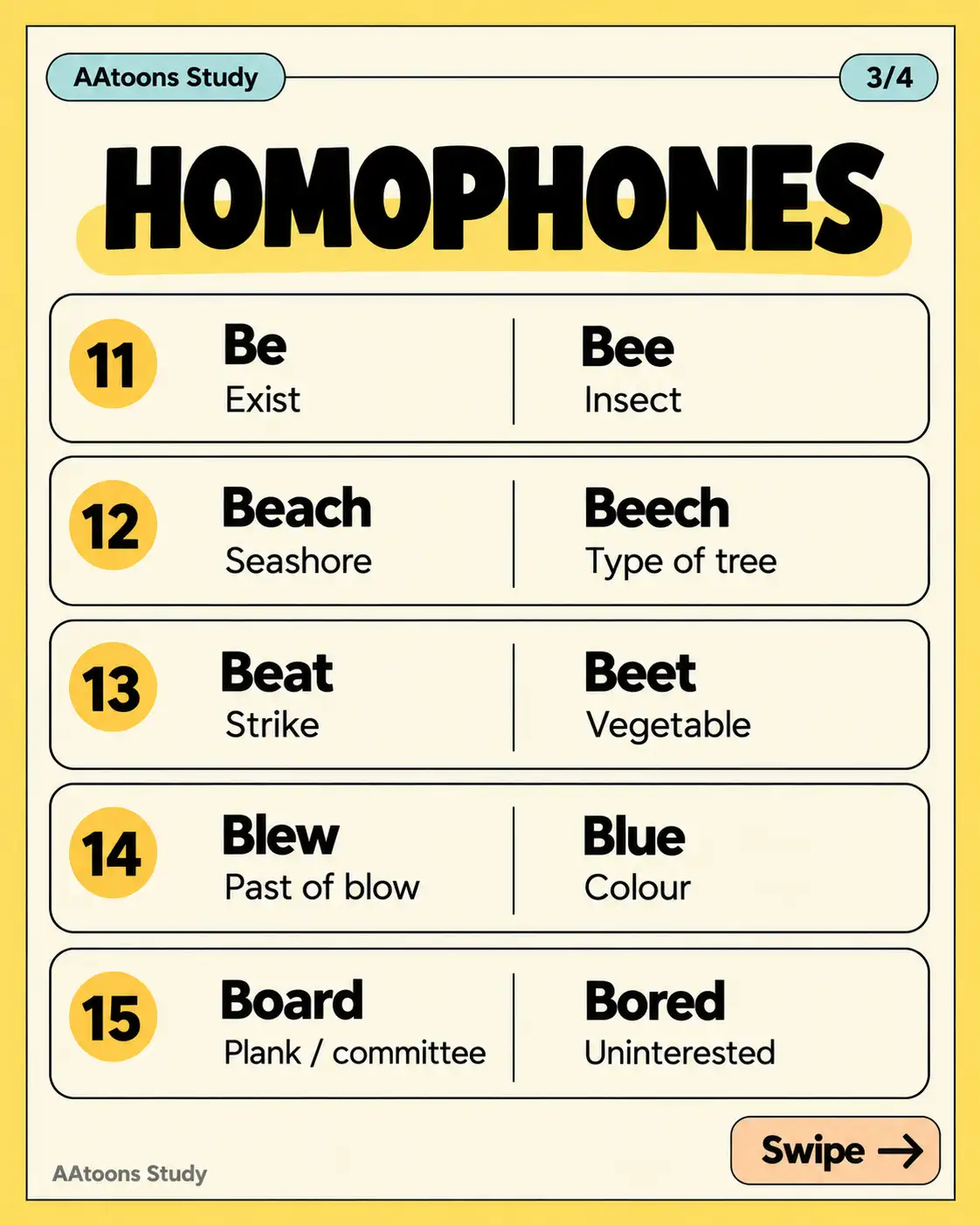
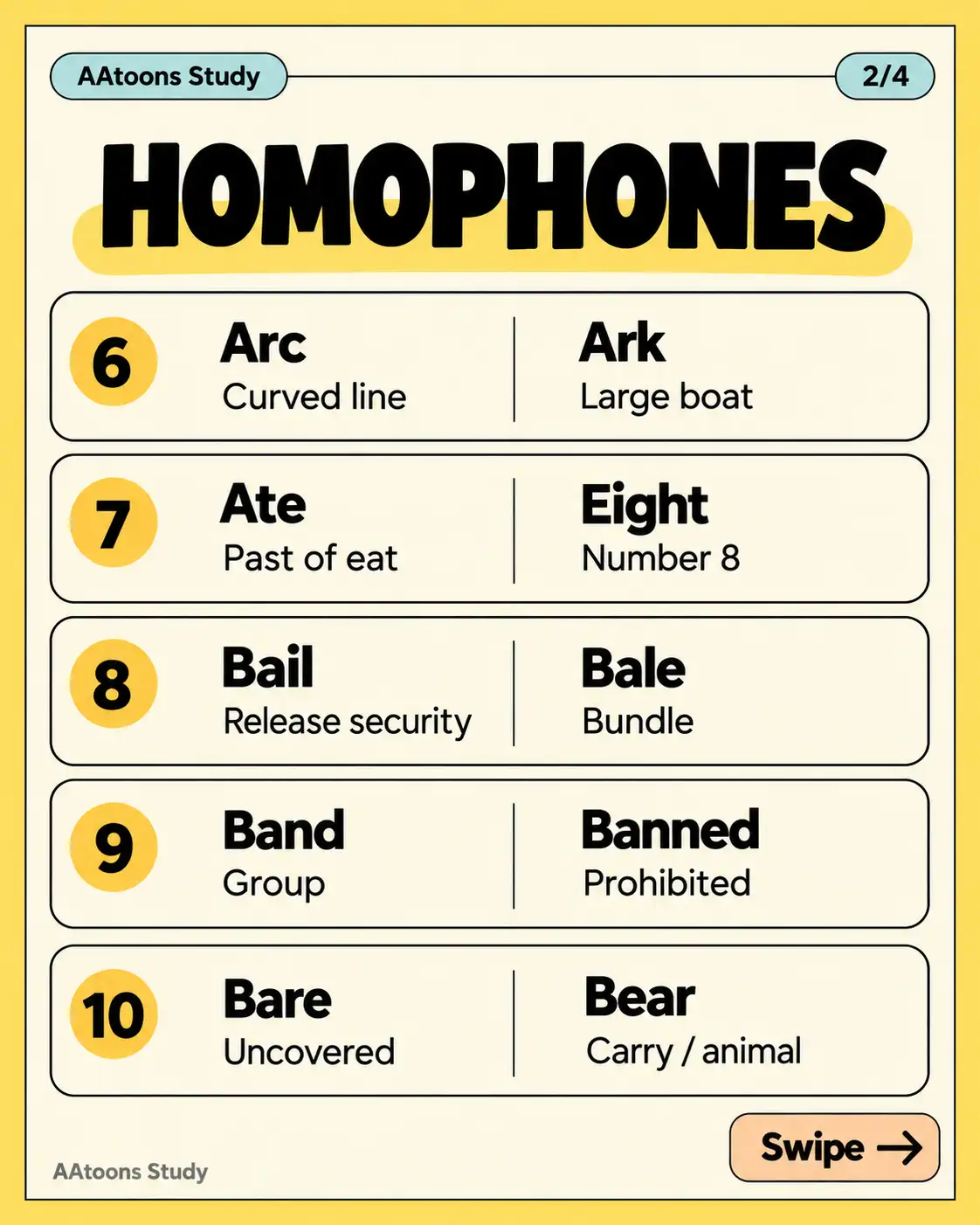
Homophones from 1 – 20
| No. | Homophones – Meaning | Homophones – Meaning |
|---|---|---|
| 1 | Accept – Receive | Except – Excluding |
| 2 | Ad – Advertisement | Add – Combine |
| 3 | Air – Atmosphere | Heir – Legal inheritor |
| 4 | Allowed – Permitted | Aloud – Audibly |
| 5 | Altar – Religious table | Alter – Change |
| 6 | Arc – Curved line | Ark – Large boat |
| 7 | Ate – Past tense of eat | Eight – Number 8 |
| 8 | Bail – Release security | Bale – Bundle |
| 9 | Band – Group | Banned – Prohibited |
| 10 | Bare – Uncovered | Bear – Animal / Carry |
| 11 | Be – Exist | Bee – Insect |
| 12 | Beach – Seashore | Beech – Type of tree |
| 13 | Beat – Strike | Beet – Vegetable |
| 14 | Blew – Past tense of blow | Blue – Colour |
| 15 | Board – Plank / Committee | Bored – Uninterested |
| 16 | Brake – Stopping device | Break – Damage / Pause |
| 17 | Buy – Purchase | By – Near / Through; Bye – Farewell |
| 18 | Cell – Small room | Sell – Exchange for money |
| 19 | Cent – Coin | Scent – Smell; Sent – Dispatched |
| 20 | Cereal – Breakfast grain | Serial – In a series |
Homophones from 21 – 40
| No. | Homophones – Meaning | Homophones – Meaning |
|---|---|---|
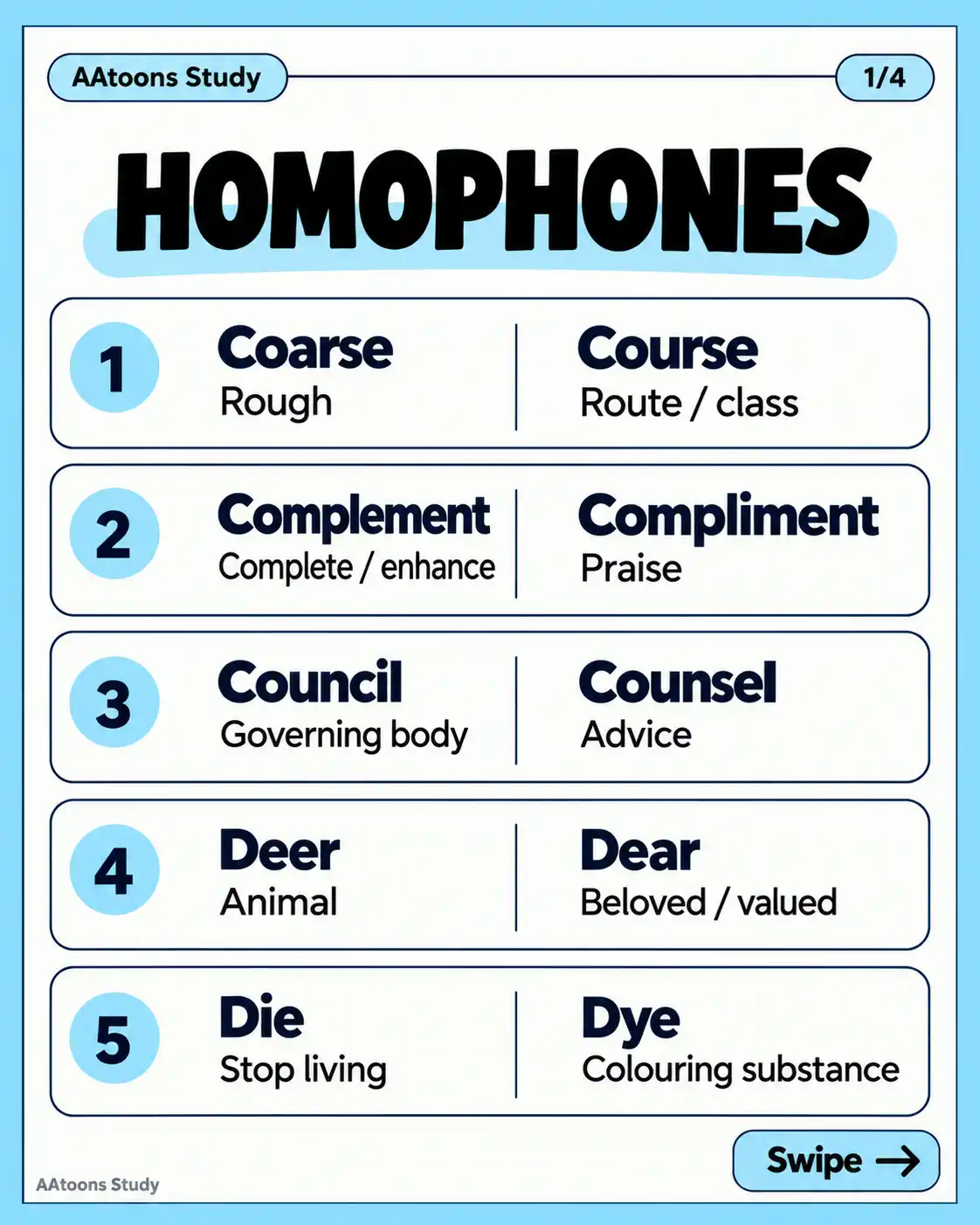
| 21 | Coarse – Rough | Course – Route / Class |
| 22 | Complement – Complete / Enhance | Compliment – Praise |
| 23 | Council – Governing body | Counsel – Advice |
| 24 | Deer – Animal | Dear – Beloved / Valued |
| 25 | Die – Stop living | Dye – Colouring substance |
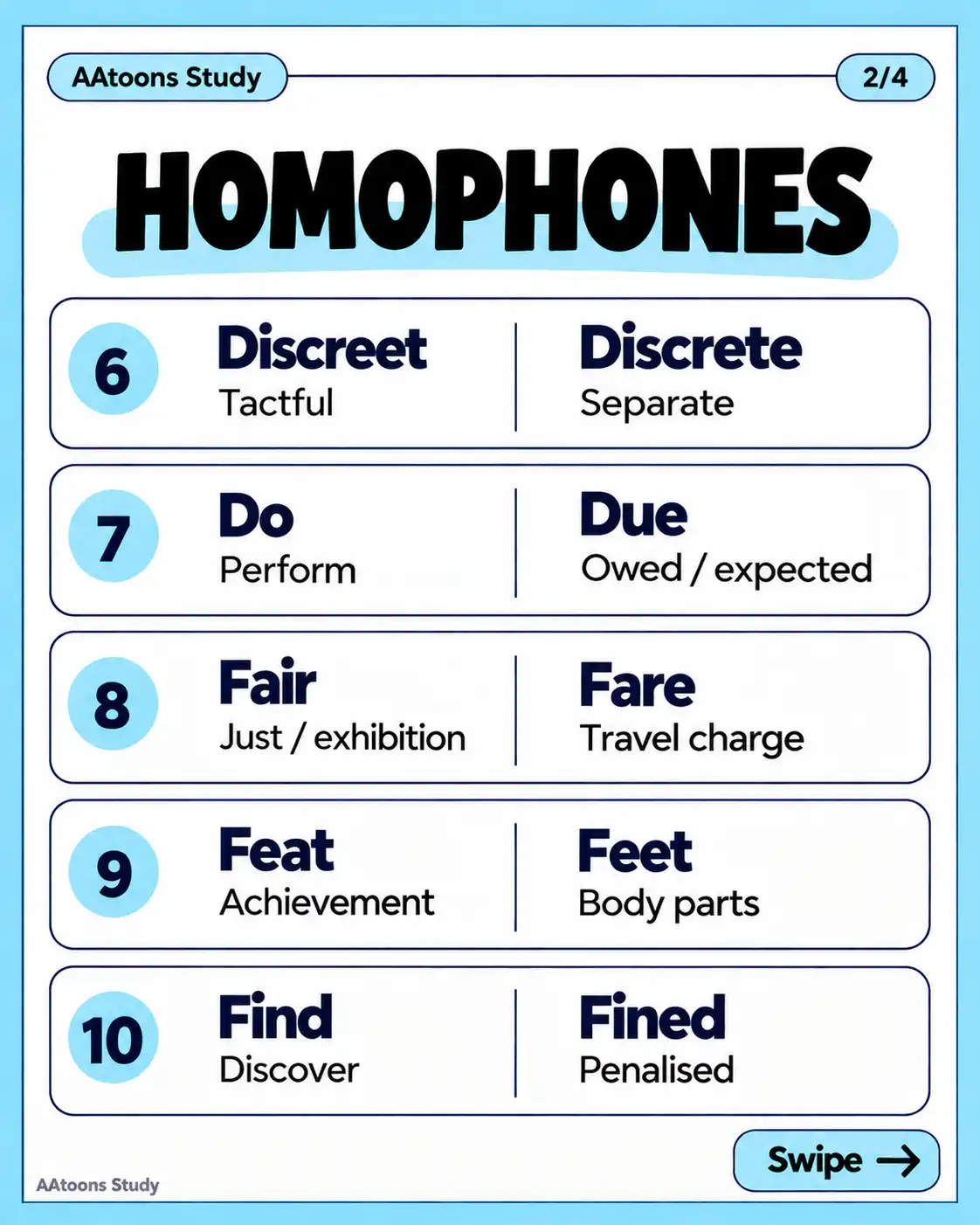
| 26 | Discreet – Tactful | Discrete – Separate |
| 27 | Do – Perform | Due – Owed / Expected |
| 28 | Fair – Just / Exhibition | Fare – Travel charge |
| 29 | Feat – Achievement | Feet – Body parts |
| 30 | Find – Discover | Fined – Penalised |
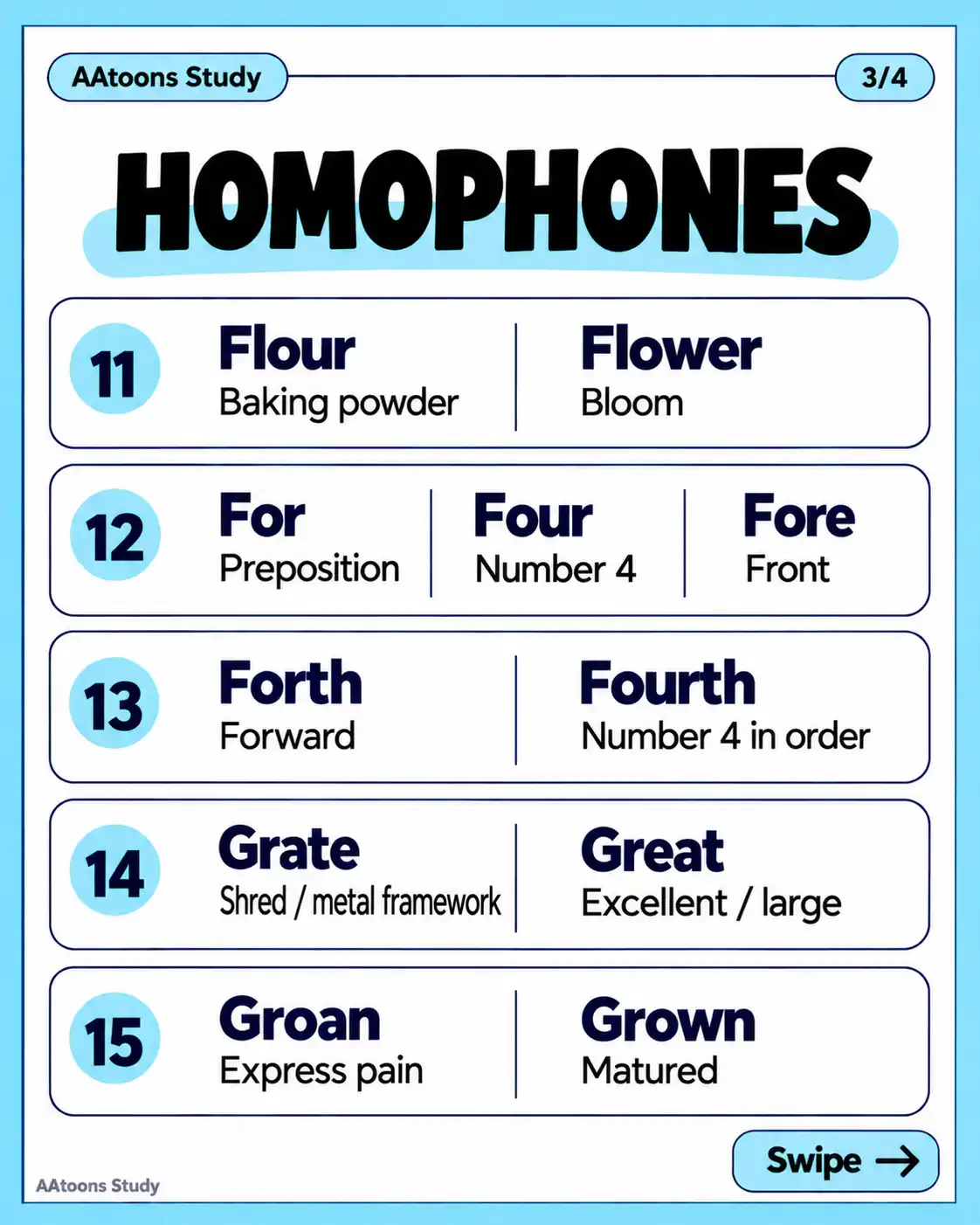
| 31 | Flour – Baking ingredient | Flower – Bloom |
| 32 | For – Preposition | Four – Number 4; Fore – Front |
| 33 | Forth – Forward | Fourth – Number 4 in order |
| 34 | Grate – Shred / Metal framework | Great – Excellent / Large |
| 35 | Groan – Express pain | Grown – Matured |
| 36 | Hair – Human strands | Hare – Rabbit-like animal |
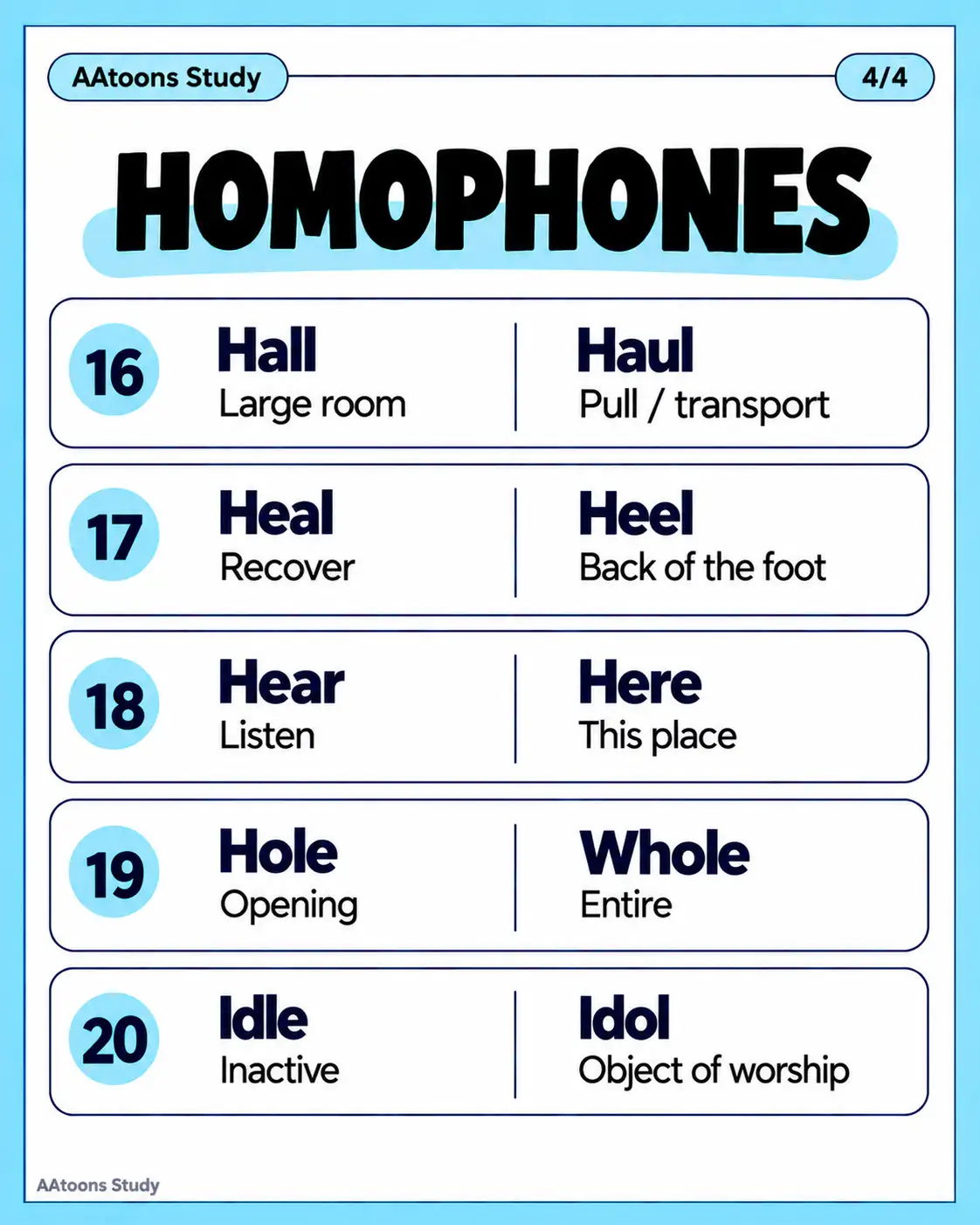
| 37 | Hall – Large room | Haul – Pull / Transport |
| 38 | Heal – Recover | Heel – Back of the foot |
| 39 | Hear – Listen | Here – This place |
| 40 | Hole – Opening | Whole – Entire |
Homophones from 41 – 60
| No. | Homophones – Meaning | Homophones – Meaning |
|---|---|---|
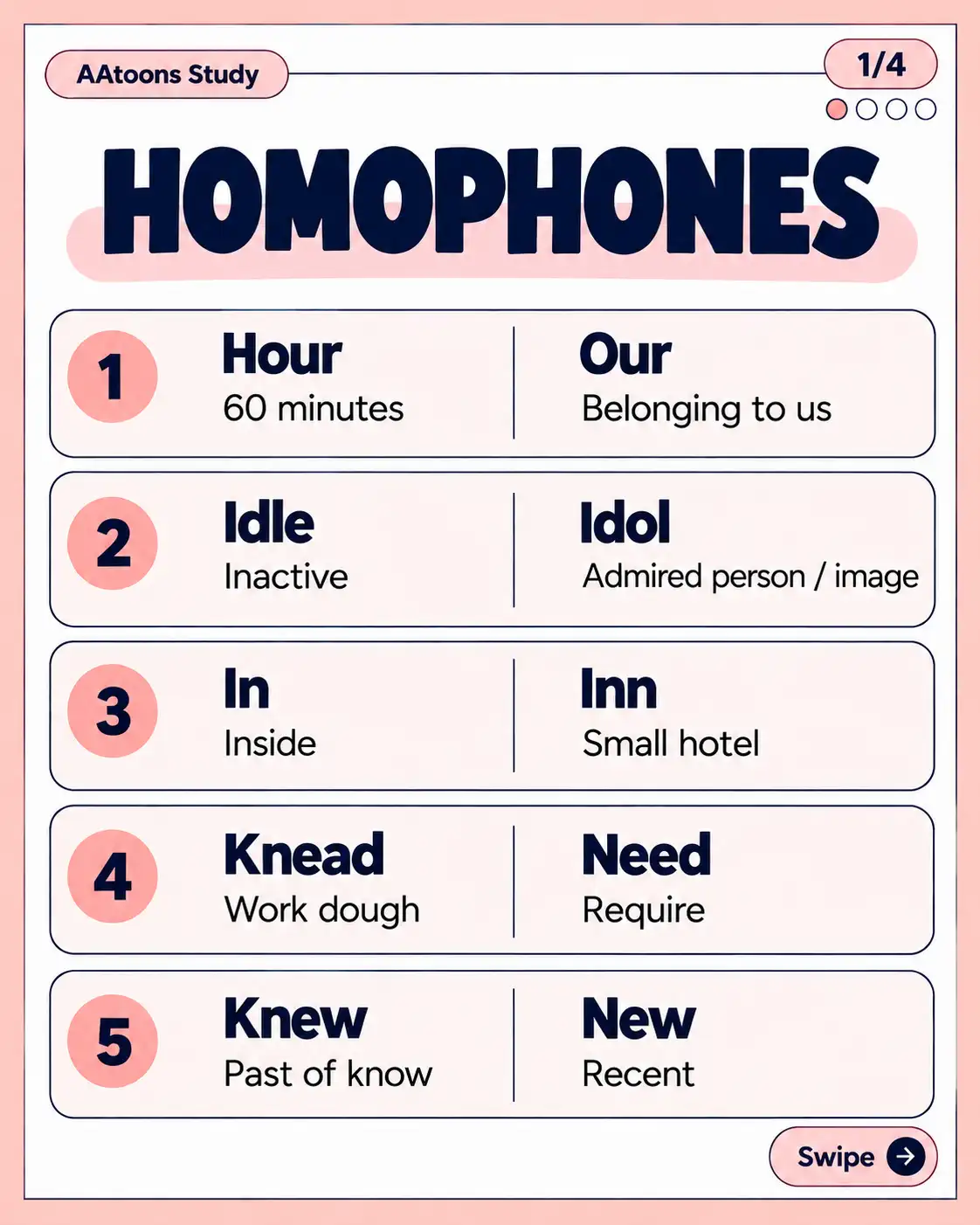
| 41 | Hour – 60 minutes | Our – Belonging to us |
| 42 | Idle – Inactive | Idol – Admired person / Image |
| 43 | In – Inside | Inn – Small hotel |
| 44 | Knead – Work dough | Need – Require |
| 45 | Knew – Past tense of know | New – Recent |
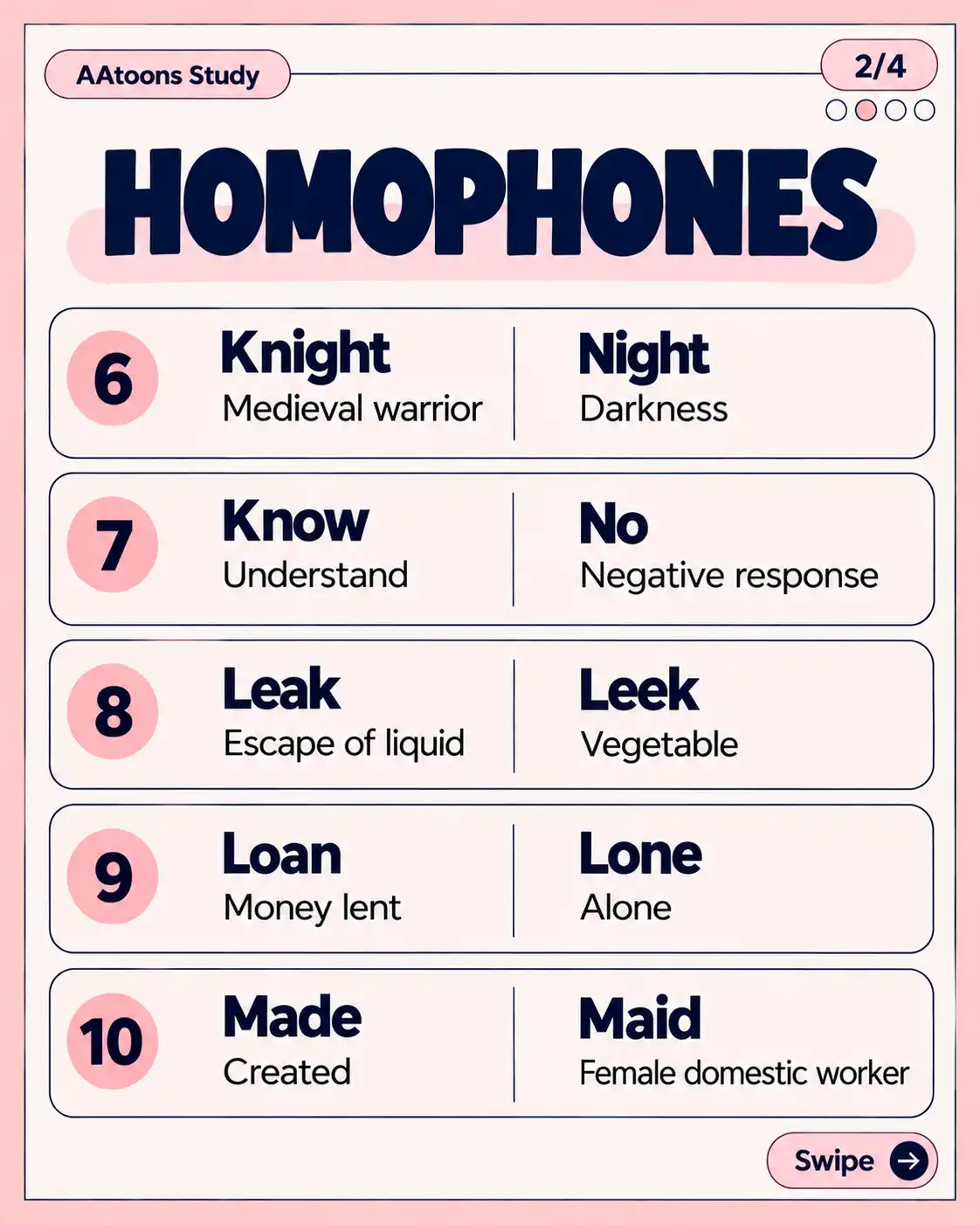
| 46 | Knight – Medieval warrior | Night – Darkness |
| 47 | Know – Understand | No – Negative response |
| 48 | Leak – Escape of liquid | Leek – Vegetable |
| 49 | Loan – Money lent | Lone – Alone |
| 50 | Made – Created | Maid – Female domestic worker |
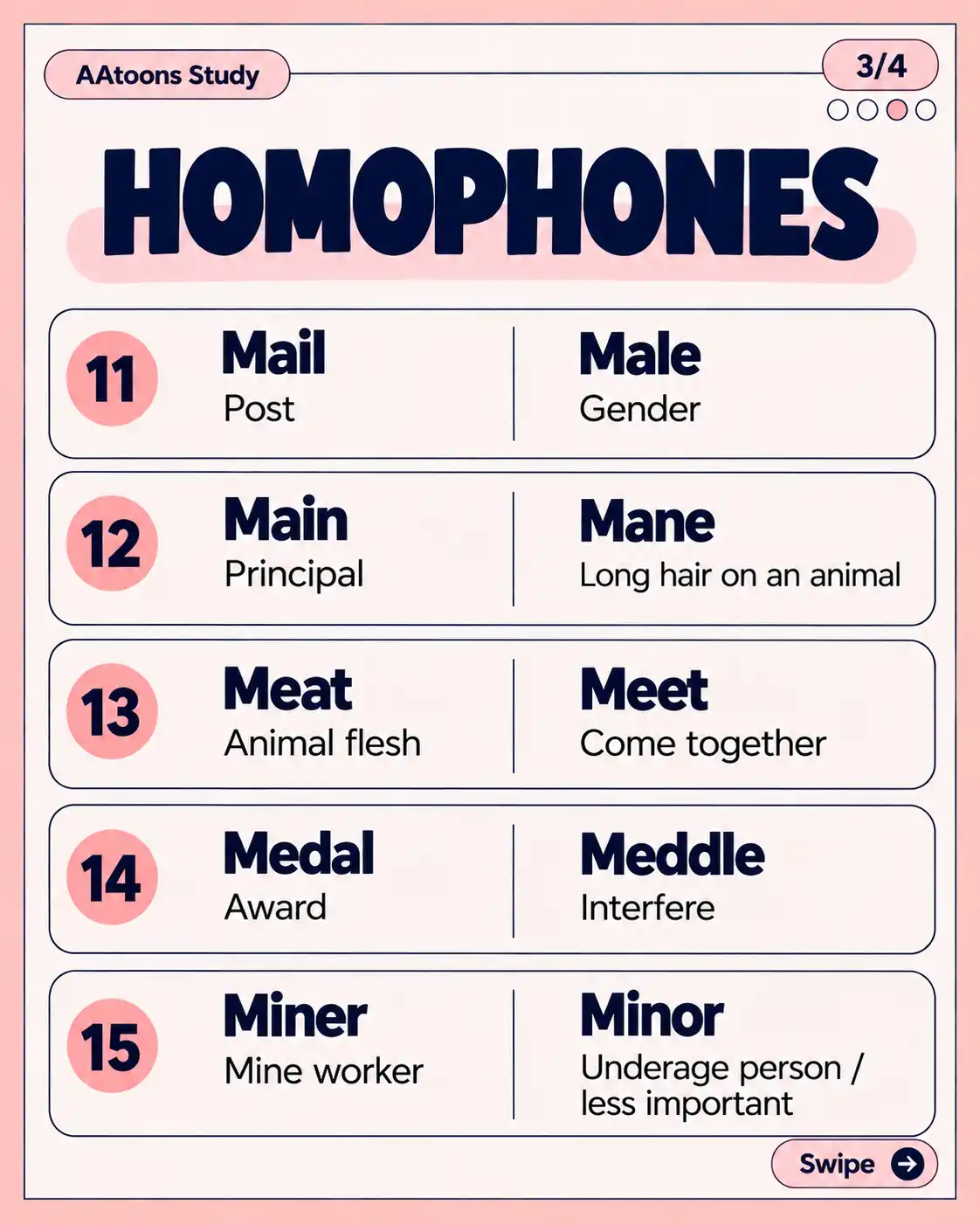
| 51 | Mail – Post | Male – Gender |
| 52 | Main – Principal | Mane – Long hair on an animal |
| 53 | Meat – Animal flesh | Meet – Come together |
| 54 | Medal – Award | Meddle – Interfere |
| 55 | Miner – Mine worker | Minor – Underage person / Less important |
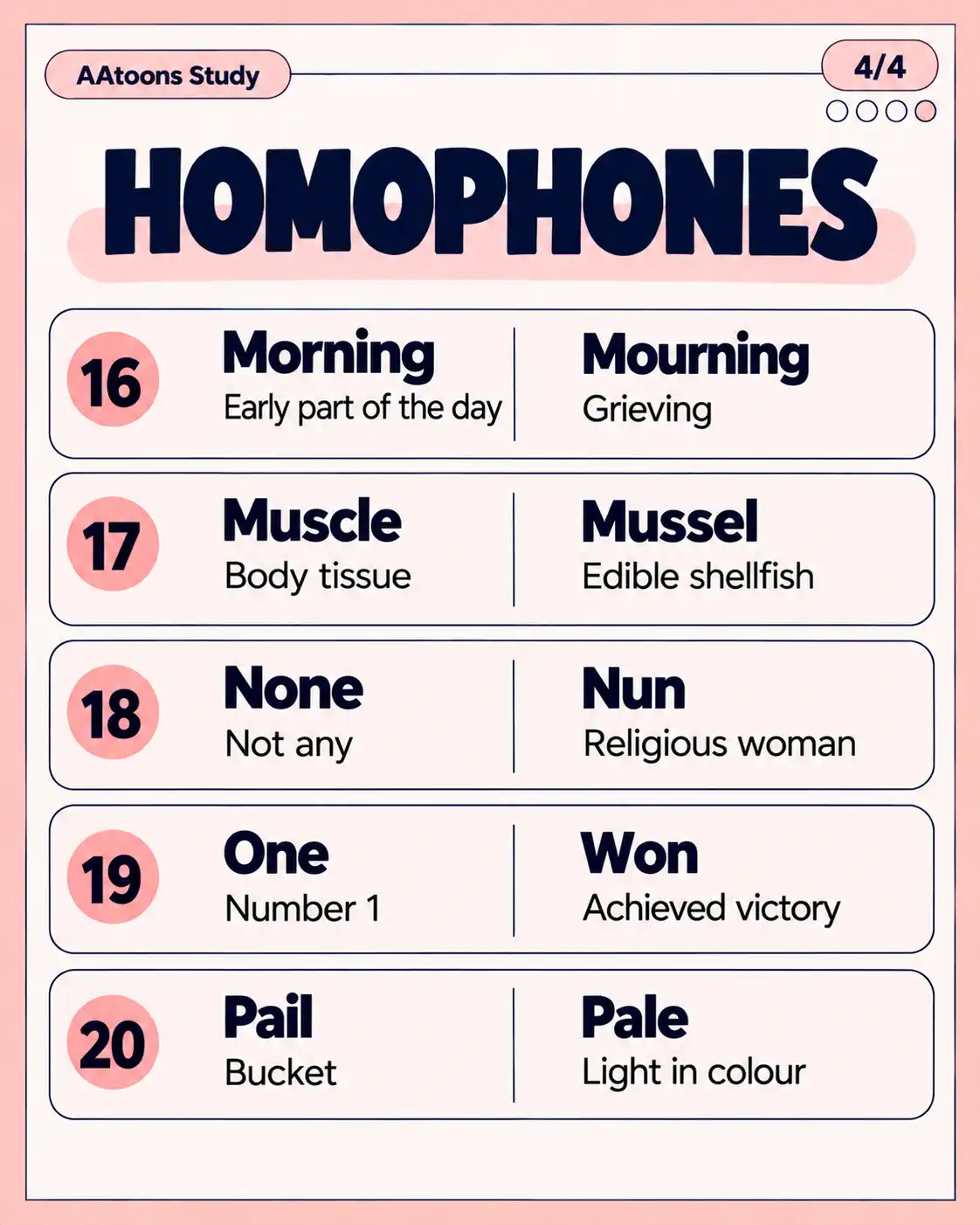
| 56 | Morning – Early part of the day | Mourning – Grieving |
| 57 | Muscle – Body tissue | Mussel – Edible shellfish |
| 58 | None – Not any | Nun – Religious woman |
| 59 | One – Number 1 | Won – Achieved victory |
| 60 | Pail – Bucket | Pale – Light in colour |
Homophones from 61 – 80
| No. | Homophones – Meaning | Homophones – Meaning |
|---|---|---|
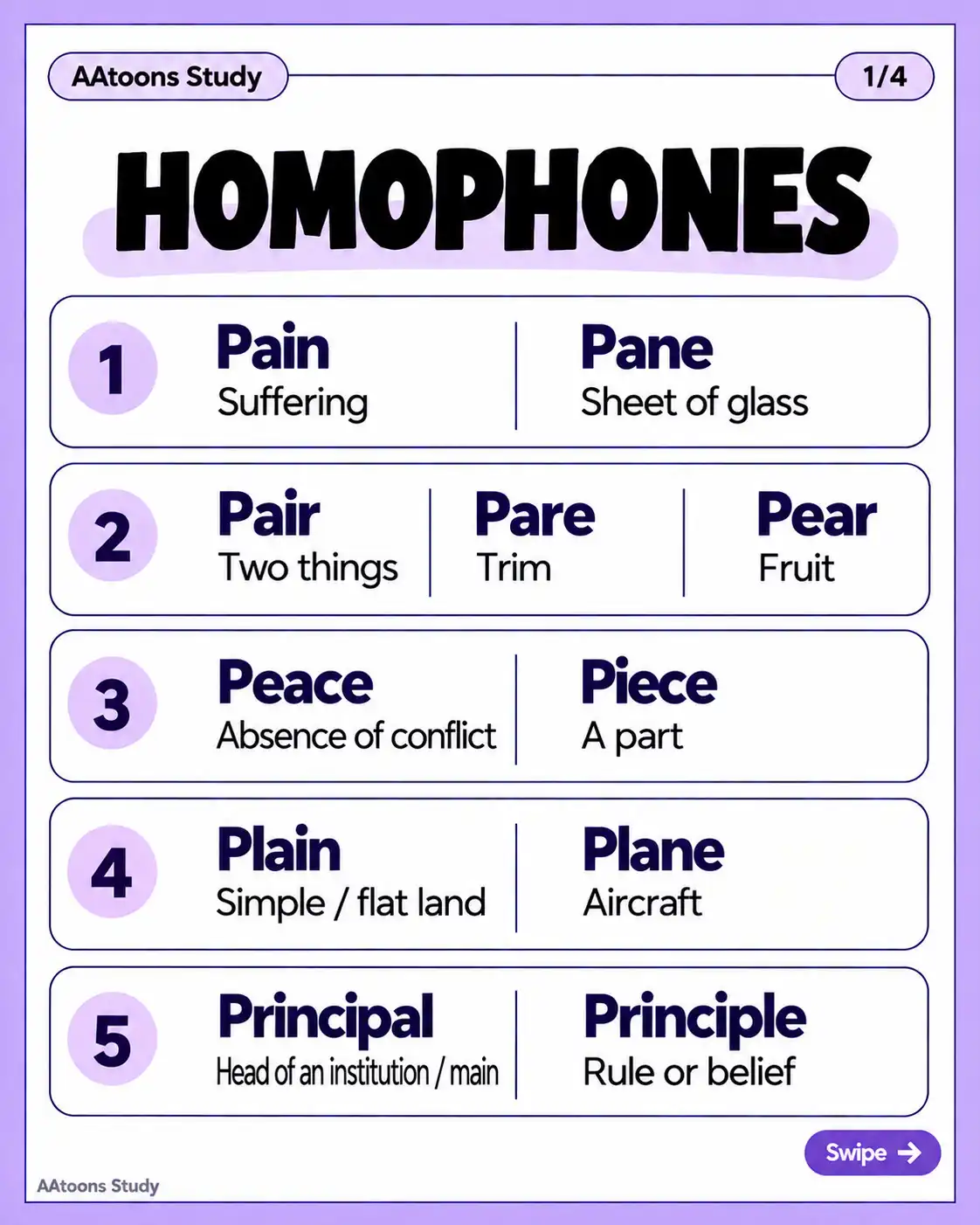
| 61 | Pain – Suffering | Pane – Sheet of glass |
| 62 | Pair – Two things | Pare – Trim; Pear – Fruit |
| 63 | Peace – Absence of conflict | Piece – A part |
| 64 | Plain – Simple / Flat land | Plane – Aircraft |
| 65 | Principal – Head of an institution / Main | Principle – Rule or belief |
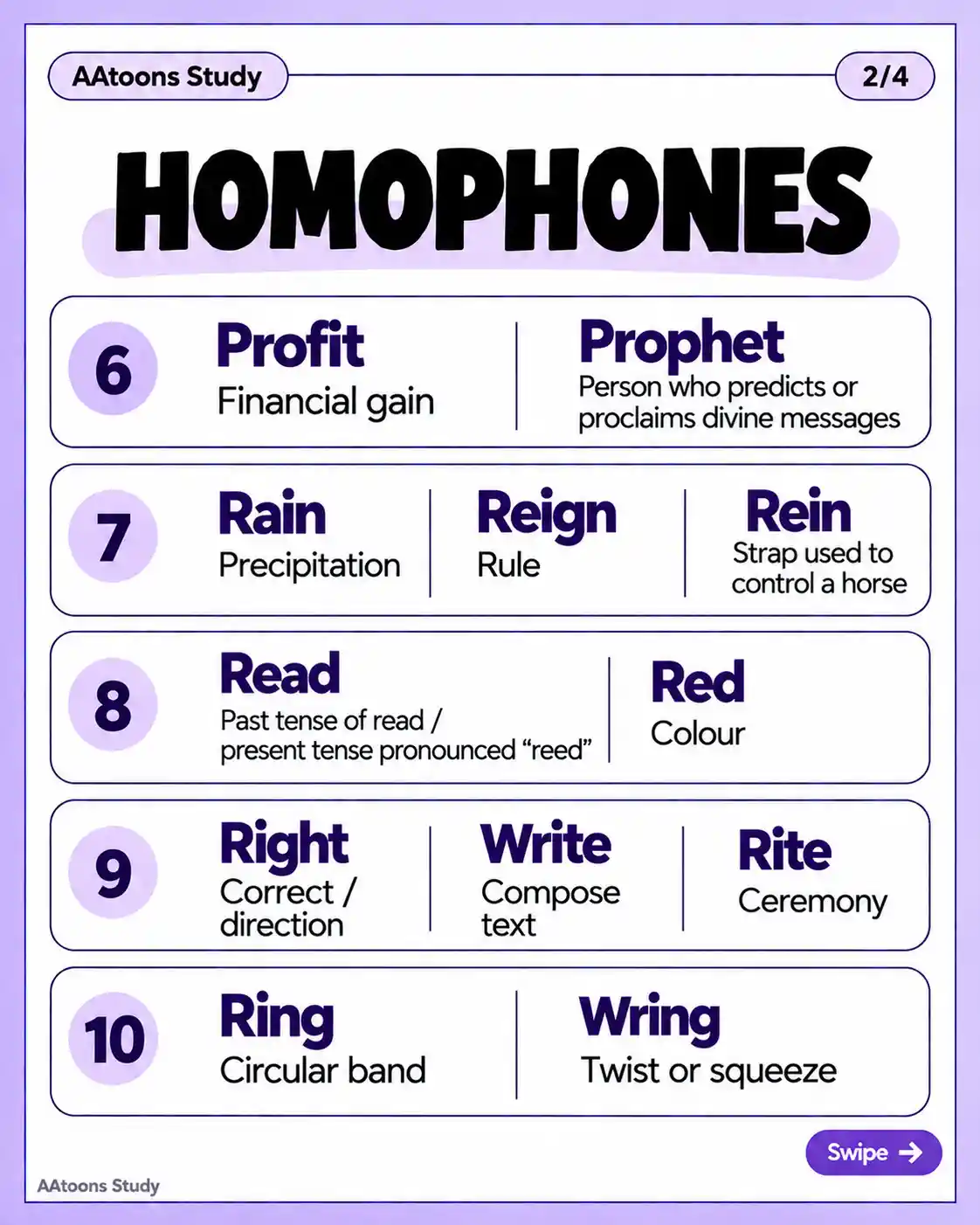
| 66 | Profit – Financial gain | Prophet – Person who predicts or proclaims divine messages |
| 67 | Rain – Precipitation | Reign – Rule; Rein – Strap used to control a horse |
| 68 | Read – Past tense of read / Present tense pronounced “reed” | Red – Colour |
| 69 | Right – Correct / Direction | Write – Compose text; Rite – Ceremony |
| 70 | Ring – Circular band | Wring – Twist or squeeze |
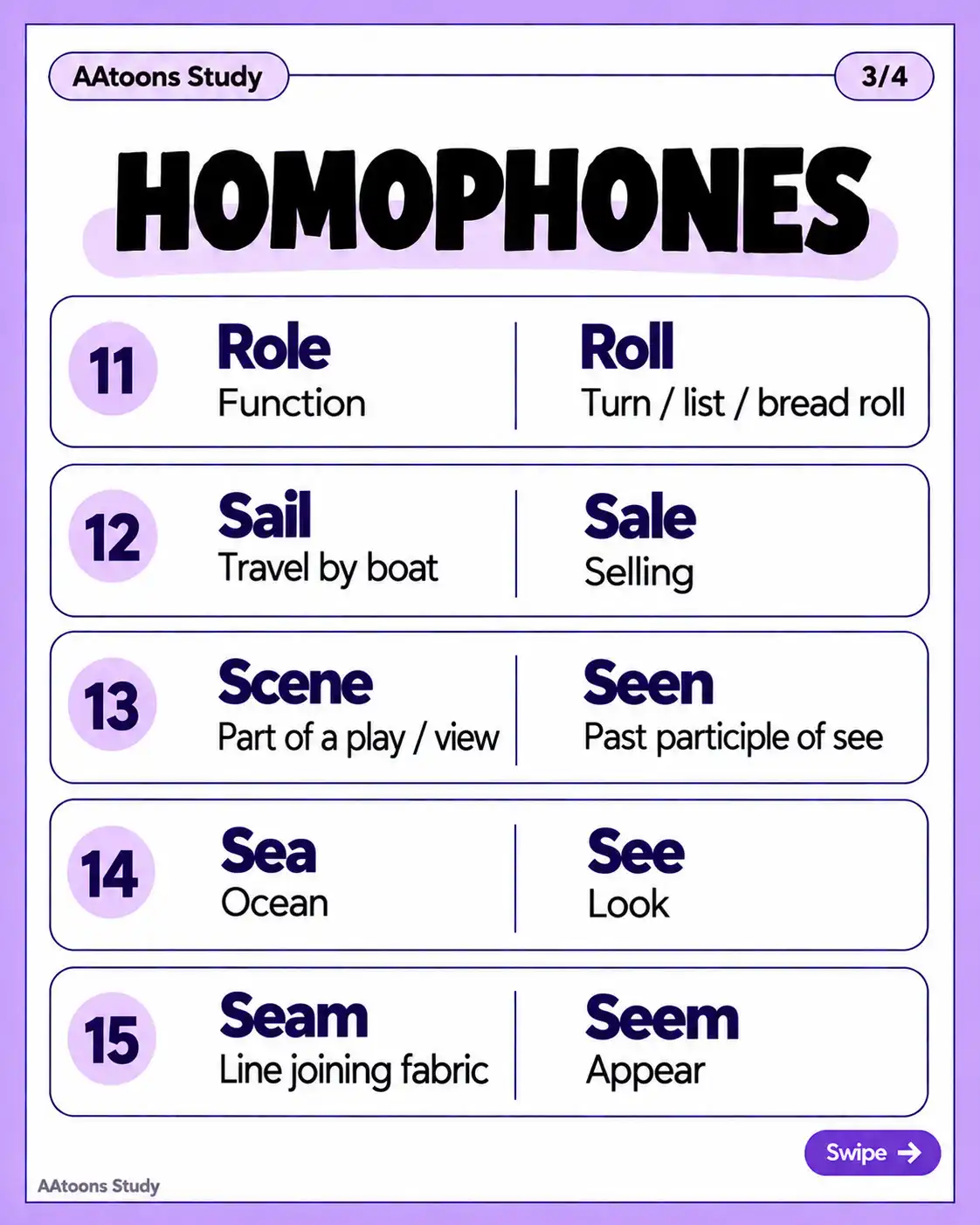
| 71 | Role – Function | Roll – Turn / List / Bread roll |
| 72 | Sail – Travel by boat | Sale – Selling |
| 73 | Scene – Part of a play / View | Seen – Past participle of see |
| 74 | Sea – Ocean | See – Look |
| 75 | Seam – Line joining fabric | Seem – Appear |
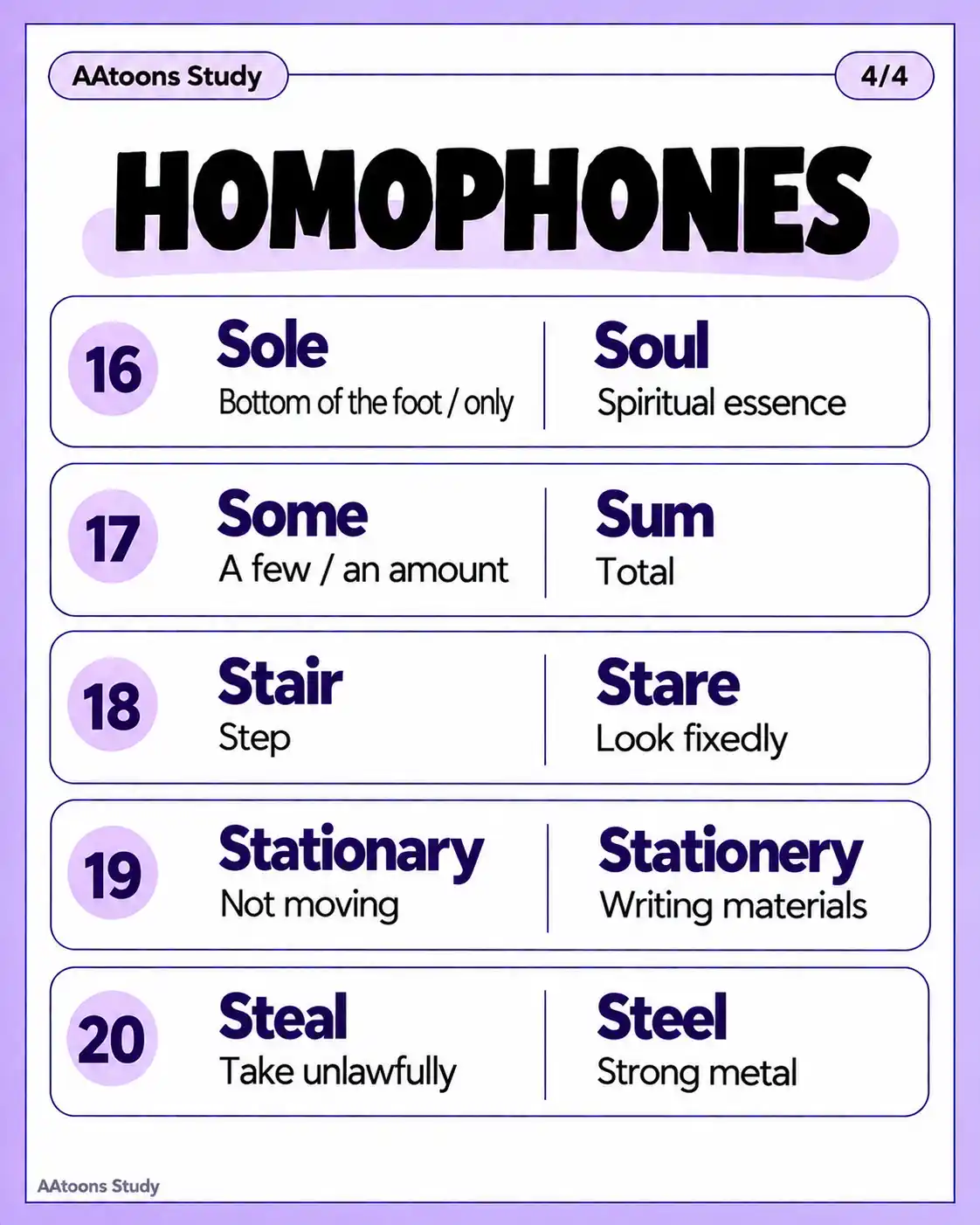
| 76 | Sole – Bottom of the foot / Only | Soul – Spiritual essence |
| 77 | Some – A few / An amount | Sum – Total |
| 78 | Stair – Step | Stare – Look fixedly |
| 79 | Stationary – Not moving | Stationery – Writing materials |
| 80 | Steal – Take unlawfully | Steel – Strong metal |
Homophones from 81 – 100
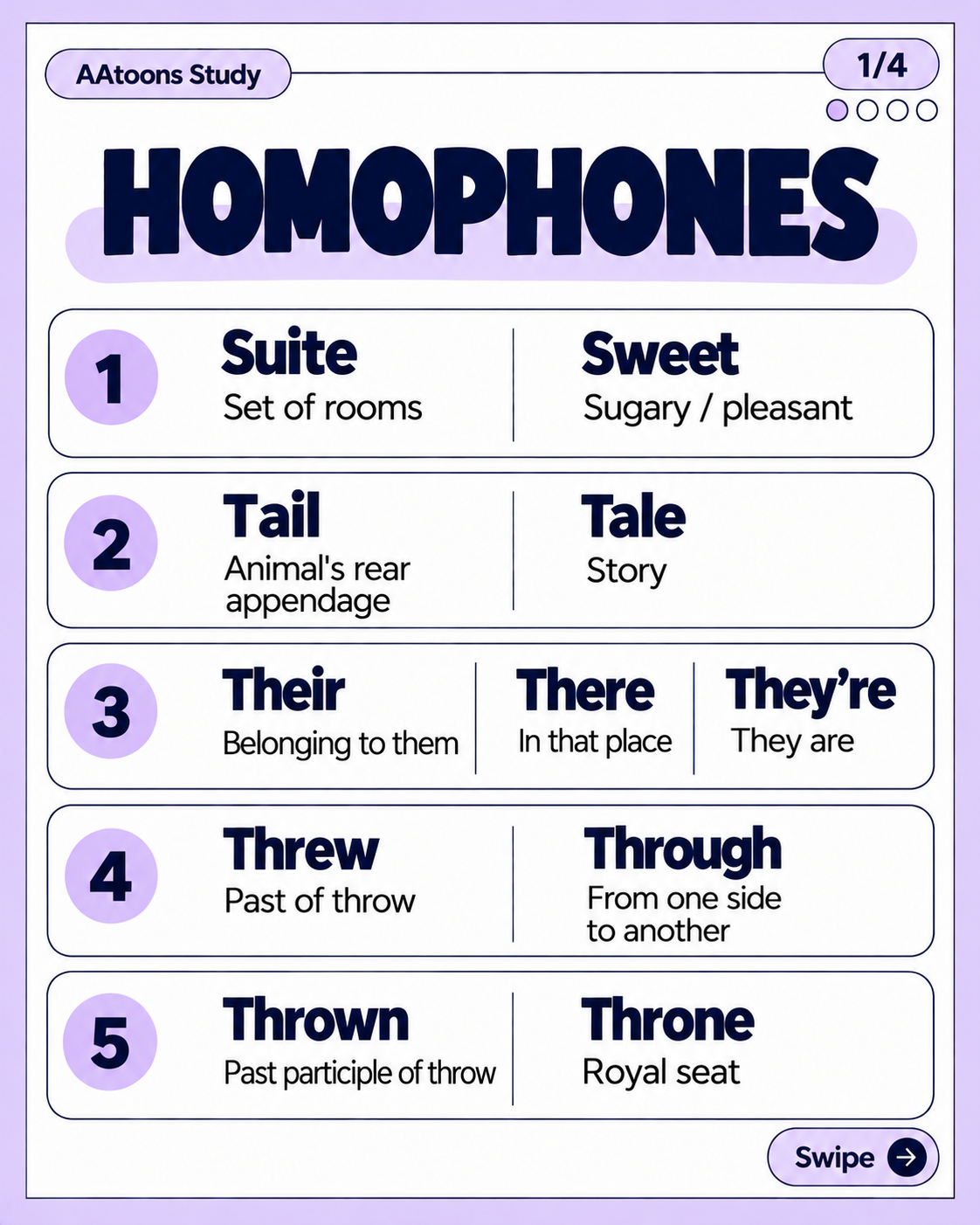
| 81 | Suite – Set of rooms | Sweet – Sugary / Pleasant |
| 82 | Tail – Animal’s rear appendage | Tale – Story |
| 83 | Their – Belonging to them | There – In that place; They’re – They are |
| 84 | Threw – Past tense of throw | Through – From one side to another |
| 85 | Thrown – Past participle of throw | Throne – Royal seat |
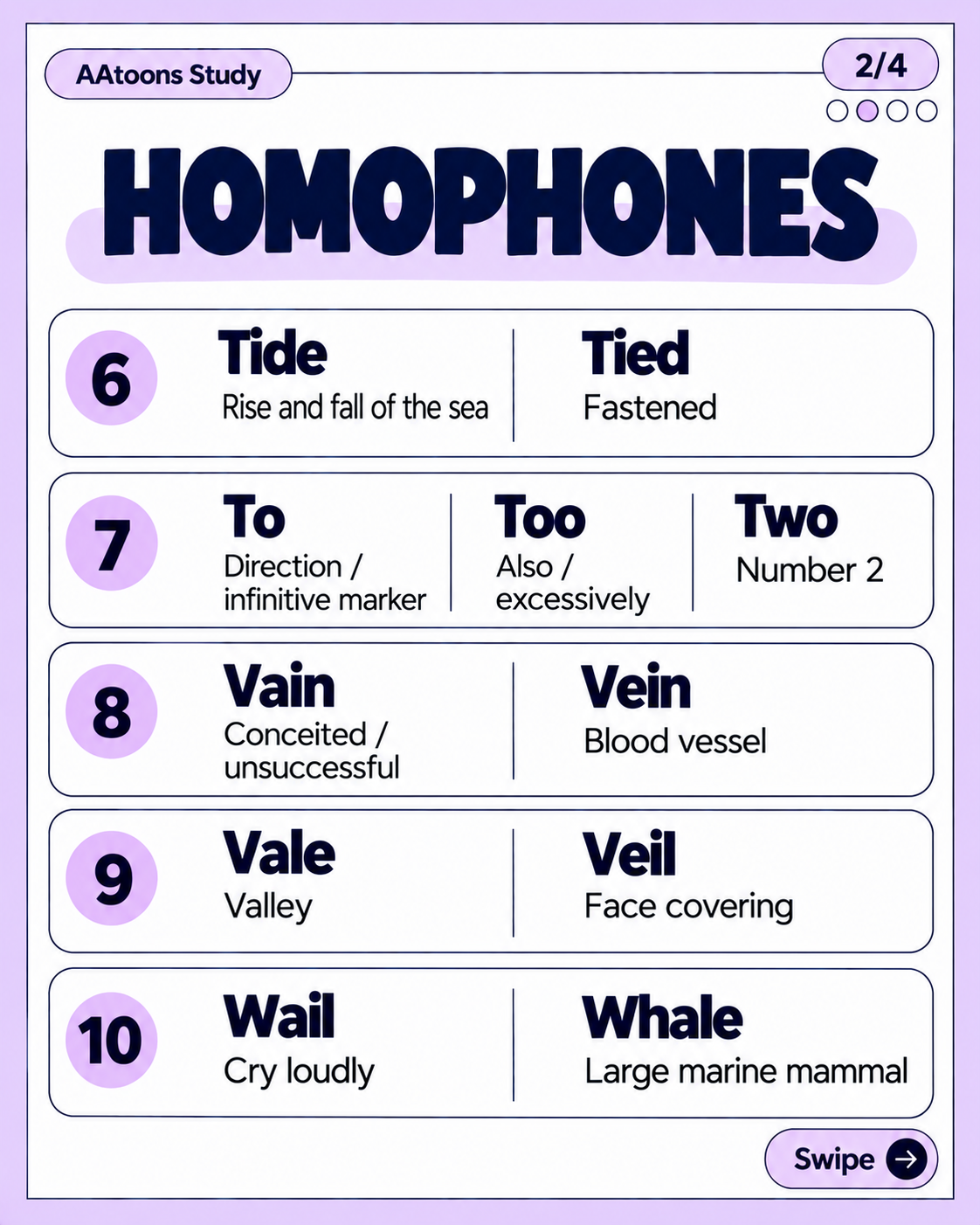
| 86 | Tide – Rise and fall of the sea | Tied – Fastened |
| 87 | To – Direction / Infinitive marker | Too – Also / Excessively; Two – Number 2 |
| 88 | Vain – Conceited / Unsuccessful | Vein – Blood vessel |
| 89 | Vale – Valley | Veil – Face covering |
| 90 | Wail – Cry loudly | Whale – Large marine mammal |
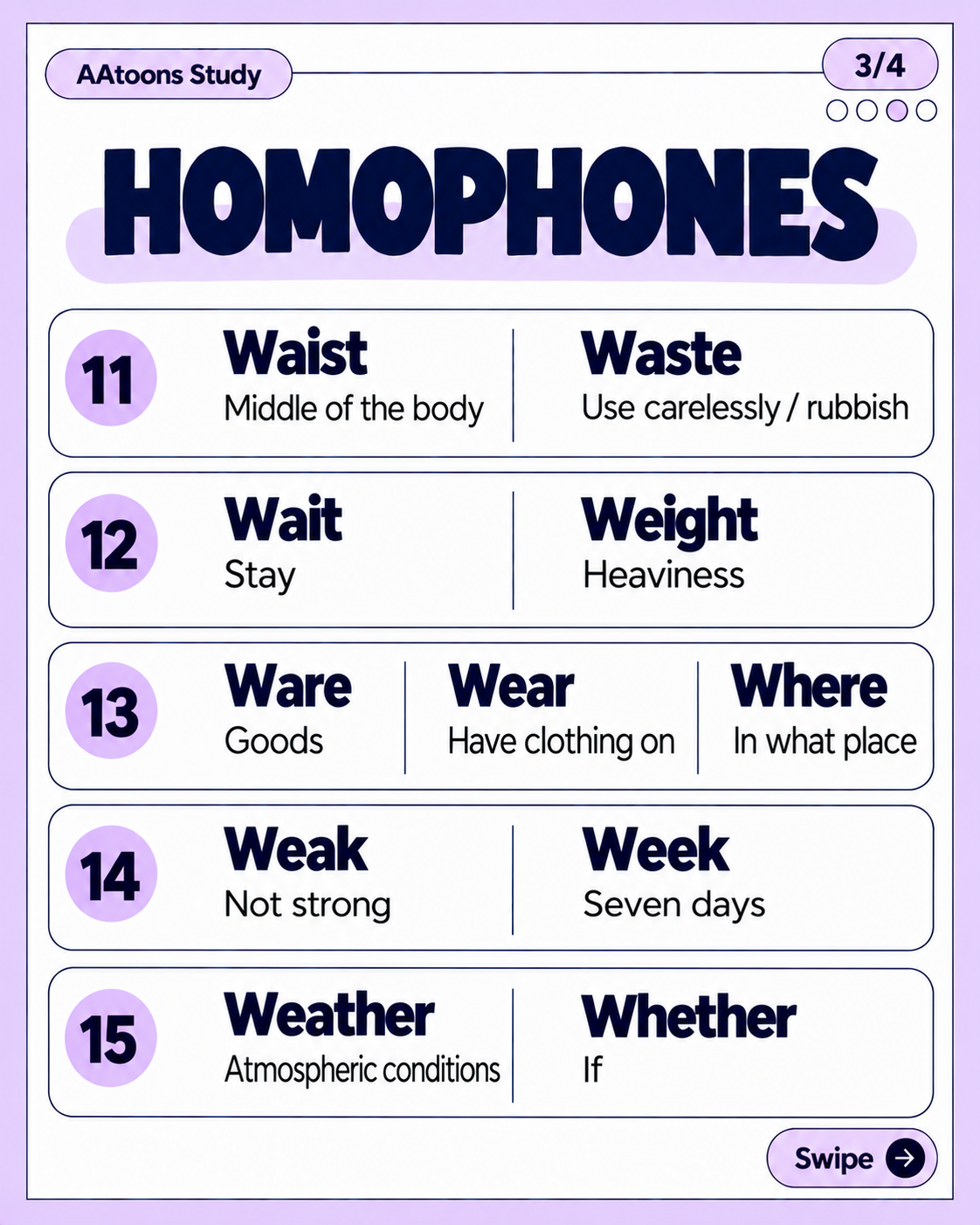
| 91 | Waist – Middle of the body | Waste – Use carelessly / Rubbish |
| 92 | Wait – Stay | Weight – Heaviness |
| 93 | Ware – Goods | Wear – Have clothing on; Where – In what place |
| 94 | Weak – Not strong | Week – Seven days |
| 95 | Weather – Atmospheric conditions | Whether – If |
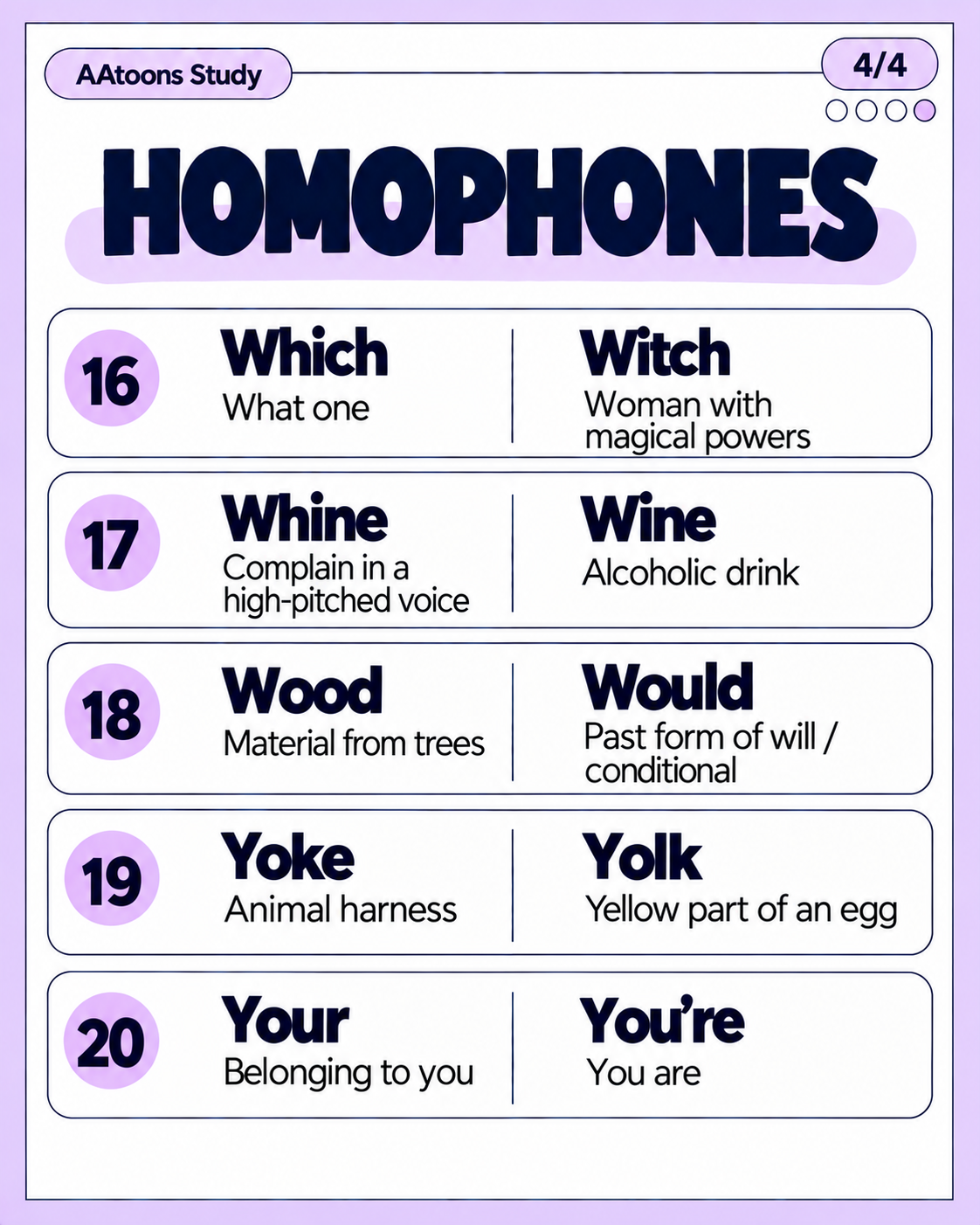
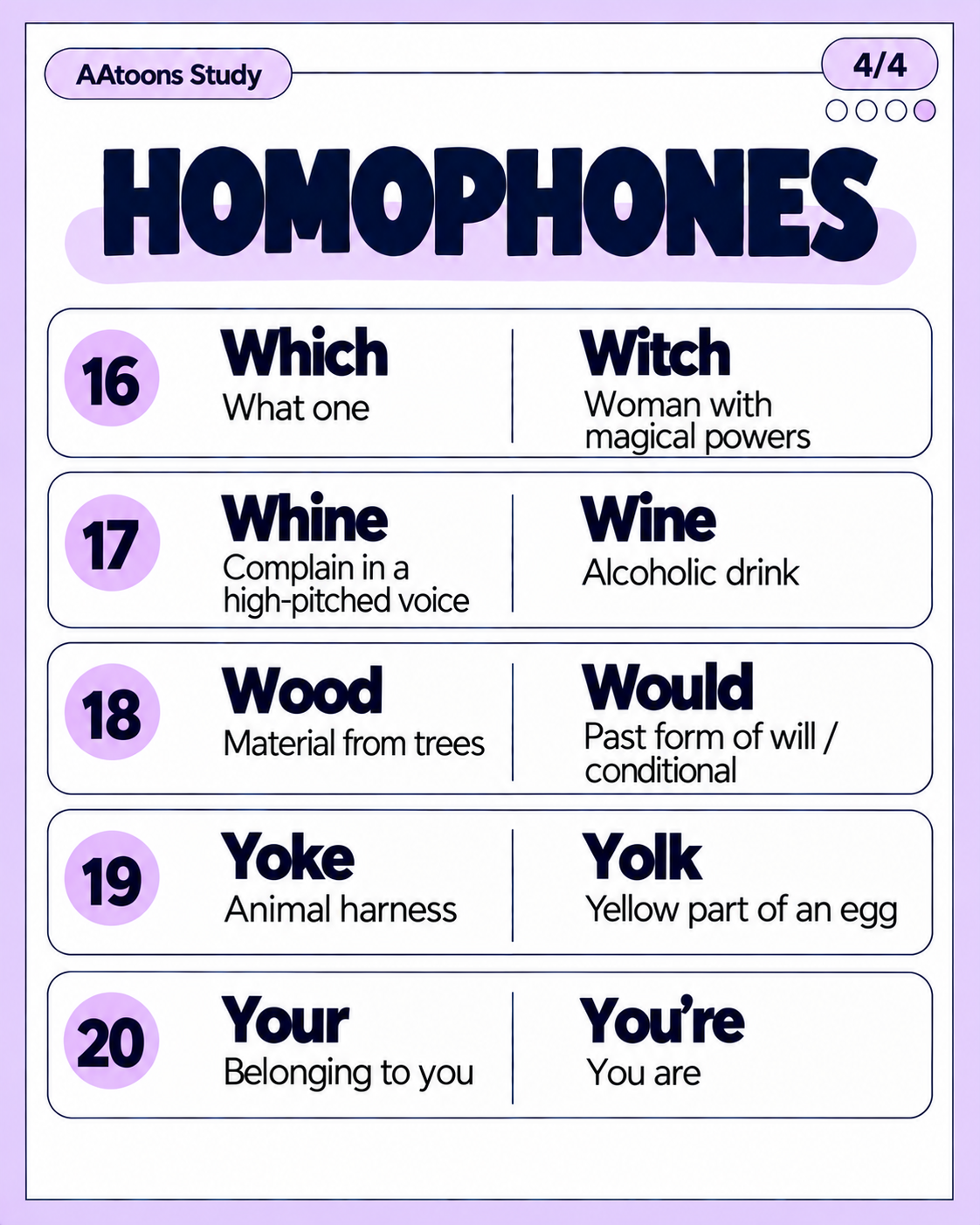
| 96 | Which – What one | Witch – Woman with magical powers |
| 97 | Whine – Complain in a high-pitched voice | Wine – Alcoholic drink |
| 98 | Wood – Material from trees | Would – Past form of will / Conditional |
| 99 | Yoke – Animal harness | Yolk – Yellow part of an egg |
| 100 | Your – Belonging to you | You’re – You are |
Questions and answers
1. What are homophones in English?
Ans: Homophones are words that have the same pronunciation but different meanings. They often have different spellings. For example, sea and see sound alike but have different meanings.
2. What is the difference between homophones and homonyms?
Ans: Homophones are words that sound alike but have different meanings, such as right and write. Homonyms is a broader term often used for words that share the same spelling or pronunciation but have different meanings, such as bat (an animal) and bat (used in sports).
3. Why are homophones important in English?
Ans: Homophones help students improve their spelling, vocabulary, reading comprehension, and writing skills. Understanding their meanings also helps learners choose the correct word when writing sentences.
4. How can I learn homophones easily?
Ans: You can learn homophones by memorising word pairs, understanding their meanings, reading example sentences, and practising with quizzes. Regular practice helps you remember the correct spelling and usage.
5. Are homophones always spelled differently?
Ans: No. Homophones often have different spellings, such as sea and see. Some words can also sound alike and have the same spelling but different meanings, depending on their usage.
6. How do homophones help in competitive exams?
Ans: Homophones can appear in vocabulary, spelling, sentence correction, and word-usage questions. Learning common homophone pairs helps students prepare for school examinations and various competitive English tests.
7. What is the easiest way to remember homophones?
Ans: The easiest way is to learn homophones in pairs and use each word in a sentence. For example, remember that sea refers to a large body of salt water, while see means to look at something. This method connects spelling with meaning.
Related Links
- West Bengal Board 10 Physical Science Syllabus
- WBBSE 10 Result 2026
- Satellite Imageries and Topographical Maps
- Transport and communication system in India
- Population of India
- Industries in India
- Agriculture in India
- Natural Vegetation of India
- Soils in India
- Climate of India