
WBBSE Class 10 Atmosphere Questions and Answers
WBBSE Class 10 Geography Chapter 2 Atmosphere Questions and Answers
Content Structure
- 1. Multiple choice questions and answers (MCQs)
- 2. Very short-type questions and answers
- 2A. Fill in the blanks
- 2B. True or false
- 2C. Very short-type questions and answers
- 3. Short-type questions and answers
- 4. Analytical questions and answers
- 5. Explanatory questions and answers
1. Multiple choice questions and answers (MCQs) [1 mark each]
1. Which instrument measures atmospheric pressure?
a) Thermometer
b) Barometer
c) Hygrometer
d) Anemometer
Ans: b) Barometer
2. Which is the most abundant gas in the atmosphere?
a) Oxygen
b) Nitrogen
c) Carbon dioxide
d) Argon
Ans: b) Nitrogen
3. The line joining places having equal pressure is called:
a) Isotherm
b) Isohyet
c) Isobar
d) Isohel
Ans: c) Isobar
4. What is the average height of the troposphere near the equator?
a) 8 km
b) 12 km
c) 18 km
d) 50 km
Ans: c) 18 km
5. The warm local wind of North America is called:
a) Foehn
b) Chinook
c) Loo
d) Mistral
Ans: b) Chinook
6. The wind that blows from sea to land during daytime is called:
a) Land breeze
b) Sea breeze
c) Trade wind
d) Loo
Ans: b) Sea breeze
7. The high pressure belt around 30° latitude is called:
a) Doldrum
b) Horse latitude
c) Polar front
d) Cyclone belt
Ans: b) Horse latitude
8. The hot and dry wind blowing in northern India during summer is called:
a) Loo
b) Chinook
c) Harmattan
d) Pampero
Ans: a) Loo
9. Rainfall caused by rising warm air is called:
a) Cyclonic rainfall
b) Orographic rainfall
c) Convectional rainfall
d) Monsoon rainfall
Ans: c) Convectional rainfall
10. Which gas is essential for respiration?
a) Nitrogen
b) Oxygen
c) Carbon dioxide
d) Hydrogen
Ans: b) Oxygen
2. Very short-type questions and answers
2A. Fill in the blanks [1 mark each]
1. The envelope of gases surrounding the earth is called the __________. (Atmosphere)
2. The hot and dry summer wind of northern India is called __________. (Loo)
3. The instrument used to measure air pressure is called a __________. (Barometer)
4. The unit of measuring air pressure is __________. (Millibar)
5. The line joining places having equal temperature is called __________. (Isotherm)
6. The solar energy received by the earth is called __________. (Insolation)
7. The calm equatorial low pressure belt is known as the __________. (Doldrum)
8. The warm and dry wind that blows down the Rocky Mountains is called __________. (Chinook)
2B. True or false [1 mark each]
1. Anticyclones are associated with clear and calm weather. (True)
2. The troposphere is the highest layer of the atmosphere. (False)
3. Air pressure is measured by a thermometer. (False)
4. Jet planes usually fly in the troposphere. (False)
5. Rainfall measured by rain gauge is expressed in millimetres. (True)
6. Cyclones are associated with low pressure. (True)
7. Loo is a cold wind that blows in winter. (False)
2C. Very short-type questions and answers [1 mark each]
1. How far is the homosphere extended in the atmosphere?
Ans: The homosphere extends up to about 80 km above the earth’s surface.
2. What is the imaginary line joining places having equal air pressure called?
Ans: The imaginary line joining places having equal air pressure is called an isobar.
3. What is the height of the atmosphere near the equatorial region?
Ans: The atmosphere extends up to about 16–18 km near the equatorial region.
4. Which is the second important gas of the atmosphere?
Ans: Oxygen is the second most important gas of the atmosphere.
5. What is the unit of air pressure?
Ans: The unit of air pressure is millibar (mb).
6. What is the height of the troposphere near the poles?
Ans: The height of the troposphere near the poles is about 8 km.
7. What is the full form of I.T.C.Z?
Ans: The full form of I.T.C.Z. is Inter Tropical Convergence Zone.
8. Name the instrument used to measure air pressure.
Ans: Air pressure is measured by an instrument called a barometer.
9. What is the nature of Pampero?
Ans: Pampero is a cold and dry wind that blows over the Pampas of South America.
10. What is Chinook?
Ans: Chinook is a warm and dry local wind that blows down the eastern slopes of the Rocky Mountains.
11. Name the layer of the atmosphere through which jet planes fly.
Ans: Jet planes usually fly through the lower stratosphere.
12. Name the rainfall that occurs in the presence of mountains.
Ans: The rainfall that occurs in the presence of mountains is called orographic rainfall.
13. When does inversion of temperature occur in mountain valleys?
Ans: Temperature inversion in mountain valleys usually occurs during clear and calm nights.
14. Name the unit by which density of ozone gas is expressed.
Ans: The density of ozone gas is expressed in Dobson Units (DU).
15. What is the height of the troposphere near the equator?
Ans: The height of the troposphere near the equator is about 16–18 km.
16. How far does the atmosphere extend above the earth’s surface?
Ans: The atmosphere extends up to about 10,000 km above the earth’s surface.
17. What is the freezing point of water in the Fahrenheit scale?
Ans: The freezing point of water in the Fahrenheit scale is 32°F.
18. Which gas is concentrated in the topmost layer of the atmosphere?
Ans: Hydrogen gas is concentrated in the topmost layer of the atmosphere.
19. Which gas causes rusting of iron?
Ans: Oxygen gas causes the rusting of iron.
20. Which is the most abundant gas in the atmosphere?
Ans: Nitrogen is the most abundant gas in the atmosphere.
21. Name two inert gases present in the atmosphere.
Ans: Argon and Neon are two inert gases present in the atmosphere.
22. Name the topmost layer of the heterosphere.
Ans: The topmost layer of the heterosphere is called the exosphere.
23. What is the average temperature of the Torrid zone?
Ans: The average temperature of the Torrid zone is about 27°C.
24. Which layer of the atmosphere allows radio broadcasting?
Ans: The ionosphere allows radio broadcasting by reflecting radio waves back to the earth.
25. Which region of the earth is affected most due to ozone depletion?
Ans: The Antarctic region is affected the most due to ozone depletion.
26. What is the solar energy coming to the earth called?
Ans: The solar energy coming to the earth is called insolation.
27. Which greenhouse gases are emitted by air conditioners and refrigerators?
Ans: Chlorofluorocarbons (CFCs) are greenhouse gases emitted by air conditioners and refrigerators.
28. What is the average temperature of the surface of the sun?
Ans: The average temperature of the surface of the sun is about 6000°C.
29. What is the boiling point of water in the Fahrenheit scale?
Ans: The boiling point of water in the Fahrenheit scale is 212°F.
30. Name two gases that destroy the ozone layer.
Ans: Chlorofluorocarbons (CFCs) and Nitrogen oxides destroy the ozone layer.
3. Short-type questions and answers [2 marks each]
1. What is atmosphere?
Ans: The atmosphere is the thick envelope of gases that surrounds the earth. It is held to the earth by gravity and protects life by regulating temperature and filtering harmful solar radiation.
2. What is specific humidity?
Ans: Specific humidity is the amount of water vapour present in a unit mass of air. It indicates the moisture content of the atmosphere.
3. What is heterosphere?
Ans: The heterosphere is the upper part of the atmosphere where gases are arranged in separate layers according to their molecular weight. Lighter gases like hydrogen and helium are found in the upper layers.
4. What is lapse rate?
Ans: Lapse rate is the rate at which temperature decreases with increase in altitude. The normal lapse rate is about 6.5°C per 1000 metres.
5. Which are the inert gases of the atmosphere?
Ans: The inert gases of the atmosphere include argon, neon, helium and krypton. These gases are chemically inactive and occur in very small quantities.
6. What is isobar?
Ans: An isobar is an imaginary line drawn on a weather map joining places having equal atmospheric pressure. It helps in studying pressure distribution.
7. What is inversion of temperature?
Ans: Inversion of temperature is the condition in which temperature increases with height instead of decreasing. It usually occurs during calm and clear nights.
8. What is isotherm?
Ans: An isotherm is an imaginary line joining places that have equal temperature. These lines are used on maps to show temperature distribution.
9. What is annual range of temperature?
Ans: The annual range of temperature is the difference between the highest and lowest temperature recorded at a place during a year.
10. What is homosphere?
Ans: The homosphere is the lower part of the atmosphere where the gases are uniformly mixed. It extends from the earth’s surface up to about 80 km.
11. What is ozone layer?
Ans: The ozone layer is a layer of ozone gas located in the stratosphere. It absorbs harmful ultraviolet rays of the sun and protects living organisms on earth.
12. What is cyclonic rainfall?
Ans: Cyclonic rainfall occurs when warm moist air rises in a cyclone and cools, leading to condensation and rainfall.
13. What is insolation?
Ans: Insolation means incoming solar radiation received by the earth. It is the main source of heat and energy for the earth.
14. What is effective solar radiation?
Ans: Effective solar radiation is the amount of solar energy that is actually absorbed by the earth after reflection and scattering.
15. What is albedo?
Ans: Albedo refers to the reflecting power of the earth’s surface. It indicates the percentage of solar radiation reflected back into space.
16. What is terrestrial radiation?
Ans: Terrestrial radiation is the heat energy radiated from the earth’s surface back into the atmosphere after absorbing solar radiation.
17. What is condensation?
Ans: Condensation is the process by which water vapour in the air changes into tiny water droplets due to cooling. It leads to the formation of clouds, dew and fog.
18. What is dew point?
Ans: Dew point is the temperature at which air becomes saturated with water vapour and condensation begins, forming dew or fog.
19. What is global warming?
Ans: Global warming is the gradual increase in the average temperature of the earth’s atmosphere. It occurs mainly due to the increase of greenhouse gases.
20. What is pressure gradient?
Ans: Pressure gradient is the rate of change of atmospheric pressure over a horizontal distance. It controls the speed and direction of winds.
21. What is ozone depletion?
Ans: Ozone depletion refers to the gradual thinning of the ozone layer in the stratosphere. It is mainly caused by gases like chlorofluorocarbons.
22. Mention the characteristic features of the exosphere.
Ans: The exosphere is the outermost layer of the atmosphere. It contains very thin gases like hydrogen and helium and gradually merges with outer space.
23. What is planetary wind?
Ans: Planetary winds are permanent winds that blow throughout the year in fixed directions over large areas of the earth.
24. What is Roaring Forties?
Ans: Roaring Forties are strong westerly winds that blow between 40° and 50° latitudes in the Southern Hemisphere. They are known for their high speed.
25. What is hydrological cycle?
Ans: The hydrological cycle is the continuous movement of water between the earth’s surface and the atmosphere through evaporation, condensation and precipitation.
26. What is pressure cells?
Ans: Pressure cells are large regions of high or low atmospheric pressure over the earth. They influence global wind circulation.
27. What is horse latitude?
Ans: Horse latitudes are subtropical high-pressure belts located around 30° north and south latitudes. Winds are generally calm in these regions.
28. What is trade wind?
Ans: Trade winds are steady easterly winds that blow from the subtropical high-pressure belts toward the equatorial low-pressure belt.
29. What is Orographic rainfall?
Ans: Orographic rainfall occurs when moist air is forced to rise over a mountain barrier. As the air rises, it cools and produces rainfall.
30. What is convectional rainfall?
Ans: Convectional rainfall occurs due to intense heating of the earth’s surface, causing warm air to rise and form clouds and rain.
4. Analytical questions and answers [3 marks each]
1. Why is the leeward side of a mountain called rainshadow region?
Ans: The leeward side of a mountain is called the rainshadow region because it receives very little rainfall. Moist winds from the sea move towards a mountain and strike the windward side first. The mountain forces the moist air to rise upward. As the air rises, it becomes cooler and the water vapour condenses to form clouds, which cause rainfall on the windward side. The air loses most of its moisture during this process. The dry air then moves down the other side of the mountain, which is known as the leeward side. As the air contains very little moisture, this side receives very little rainfall and remains dry. Therefore, the leeward side of a mountain is called the rainshadow region.
2. Write the differences between cyclones and anticyclones.
Ans:
| Cyclone | Anticyclone |
|---|---|
| A cyclone is a low pressure system where winds move towards the centre in a circular motion. | An anticyclone is a high pressure system where winds move outward from the centre. |
| In a cyclone, the air rises upward, which leads to cloud formation. | In an anticyclone, the air sinks downward, which prevents cloud formation. |
| Cyclones are usually associated with cloudy weather, heavy rainfall and storms. | Anticyclones are generally associated with clear skies, dry weather and calm conditions. |
| Cyclones often bring unstable and stormy weather conditions. | Anticyclones usually bring stable and pleasant weather conditions. |
3. Distinguish between Anabatic and Katabatic wind.
Ans:
| Anabatic Wind | Katabatic Wind |
|---|---|
| Anabatic wind is a warm wind that blows up the mountain slopes during the daytime. | Katabatic wind is a cold wind that blows down the mountain slopes during the night. |
| It occurs because the mountain slopes become heated by the sun during the day. | It occurs because the mountain slopes cool rapidly at night. |
| In anabatic wind, the air moves upward along the slope. | In katabatic wind, the air moves downward along the slope. |
| Anabatic winds are generally warm and rising winds. | Katabatic winds are generally cold and descending winds. |
4. Discuss the importance of oxygen in the atmosphere.
Ans: Oxygen is one of the most important gases in the atmosphere because it supports life and many natural processes.
- Respiration: Oxygen is essential for respiration, which helps living organisms produce energy from food.
- Combustion: It supports burning and combustion processes, which are necessary for many natural and human activities.
- Formation of Compounds: Oxygen combines with other elements to form many important compounds necessary for life and natural processes.
5. Which type of rainfall is common in equatorial region and why?
Ans: Convectional rainfall is common in the equatorial region. In these areas, the intense heat of the sun strongly heats the earth’s surface. As a result, the warm and moist air rises upward. When this rising air reaches higher levels, it cools and the water vapour condenses to form clouds. This process leads to heavy rainfall, which usually occurs in the afternoon. Therefore, equatorial regions receive frequent convectional rainfall throughout the year.
6. What is the importance of the Ozonosphere?
Ans: The ozonosphere is an important layer of the atmosphere that contains a large amount of ozone gas and plays a vital role in protecting life on Earth.
- Protection from Ultraviolet Rays: The ozonosphere absorbs most of the harmful ultraviolet (UV) rays coming from the sun and prevents them from reaching the Earth’s surface.
- Protection of Living Organisms: By blocking harmful radiation, it protects plants, animals and human beings from serious health problems such as skin diseases and damage to crops.
- Maintaining Heat Balance: The ozonosphere also helps to maintain the heat balance of the Earth’s atmosphere by absorbing solar radiation.
7. What are the characteristics of the Troposphere?
Ans: The troposphere is the lowest and most important layer of the atmosphere where most atmospheric activities occur.
- Lowest Layer of the Atmosphere: The troposphere is the lowest layer of the atmosphere and lies directly above the Earth’s surface.
- Extent of the Troposphere: It extends up to about 8 km at the poles and about 18 km at the equator, making it thicker in the equatorial region.
- Weather Phenomena: Almost all weather phenomena such as clouds, rainfall, storms, winds and fog occur in this layer.
- Decrease of Temperature: In the troposphere, temperature decreases gradually with increase in altitude, which affects weather conditions.
8. What are the characteristics of Jet Streams?
Ans: Jet streams are narrow bands of very fast moving winds that blow in the upper atmosphere. They are mainly found in the upper troposphere and lower stratosphere. The speed of these winds usually ranges from about 150 to 300 km per hour or even more. Jet streams generally blow from west to east and follow a wavy or meandering path around the Earth. They play an important role in influencing weather conditions, including the formation of cyclones and rainfall patterns. Jet streams also affect the speed and routes of jet aircraft.
9. Discuss the importance of nitrogen gas in the atmosphere.
Ans: Nitrogen is the most abundant gas in the atmosphere and plays an important role in maintaining life and environmental balance.
- Largest Component: Nitrogen forms about 78% of the atmosphere, making it the largest component of air.
- Plant Growth: It helps in plant growth and improves soil fertility by becoming part of nutrients in the soil.
- Formation of Proteins: Nitrogen is necessary for the formation of proteins and other essential substances in living organisms.
- Control of Combustion: Nitrogen also dilutes oxygen in the atmosphere and prevents rapid combustion or burning.
10. Discuss the importance of water vapour in the atmosphere.
Ans: Water vapour is the gaseous form of water present in the atmosphere and plays a key role in weather and climate.
- Formation of Clouds and Rainfall: Water vapour condenses in the atmosphere to form clouds, which later produce rainfall.
- Role in Hydrological Cycle: It plays a major role in the hydrological cycle, which includes evaporation, condensation and precipitation.
- Regulation of Temperature: Water vapour absorbs and retains heat, helping to regulate the temperature of the Earth.
11. Discuss the importance of carbon dioxide in the atmosphere.
Ans: Carbon dioxide is a small but important component of the atmosphere that supports plant life and influences climate.
- Photosynthesis: Carbon dioxide is essential for photosynthesis, the process by which plants prepare their food.
- Production of Food and Oxygen: Plants use carbon dioxide to produce food and release oxygen into the atmosphere.
- Maintaining Heat Balance: Carbon dioxide traps heat in the atmosphere and helps maintain the Earth’s heat balance.
12. How is the ozone layer contracting?
Ans: The ozone layer is contracting due to the emission of harmful chemicals such as chlorofluorocarbons (CFCs), halons and nitrogen oxides into the atmosphere. These gases rise to the upper atmosphere and react with ozone molecules. This chemical reaction breaks down ozone into oxygen and reduces the amount of ozone present in the layer. As a result, the thickness of the ozone layer decreases and the layer gradually becomes thinner.
13. Discuss the importance of dust particles in the atmosphere.
Ans: Dust particles are very small solid particles present in the air and play an important role in atmospheric processes.
- Condensation Nuclei: Dust particles act as nuclei for condensation, around which water vapour collects.
- Formation of Clouds and Rainfall: Water vapour condenses around these particles to form clouds that eventually lead to rainfall.
- Scattering of Sunlight: Dust particles scatter sunlight in the atmosphere, producing colourful sunrise and sunset.
14. Mention the general characteristics of air.
Ans: Air is the mixture of different gases that surrounds the Earth and is essential for life.
- Mixture of Gases: Air is a mixture of several gases such as nitrogen, oxygen and carbon dioxide.
- Physical Nature: It is colourless, odourless and tasteless, and therefore cannot be seen or smelled.
- Weight and Pressure: Air has weight and exerts pressure on the Earth’s surface, which is known as air pressure.
- Effect of Temperature: Air expands when heated and contracts when cooled, which causes movement of air and formation of winds.
15. Name the components of the atmosphere.
Ans: The atmosphere is made up of several gases and tiny particles that together form the air surrounding the Earth.
- Major Gases: The atmosphere mainly contains nitrogen, oxygen and carbon dioxide, which form the major part of the air.
- Water Vapour: It also contains water vapour, which plays an important role in the formation of clouds and rainfall.
- Dust Particles: The atmosphere includes dust particles, which help in the condensation of water vapour and formation of clouds.
- Inert Gases: It also contains inert gases such as argon and helium, which are present in very small quantities.
16. Distinguish between Troposphere and Stratosphere.
Ans:
| Troposphere | Stratosphere |
|---|---|
| The troposphere is the lowest layer of the atmosphere located just above the Earth’s surface. | The stratosphere is the layer of the atmosphere that lies above the troposphere. |
| The troposphere extends up to about 8 km at the poles and about 18 km at the equator. | The stratosphere extends from the top of the troposphere up to about 50 km above the Earth’s surface. |
| Almost all weather phenomena such as clouds, rainfall and storms occur in this layer. | In the stratosphere weather conditions remain calm and stable and almost no weather changes occur. |
| In the troposphere, temperature decreases with increase in altitude. | In the stratosphere, temperature gradually increases with height. |
17. How is the ozone layer being depleted?
Ans: The ozone layer is being depleted mainly because of the release of harmful gases into the atmosphere. These gases include chlorofluorocarbons (CFCs), nitrogen oxides and halons, which are produced from industries, refrigerators, air conditioners and aerosol sprays. When these gases reach the upper atmosphere, they react with ozone molecules and break them down into oxygen. As a result, the amount of ozone in the atmosphere decreases and the ozone layer gradually becomes thinner.
18. Why are cloudless nights cooler than cloudy nights?
Ans: Cloudless nights are cooler because heat from the Earth’s surface escapes rapidly into space through radiation. Since there are no clouds in the sky, nothing prevents the heat from leaving the surface of the Earth. As a result, the temperature falls quickly and the night becomes cooler. On cloudy nights, clouds act like a blanket and trap some of the heat near the Earth’s surface. Because of this, the temperature does not fall much and cloudy nights remain warmer than clear nights.
19. Why are days very hot and nights very cold in hot desert regions?
Ans: Hot desert regions have very little water vapour and almost no cloud cover in the sky. During the day, the sand on the desert surface heats up very quickly because it absorbs a large amount of heat from the sun. This causes the temperature to rise sharply and the days become very hot. At night, the heat stored in the sand escapes rapidly into space because there are no clouds or water vapour to trap the heat. As a result, the temperature falls quickly and the nights become very cold.
20. Describe the different temperature zones.
Ans: The Earth is divided into different temperature zones according to the amount of heat received from the sun. These zones are mainly three.
- Torrid Zone: The Torrid Zone lies between the Tropic of Cancer and the Tropic of Capricorn. This region receives the maximum heat from the sun throughout the year because the sun’s rays fall almost vertically. As a result, the climate of this zone remains very hot.
- Temperate Zones: The Temperate Zones lie between the Tropics and the Polar Circles in both hemispheres. These regions receive moderate heat from the sun because the sun’s rays fall at a slanting angle. Therefore, the climate in this zone is neither very hot nor very cold.
- Frigid Zones: The Frigid Zones lie between the Polar Circles and the Poles. These regions receive very little heat from the sun because the sun’s rays fall very slantingly. As a result, the climate of this zone remains extremely cold throughout the year.
21. Discuss the characteristics of air temperature.
Ans: Air temperature refers to the degree of hotness or coldness of the air. It has several important characteristics.
- Variation from Place to Place: Air temperature does not remain the same everywhere on the Earth. It varies from one place to another depending on different geographical conditions.
- Variation with Time: Air temperature also changes from time to time. It varies between day and night as well as between different seasons of the year.
- Influence of Latitude: Places located near the Equator receive more direct sunlight and therefore have higher temperatures than places near the poles.
- Influence of Altitude: Air temperature decreases with increase in altitude. Therefore, mountain regions are usually cooler than lowland areas.
- Distance from the Sea and Winds: Air temperature is also influenced by the distance from the sea and the direction of prevailing winds, which can make a place warmer or cooler.
22. Discuss the causes of global warming.
Ans: Global warming refers to the gradual increase in the average temperature of the Earth due to the increase of greenhouse gases in the atmosphere.
- Increase of Greenhouse Gases: The main cause of global warming is the increase of greenhouse gases such as carbon dioxide, methane and chlorofluorocarbons in the atmosphere.
- Burning of Fossil Fuels: The burning of fossil fuels such as coal, petroleum and natural gas for industries, electricity and transport releases a large amount of carbon dioxide into the atmosphere.
- Deforestation: Large-scale cutting of forests reduces the number of trees that absorb carbon dioxide from the air. This increases the amount of carbon dioxide in the atmosphere.
- Industrial and Vehicular Pollution: Industries and vehicles release harmful gases into the atmosphere. These gases trap heat in the atmosphere and gradually increase the temperature of the Earth.
23. Discuss the causes of global warming.
Ans: Global warming refers to the gradual increase in the average temperature of the Earth due to the increase of greenhouse gases in the atmosphere.
- Increase of Greenhouse Gases: The main cause of global warming is the increase of greenhouse gases such as carbon dioxide and methane in the atmosphere.
- Deforestation: Large-scale cutting of forests reduces the number of trees that absorb carbon dioxide from the air, which increases the amount of greenhouse gases.
- Industrialization: Rapid industrial development releases large amounts of harmful gases into the atmosphere.
- Burning of Fossil Fuels: The excessive use of fossil fuels such as coal, petroleum and natural gas for transport, industries and electricity produces large amounts of carbon dioxide that trap heat in the atmosphere.
24. What is inversion of temperature?
Ans: Temperature inversion is a condition in the atmosphere in which the normal pattern of temperature change is reversed. Normally, temperature decreases with increase in altitude, but during temperature inversion the temperature increases with height. This situation usually occurs during calm and clear nights when the Earth’s surface loses heat rapidly. As a result, the air near the ground becomes cooler than the air above it.
25. What are thermal zones? Name the different thermal zones on earth.
Ans: Thermal zones are large regions of the Earth that are classified according to the amount of heat received from the sun. The unequal distribution of solar heat on the Earth’s surface leads to the formation of different thermal zones. These zones are determined mainly by the angle at which the sun’s rays fall on the Earth.
- Torrid Zone: The Torrid Zone lies between the Tropic of Cancer (23½° N) and the Tropic of Capricorn (23½° S). In this region, the sun’s rays fall almost vertically during most of the year. As a result, this zone receives the maximum heat and remains the hottest region of the Earth.
- Temperate Zones: The Temperate Zones lie between the Tropics and the Polar Circles in both hemispheres. In these regions, the sun’s rays fall at a slanting angle. Therefore, these areas receive a moderate amount of heat and experience a moderate climate.
- Frigid Zones: The Frigid Zones lie between the Polar Circles and the Poles. In these regions, the sun’s rays fall very slantingly throughout the year. As a result, these areas receive very little heat and remain extremely cold for most of the year.
5. Explanatory questions and answers [5 marks each]
1. Distinguish between Cyclone and Anti-cyclone.
Ans:
| Cyclone | Anticyclone |
|---|---|
| A cyclone is a low pressure system formed in the atmosphere. | An anticyclone is a high pressure system formed in the atmosphere. |
| In a cyclone, winds blow towards the centre of the low pressure area. | In an anticyclone, winds blow outward from the centre of the high pressure area. |
| The air in a cyclone rises upward which leads to cloud formation and rainfall. | The air in an anticyclone descends downward which usually produces clear skies. |
| In the Northern Hemisphere, winds rotate anticlockwise around the centre of a cyclone. | In the Northern Hemisphere, winds rotate clockwise around the centre of an anticyclone. |
| Cyclones usually produce stormy weather with heavy rain and strong winds. | Anticyclones usually produce calm, dry and stable weather conditions. |
| Cyclones are often associated with destructive storms and severe weather. | Anticyclones are generally associated with pleasant and stable weather. |
2. Distinguish between Rainfall and Precipitation.
Ans:
| Rainfall | Precipitation |
|---|---|
| Rainfall refers to water falling from clouds in the liquid form of raindrops. | Precipitation refers to all forms of water that fall from clouds to the Earth’s surface. |
| Rainfall occurs when condensed water vapour in clouds becomes heavy and falls as rain. | Precipitation includes rain, snow, sleet and hail. |
| Rainfall is only one form of atmospheric water fall. | Precipitation is the general term used for all types of atmospheric water fall. |
| Rainfall mainly occurs in liquid form when the temperature is above freezing point. | Precipitation may occur in both liquid and solid forms depending on temperature. |
| Rainfall is measured with the help of a rain gauge. | Precipitation is also measured to study the total water received from the atmosphere. |
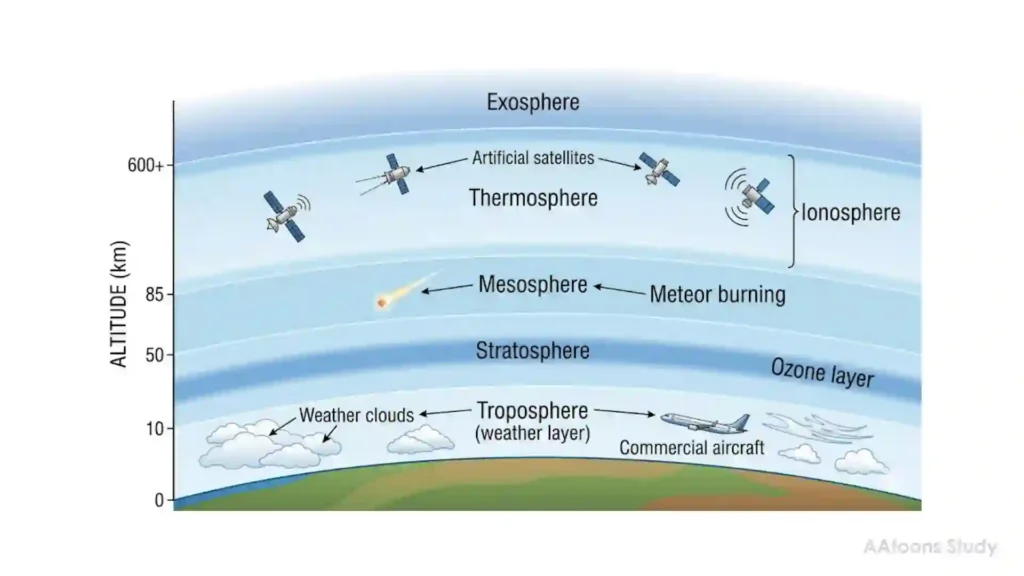
3. Classify the vertical structure of the atmosphere and describe the suitable sketch.
Ans: The atmosphere is divided into several layers based on the change of temperature with altitude. Each layer has its own characteristics and plays an important role in atmospheric processes.
- 1. Troposphere – The troposphere is the lowest layer of the atmosphere and lies directly above the Earth’s surface. It extends up to about 8 km at the poles and about 18 km at the equator. Almost all weather phenomena such as clouds, rainfall, storms and winds occur in this layer. Temperature decreases with increase in altitude in this layer.
- 2. Stratosphere – The stratosphere lies above the troposphere and extends up to about 50 km above the Earth’s surface. This layer contains the ozone layer which absorbs harmful ultraviolet rays coming from the sun. In this layer, temperature gradually increases with height and the air remains stable.
- 3. Mesosphere – The mesosphere lies above the stratosphere and extends up to about 80 km. In this layer, temperature again decreases with altitude. Most meteors burn up in this layer when they enter the Earth’s atmosphere.
- 4. Thermosphere – The thermosphere extends from about 80 km to nearly 400 km above the Earth’s surface. In this layer, temperature increases rapidly with height. This layer also contains the ionosphere, which helps in the reflection of radio waves used for communication.
- 5. Exosphere – The exosphere is the outermost layer of the atmosphere. It gradually merges into outer space. In this layer, the air is extremely thin and mainly consists of light gases such as hydrogen and helium.
- A suitable sketch of the vertical structure of the atmosphere should show the layers in order from Troposphere → Stratosphere → Mesosphere → Thermosphere → Exosphere with their approximate heights.
4. Discuss the causes of variation of air temperature.
Ans: Air temperature does not remain the same everywhere on the Earth. It varies from place to place due to several geographical and atmospheric factors.
- Latitude – Latitude greatly influences air temperature. Places near the equator receive direct sun rays and therefore experience higher temperatures, while the polar regions receive slanting rays and remain colder.
- Altitude – Temperature decreases with increase in altitude at an average rate of about 6.5°C per kilometre. Therefore, mountainous regions are cooler than lowland areas.
- Distance from the Sea – Coastal regions experience moderate temperatures because the sea heats and cools slowly. Inland areas, which are far from the sea, experience extreme temperatures.
- Ocean Currents – Ocean currents influence the temperature of nearby coastal regions. Warm ocean currents raise the temperature of coastal areas, while cold currents lower it.
- Prevailing Winds – Prevailing winds carry heat or cold from their source regions and influence the temperature of the places they pass through.
- Cloud Cover – Clouds reduce heating during the day by reflecting sunlight and prevent rapid cooling at night by trapping heat near the Earth’s surface.
5. Distinguish between Land Breeze and Sea Breeza.
Ans:
| Land Breeze | Sea Breeze |
|---|---|
| Land breeze is the wind that blows from land towards the sea. | Sea breeze is the wind that blows from the sea towards the land. |
| Land breeze generally occurs during the night. | Sea breeze generally occurs during the daytime. |
| At night the land cools faster than the sea, creating high pressure over the land. | During the day the land heats faster than the sea, creating low pressure over the land. |
| The wind therefore moves from the land towards the sea. | The wind therefore moves from the sea towards the land. |
| Land breeze usually carries dry air from the land. | Sea breeze usually brings moist air from the sea. |
| Land breeze is generally weaker and less strong than sea breeze. | Sea breeze is usually stronger and more noticeable during hot days. |
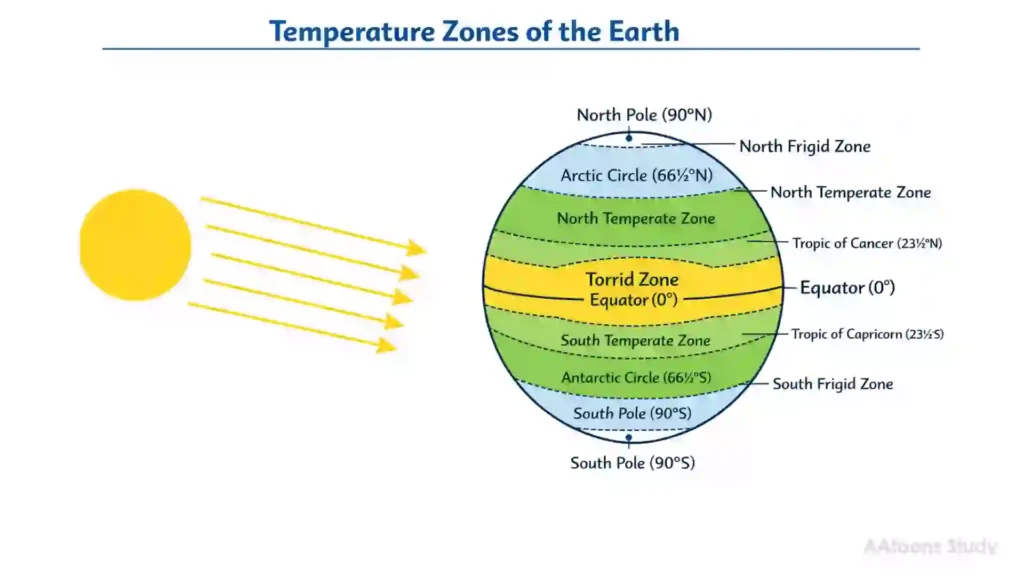
6. Describe the heat zones of the earth.
Ans: The Earth is divided into three main heat zones based on the amount of solar energy received from the sun. These zones are determined by the angle at which the sun’s rays fall on the Earth’s surface.
- Torrid Zone – The Torrid Zone lies between the Tropic of Cancer (23½° N) and the Tropic of Capricorn (23½° S). In this region, the sun’s rays fall almost vertically throughout the year. As a result, this zone receives the maximum heat and remains the hottest region of the Earth.
- Temperate Zone – The Temperate Zones lie between the Tropics and the Polar Circles in both hemispheres. The sun’s rays fall at a slanting angle in these regions, so they receive a moderate amount of heat. Therefore, the climate in these zones is moderate.
- Frigid Zone – The Frigid Zones lie between the Polar Circles and the Poles. In these regions, the sun’s rays fall very slantingly and the amount of heat received is very small. As a result, these regions remain extremely cold for most of the year.
7. Discuss the factors responsible for ozone depletion.
Ans: Ozone depletion refers to the gradual thinning of the ozone layer in the stratosphere. This mainly occurs due to the release of harmful chemicals into the atmosphere as a result of human activities.
- Chlorofluorocarbons (CFCs): Chlorofluorocarbons are widely used in refrigerators, air conditioners, foam making and aerosol sprays. When these gases reach the upper atmosphere, they react with ozone molecules and break them down, which reduces the amount of ozone.
- Halons: Halons are chemicals used in fire extinguishers. These gases rise to the upper atmosphere and destroy ozone molecules through chemical reactions.
- Industrial Gases and Chemicals: Various industries release harmful gases and chemicals into the atmosphere. These substances react with ozone and contribute to the thinning of the ozone layer.
- Aerosol Sprays: Many aerosol sprays release chemicals containing CFCs into the atmosphere. These chemicals eventually reach the stratosphere and damage the ozone layer.
- Nitrogen Oxides from Aircraft: High-flying aircraft release nitrogen oxides into the upper atmosphere. These gases also react with ozone molecules and reduce the thickness of the ozone layer.
8. Discuss about the pressure belts of the earth.
Ans: The unequal heating of the Earth’s surface results in the formation of different pressure belts across the globe. These pressure belts play an important role in controlling global wind systems and climate.
- 1. Equatorial Low Pressure Belt – This belt lies near the equator where the temperature is very high. The intense heating causes air to rise, creating a low pressure area known as the equatorial low pressure belt.
- 2. Subtropical High Pressure Belt – This belt is located around 30° north and south latitudes. In this region, the air that rises at the equator moves towards higher latitudes and descends, creating a high pressure belt.
- 3. Subpolar Low Pressure Belt – This belt occurs around 60° north and south latitudes. Here, warm air from the subtropics meets cold air from the polar regions, causing the air to rise and creating a low pressure area.
- 4. Polar High Pressure Belt – This belt is located near the North and South Poles. The extremely cold and dense air sinks downward, producing high pressure conditions in these regions.
9. Describe the various types of rainfall.
Ans: Rainfall occurs when water vapour in the atmosphere cools, condenses and falls to the Earth as rain. There are three main types of rainfall.
- Convectional Rainfall: Convectional rainfall occurs when the Sun strongly heats the Earth’s surface. The warm air rises upward carrying water vapour with it. As the air rises, it cools and condenses to form clouds, which later produce rainfall. This type of rainfall is common in equatorial regions.
- Orographic Rainfall: Orographic rainfall occurs when moist air is forced to rise over mountains or highlands. As the air rises along the mountain slopes, it cools and condenses to form clouds, causing rainfall on the windward side of the mountain. The leeward side usually remains dry and forms a rainshadow region.
- Cyclonic Rainfall: Cyclonic rainfall occurs due to the meeting of warm and cold air masses in a cyclone. The warm air rises above the colder air, cools and condenses to form clouds. This results in widespread rainfall over a large area.
10. Discuss the effects of global warming.
Ans: Global warming refers to the gradual increase in the average temperature of the Earth due to the increase of greenhouse gases such as carbon dioxide and methane in the atmosphere. This rise in temperature causes many environmental and climatic changes across the world.
- Rise in Global Temperature:
Global warming increases the average temperature of the Earth’s surface and leads to hotter summers in many regions. - Melting of Glaciers and Polar Ice:
The increase in temperature causes glaciers and polar ice caps to melt rapidly. This affects polar ecosystems and reduces the habitat of animals such as polar bears. - Rise in Sea Level:
When glaciers and ice caps melt, the water level of oceans increases. This leads to a rise in sea level and may cause flooding of low-lying coastal areas and islands. - Increase in Extreme Weather Events:
Global warming increases the occurrence of extreme weather conditions such as storms, floods, droughts and heat waves. - Disturbance of Ecosystems:
Changes in temperature and climate affect natural ecosystems and disturb the balance of nature. - Loss of Biodiversity:
Many plants and animals may lose their natural habitats due to climate change, which threatens biodiversity.
11. Describe the characteristics of equatorial climate and tropical monsoon climate.
Ans:
- Equatorial Climate:
The equatorial climate is found in regions close to the equator such as the Amazon Basin in South America, the Congo Basin in Africa and parts of Southeast Asia. This climate is characterized by high temperature throughout the year because the sun’s rays fall almost vertically. The average temperature generally remains around 25°C to 27°C. Rainfall is very heavy and occurs almost daily due to strong convectional rainfall. The humidity remains very high and the sky is often cloudy. Because of the high temperature and heavy rainfall, dense evergreen forests grow in these regions. Seasonal variation in temperature is very small, but rainfall occurs throughout the year. - Tropical Monsoon Climate:
The tropical monsoon climate is mainly found in South Asia, Southeast Asia and parts of Africa. This climate is strongly influenced by monsoon winds which change their direction seasonally. During the summer season, moist winds blow from the oceans towards the land and bring heavy rainfall. During winter, dry winds blow from land towards the sea, causing a dry season. This climate therefore has clearly defined wet and dry seasons. The temperature remains high for most of the year and the rainfall is mainly concentrated during the monsoon months. This type of climate is very important for agriculture in many Asian countries.
12. Discuss the characteristics of the temperature zones of the world.
Ans: The Earth is divided into different temperature zones depending on the amount of heat received from the Sun. These zones are determined by the angle at which the sun’s rays fall on the Earth’s surface.
- Torrid Zone: The Torrid Zone lies between the Tropic of Cancer (23½° N) and the Tropic of Capricorn (23½° S). In this region the sun’s rays fall almost vertically during most of the year. As a result, this zone receives the maximum amount of heat and remains the hottest part of the Earth. The climate is generally hot and many tropical forests and deserts are found in this zone.
- Temperate Zone: The Temperate Zones lie between the tropics and the polar circles in both hemispheres. In these regions the sun’s rays fall at a slanting angle, so they receive a moderate amount of heat. The climate is neither very hot nor very cold and the seasons such as summer, winter, spring and autumn are clearly noticeable.
- Frigid Zone: The Frigid Zones lie between the Arctic Circle and the North Pole in the Northern Hemisphere and between the Antarctic Circle and the South Pole in the Southern Hemisphere. In these regions the sun’s rays fall very slantingly and therefore the amount of heat received is very small. As a result, these areas remain extremely cold for most of the year and are often covered with ice and snow.
Related Links
- WBBSE 10 Result 2026
- Satellite Imageries and Topographical Maps
- Transport and communication system in India
- Population of India
- Industries in India
- Agriculture in India
- Natural Vegetation of India
- Soils in India
- Climate of India
- Water resources of India